
Using science background to write rationally about Israel, Jews and Academia
What Palestinians Can Learn from Jewish History
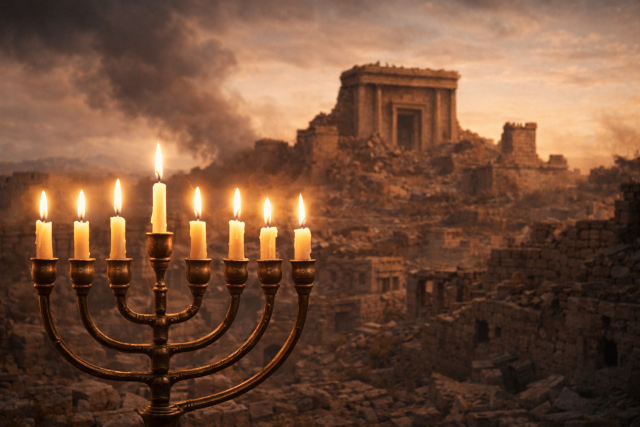
As we celebrate Hanukkah and recall the exploits of the Maccabees, I am reminded of a very different episode in Jewish history: the uprising of the Zealots. Unlike Maccabees revolt, the fight initiated by Zealots ended in catastrophe for the Jewish community of Jerusalem and culminated in the destruction of the Second Temple. While victories are naturally more joyful to commemorate, defeats and catastrophes often provide more enduring and consequential lessons. While both the triumph of the Maccabees and the tragedy of the Zealots belong to ancient Jewish history, it has occurred to me that it is the Palestinians of today who may benefit most from these painful lessons.
History does not repeat itself, but it does rhyme. Any analogy between contemporary and historical events is fraught with the risk of misunderstanding and misuse and therefore must be approached with care. Such analogies should be framed narrowly, clearly delimited, and not extended beyond their legitimate scope. Nevertheless, let me attempt one here, in the hope that readers will resist jumping to immediate conclusions and will read this text in its entirety.
The Maccabean uprising was a struggle against imperial domination and enforced religious conversion. It was a strategic revolt that combined armed resistance with diplomacy, internal restraint, and a willingness to consolidate gains rather than pursue apocalyptic confrontation. The Maccabees succeeded in restoring religious autonomy, communal continuity, and political independence for roughly a century.
The contrast with the Zealots of the late Second Temple period could not be more striking. While both movements emerged under conditions of foreign domination and religious persecution, the Zealots arose from a different set of circumstances. By the late Second Temple period, Jews of the former kingdom of Judea living under Roman rule were deeply divided, torn by economic inequality and sectarian rivalries. The population was generally miserable, and the situation was ripe for explosion. And it did explode, violently. The crucial difference from the Maccabees, and the source of the unfolding tragedy was that the leadership of the uprising fell into the hands of a fanatical faction for whom compromise was not merely a mistake but a sacrilegious act.
The Zealots demanded absolute purity and conformity to their vision of proper Jewish behavior. Those who deviated were labeled collaborators and often executed. Attempts at negotiation with Rome were treated as apostasy. As military losses mounted, violence increasingly turned inward. Jerusalem was consumed not only by Roman siege but also by civil conflict, assassinations, intimidation, and internecine warfare. Most of what we know about the Zealot movement and the Great Jewish Revolt comes from the writings of Flavius Josephus. One of the most striking details he reports is that Zealot factions destroyed food supplies in Jerusalem in order to provoke famine, all in the name of forcing the population to support their fight against Rome.
While Rome delivered the final blow by sacking Jerusalem and destroying the Temple, Jewish historical memory ultimately came to view the catastrophe as the result of internal moral and political collapse. In a remarkable demonstration of clarity, rabbinic Judaism in the centuries that followed did not mythologize the Zealots. Instead, it condemned destructive fanaticism and redirected Jewish survival away from suicidal revolts toward law, learning, and the construction of durable communal institutions. This did not erase the loss, but it made civilizational survival possible. Hanukkah thus commemorates not fanaticism but a disciplined form of resistance—one that understood the difference between fighting for a people and sacrificing a people to an idea.
It is difficult not to notice parallels between the Zealots’ story and the modern Palestinian struggle, which has been led by radical movements ranging from the PLO in its earlier absolutist phases to Hamas today. To be clear, I do not compare Israel to Rome—Israel is not an imperial power bent on world domination. Nor do I call for the expulsion of Palestinians or the destruction of the Al-Aqsa Mosque. We live in a different historical moment, governed by different moral, political, and legal norms, which Israel attempts to follow under conditions of persistent and severe threats to its existence.
This comparison is not about replicating outcomes but about identifying patterns of internal radicalization and the catastrophic costs they impose on one’s own society. It concerns what happens when a movement of religious-national zeal claims a monopoly on legitimacy, brands internal dissent as betrayal, and treats the suffering of its own people as a form of sanctity. Palestinians today face an internal struggle between political realism and absolutist militancy, with Hamas representing the most consequential expression of the latter. The point of this comparison is not to humiliate Palestinians, but to argue that fanaticism can defeat a people even before its enemy does.
Hamas emerged under very different historical conditions, yet it exhibits a comparable internal logic. It claims moral monopoly, represses dissent, and consistently subordinates civilian welfare to militarized strategy. While the Zealots exacerbated suffering through internal terror, they did not operate in a system where deprivation could be transformed into international pressure. Hamas does. Modern conditions have provided Hamas with the means to use the suffering of its own population as a strategic geopolitical instrument. Operating in a world shaped by global media, international law, and diplomatic pressure, Hamas has repeatedly and deliberately put its own population at risk, relying on civilian distress as a means of political leverage. This makes the contemporary Palestinian tragedy even more morally charged.
What further exacerbates the Palestinian tragedy is the sharp contrast between the response of Jewish religious authorities to the catastrophe of Zealotry and that of Muslim leadership to the fanaticism of Hamas. While Jewish spiritual leadership eventually produced a broad and authoritative disavowal of militant fanaticism, contemporary Muslim religious responses have been fragmented and politically constrained. Explicit condemnations exist, but they are rare and limited to a small number of figures. No widespread, authoritative delegitimization of Hamas’s violence especially against civilians has occurred, while some influential figures, such as Iran’s Supreme Leader Ayatollah Ali Khamenei, have openly celebrated it.
Jewish history demonstrates that when purity politics overwhelms sober leadership, a society may contribute to its own destruction. After the fall of the Temple, Judaism underwent a strategic spiritual revolution, rejecting the sanctification of ruin and redefining endurance itself as a moral achievement. By contrast, much of Palestinian political culture has sacralized the Nakba and repeatedly used it to inflame militant, uncompromising rejection of any accommodation with Israel.
This analogy should not be understood as a weapon against Palestinians or Israelis. It is offered as a cautionary tale about the seductions of fanaticism and the price societies pay when internal absolutism eclipses survival. Jewish history does not dictate Palestinian destiny, but it does illuminate the danger of leadership that treats its own people as expendable fuel for sacred struggle.
Nor are the lessons of the Zealots limited to Palestinians. Certain elements of contemporary Israeli society also appear to forget the dangers of religious fanaticism. While Israel no longer faces the threat of annihilation by a foreign army, inflammatory rhetoric by parts of the Israeli leadership and anti-Palestinian violence disproportionately perpetrated by a small but highly active fringe associated with the Hilltop Youth movement and inspired by the writings of Rabbi Yitzchak (Itzhak) Ginsburgh pose a different kind of danger. They provide antizionist activists worldwide with ammunition to influence public opinion and political elites abroad and risk driving Israel toward international isolation, a condition the country may not ultimately survive.
Related Topics