Consultant and writer exploring policy, society, and identity
What the Nobel Committee Did Not Say
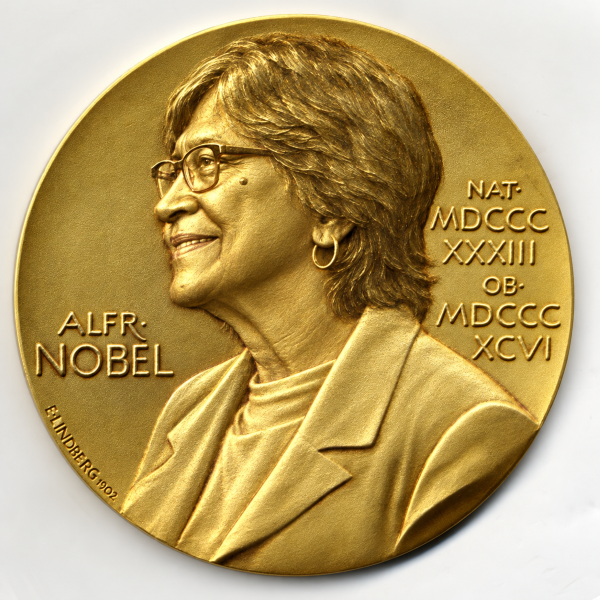
Nobel Prize Medal (AI)
Both sides answered a document the Committee never published.
Bernard Markowicz It honors Navi Pillay for a career in international criminal justice and for the international rule of law. It names one body of work specifically: the Rwanda jurisprudence establishing that rape and sexual violence can amount to crimes against humanity and to genocide.[S04] Jørgen Watne Frydnes, the Committee’s chair, framed the award as a response to international law being under tremendous pressure and its institutions under attack. He said judges guard the thin red line between order and chaos.
The citation does not endorse the Commission of Inquiry’s genocide findings. It does not mention them. That settles nothing on its own. But it is not Pillay’s defenders making the point. It is the Committee, and it sits badly with the claim that the prize was awarded for the Gaza finding.
She was told that white secretaries would not take dictation from a black woman.[S05] So in 1967 she opened her own practice in Durban, the first woman of colour in Natal to do so. As a practising advocate she was not permitted into the judges’ chambers. Pillay was born in 1941 in Clairwood, Durban, one of eight children. Her father drove a bus. Her grandfather had arrived from India as an indentured worker on a sugar plantation. Her own phrase for what she was up against was a triple handicap: race, class and sex.[S06] The community in Clairwood raised the money to send her to university. A teacher advised her against law. She read the Nuremberg trial records in the library because she had no bus fare home.
Then twenty-eight years defending people the apartheid state was trying to break. In 1973 she won Robben Island prisoners the right to a lawyer and to a hearing before a magistrate, and the Rand Daily Mail ran it on the front page.[S07] In 1995 she was appointed an acting judge of the South African High Court, and in the same year joined the International Criminal Tribunal for Rwanda. She sat on the chamber that convicted Jean-Paul Akayesu: the first genocide conviction by any international court, and the first judgment anywhere to hold that rape can be an act of genocide.[S08] She was a member of that chamber rather than its president; Laïty Kama presided. She did preside over the Media Case in 2003, which tied radio broadcasting to criminal responsibility for mass killing, while serving as the Tribunal’s President.
Three claims circulating this week are wrong, and worth correcting even where they flatter her. She did not represent Nelson Mandela; she went to Robben Island as a lawyer and never met him. She did not preside in Akayesu. Her 1995 South African appointment was acting, not permanent. The woman who could not get a white secretary to take her dictation sat on the bench that made sexual violence a prosecutable instrument of genocide. That is the judgment the Committee named. It is from 1998.
In 2012 the United States tried to block her reappointment as High Commissioner for Human Rights. The leadership of the House Foreign Affairs Committee wrote to Ambassador Susan Rice urging Washington to defeat the extension, citing bias against Israel. The compromise, brokered largely by South Africa, renewed her by consensus but for two years rather than the customary four.[S09]
She was not blocked. She was shortened.
And the critique behind that fight was not invented. The Human Rights Council’s record of resolutions on Israel relative to every other state is a matter of counting.[S10] The argument that a standing, open-ended commission aimed at a single country cannot produce a neutral finding is a serious structural objection, and that mandate was in fact open-ended and in fact aimed at one state.[S11] A member of that body did describe the media as controlled largely by the Jewish lobby, and Pillay defended him rather than removing him.[S12] I do not think those facts dissolve her record. I do think an article that skipped them would not be worth your time.
On 16 September 2025 the Commission of Inquiry found, on reasonable grounds, that four of the five acts listed in the Genocide Convention had been committed in Gaza. Not five. The one it did not find was the forcible transfer of children. Intent was inferred from official statements and from the pattern of conduct. The Commission is not a court and its findings bind nobody.[S13]
The case that its reasoning is sound: inferring intent is the standard method, because no state leaves a signed plan. The same method underpins the Myanmar proceedings, where Pillay now sits as judge ad hoc. And the same conclusion was reached independently by B’Tselem and by Physicians for Human Rights Israel, both Israeli organisations, and by Omer Bartov, an Israeli-born Holocaust historian and former IDF company commander.[S14]
The case that it fails: genocide requires intent to destroy a group as such. Against a state the International Court of Justice requires evidence that is fully conclusive, and where intent is inferred it must be the only reasonable inference available.[S15] If a court can read the same conduct as a brutal and even unlawful military campaign, that reading defeats the finding. William Schabas, who wrote the standard work on the Convention, doubts the threshold is met. Marko Milanovic, who thought the ICJ was right to let South Africa’s case proceed, still expects a majority to decline to infer genocidal intent on the merits.[S16] And the ICC’s own charge sheet, which David Luban reads count by count, alleges starvation as a method of warfare and crimes against humanity, with no count of genocide.[S17]
So four things are true at once.
I am not going to tell you whether this was genocide in law. I am not a lawyer and the Convention’s intent test is not mine to apply.
What I will say is that the argument over that one word has crowded out a question that can be settled. The case made for how this war was fought was that force would bring the hostages home and finish Hamas. The twenty living hostages came home on 13 October 2025, in a negotiated exchange for Palestinian prisoners, 250 of them serving life sentences. Not a rescue. The remains of the dead were returned in stages over the following three months, under the same agreement.[S18]
Hamas kept its weapons. It rejected the Board of Peace disarmament plan in April 2026 as unacceptable. It handed day-to-day administration to a technocratic committee in January 2026, which is not the same as giving up power. Phase two of the plan was announced in January 2026 and had stalled by May. Israel said in May that it would not withdraw past the yellow line. The commitment of 600 aid trucks a day was never met.[S19]
A year past the ceasefire, the thing the force was for has not arrived.
That is a judgment about effectiveness, and I do not want it standing in for a moral claim it cannot carry. So here is the moral claim, separately. A part of the Israeli public accepted the proposition that force, whether or not it crossed into genocide, was the answer. That is the part I find hardest to set aside, and it does not depend on what any court rules.
The surveys do not read as enthusiasm. They read as a different account of what happened. In July 2025, 78.1 per cent of Jewish Israelis said Israel was making substantial efforts to avoid unnecessary Palestinian suffering, and 69.8 per cent trusted the army’s reporting of Palestinian civilian casualties.[S20] You can hold both of those and support the war without ever endorsing anything you would recognise as excess. That is what makes it hard to argue with. And what a public believes is not the same question as a verdict on a state.
Israel votes for the 26th Knesset on 27 October, seventeen days after this award. Which means the Foreign Ministry’s statement is campaign speech as well as diplomacy, and it also means the alternative is worth looking at. It is not a dovish one. The current poll-of-polls average has Likud at 23 seats and Gadi Eisenkot’s Yashar at 22. Eisenkot is a former chief of the general staff. Naftali Bennett, running alongside him, has ruled out governing with Arab parties outright, on the grounds that they are not Zionist, a word whose meaning is itself now contested.[S21] Grouped by bloc: right and religious 53, centre 44, the explicit left 10 seats out of 120, Arab parties 13. Nobody reaches 61. Seventy per cent of Jewish Israelis oppose an Arab party in government at all.[S22] I raise this not as a complaint about Israeli voters but as a description of the choice in front of them. Whoever forms the next government, nobody on the ballot is offering a different account of how this war was fought.
One more thing happened this week. Avi Gil, Netanyahu’s military secretary on 7 October, alleged that the Prime Minister’s Office had the logged time of a call altered, and that the government’s account to the state comptroller is part of the truth but not the whole truth. The official under criminal investigation says it was a mistake.[S23] That concerns the records of 7 October, not the conduct of the war, and I will not stretch it further. But it is a poor week to ask anyone to take an official account on trust.
You can hold that the Commission overreached, that its mandate was built to reach one conclusion, and that no court has come close to a genocide finding. And you can hold that Navi Pillay’s career is among the most consequential in the history of international criminal law. Those are not in tension. They are answers to different questions. The Committee kept them apart. The reaction did not. If you read one document this week, make it the citation itself. Then read the two responses to it, and notice that neither is describing the same page.
S01 Israeli Ministry of Foreign Affairs, statement on the award, 9 October 2026.
11 October 2026 ·
What the citation says
The record
The complaint is old, and it is not frivolous
The question I am not going to settle
The question that has an answer
What is on the ballot
The distinction worth keeping
Sources
S02 Reaction coverage including the Goebbels comparison, Algemeiner, October 2026.
S03 US reaction and the same-day ICC sanctions announcement.
S04 Norwegian Nobel Committee, press release, Nobel Peace Prize 2026. nobelprize.org
S05 Pillay on being refused a white secretary; interview and biographical material.
S06 Biographical facts, Nobel Prize 2026. nobelprize.org
S07 The 1973 Robben Island case and its contemporaneous coverage.
S08 Prosecutor v. Akayesu, ICTR-96-4-T, judgment of 2 September 1998.
S09 The 2012 reappointment fight and the two-year renewal.
S10 UN Watch tally of Human Rights Council resolutions by state.
S11 Bayefsky on the Commission’s open-ended, single-state mandate.
S12 Reporting on the commissioner’s remarks and the calls to disband.
S13 Commission of Inquiry on the Occupied Palestinian Territory, report of 16 September 2025, legal analysis.
S14 B’Tselem, Physicians for Human Rights Israel, and Omer Bartov.
S15 Bosnia and Herzegovina v. Serbia and Montenegro, ICJ, 26 February 2007. icj-cij.org
S16 Milanovic on the ICJ provisional measures and the merits prospects; Schabas on the threshold.
S17 Luban on the ICC charge sheet, count by count.
S18 Hostage release of 13 October 2025 and the staged return of remains. icj-cij.org
S19 Gaza peace plan implementation status: disarmament rejected April 2026, phase two stalled by May 2026, aid volumes, the yellow line.
S20 Israel Democracy Institute, Israeli Voice Index, July 2025 (n=753) and September 2025. en.idi.org.il
S21 Poll-of-polls seat average, fieldwork 24 September to 8 October 2026. israelvote.meforum.org
S22 Arab Center Washington on the coalition arithmetic and the 70 per cent figure. arabcenterdc.org
S23 Avi Gil’s allegations on the altering of October 7 records. timesofisrael.com
Related Topics