
What They Claim. What They Do.
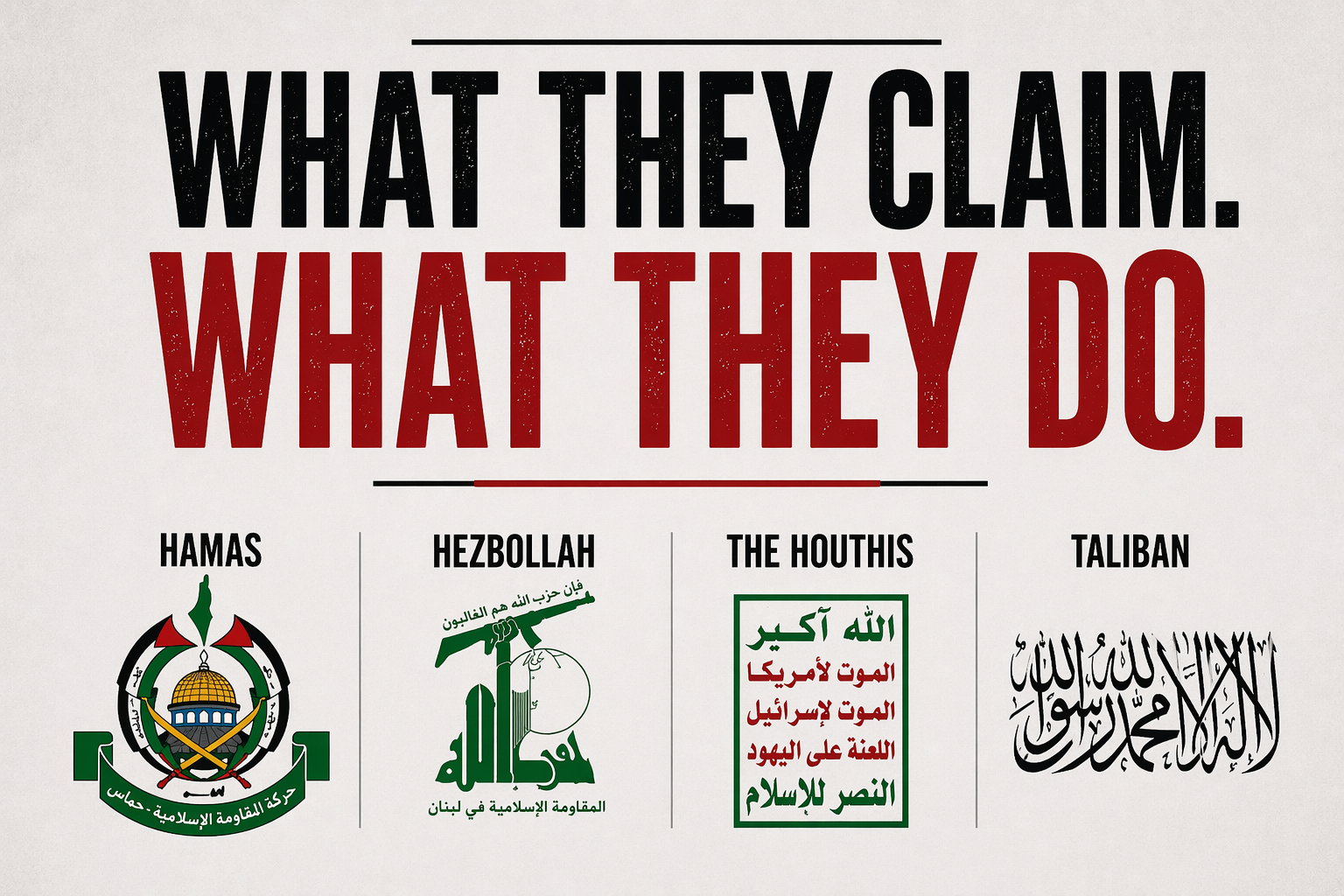
Across the Middle East and South Asia, movements such as Hamas, Hezbollah, the Houthis, and the Taliban consistently present themselves as defenders of their people. Their language is familiar: protection, dignity, resistance, sovereignty.
But claims are easy to make. Governance is harder to justify.
The question that matters is not what these movements say about themselves. It is whether the people living under their authority are freer, safer, and more empowered as a result.
Measured against that standard, a consistent contradiction emerges:
the populations in whose name these groups claim authority are often the very populations whose freedoms are most restricted.
The Test of Legitimacy
Political theory and international law converge on a basic principle: authority derives its legitimacy from responsibility toward those it governs.
From early modern concepts of sovereignty to contemporary human rights frameworks, one idea has remained constant: power is not self-justifying. It must be exercised in a way that preserves the dignity, rights, and agency of the population.
This provides a clear test.
Not ideological alignment. Not declared enemies. Not historical narratives.
The test is whether ordinary people can speak, dissent, and live without fear under that authority.
Hamas: Representation Without Pluralism
Hamas asserts that it represents and defends Palestinians. Yet governance in Gaza has been marked by restrictions that undermine the very notion of representation.
Independent political activity is limited. Journalists operate under pressure. Critics face intimidation and, at times, detention.
These patterns are not incidental. They reflect a system in which authority is insulated from challenge.
A movement cannot meaningfully claim to represent a population while constraining that population’s ability to express disagreement. Representation without pluralism is not representation. It is control.
Hezbollah: Power Beyond the State
Hezbollah positions itself as a protector of Lebanon. In practice, it operates as a parallel authority.
Its military capacity exists outside the framework of the Lebanese state, raising fundamental questions about sovereignty and accountability. When a non-state actor exercises decisive force without being subject to the same legal and political constraints as the state, the balance of power shifts away from public oversight.
Reports of pressure on critics and journalists further underscore the absence of meaningful accountability.
Power that cannot be questioned is not protective. It is coercive.
The Houthis: Authority Without Consent
The Houthis justify their control over large parts of Yemen as a defense of national and religious interests. Yet governance under their authority has been associated with practices that erode basic freedoms.
Documented concerns include the detention of journalists, suppression of opposition, and recruitment of child soldiers.
These are not marginal issues. They strike at the core of what distinguishes governance from domination.
Authority that is maintained through fear rather than consent cannot plausibly be framed as protection.
The Taliban: The Formalization of Exclusion
The Taliban claim to offer stability. However, their governance model has institutionalized exclusion.
Women and girls have been removed from large parts of public life. Independent media is severely restricted. Political opposition is absent.
This is not a temporary condition. It is a structured system in which participation is narrowed and rights are conditional.
Stability achieved through exclusion is not stability in any meaningful sense. It is the absence of visible dissent in an environment where dissent is not permitted.
A Coherent Pattern
Despite differences in origin and ideology, these movements share a common operational logic.
They centralize authority.
They limit internal challenge.
They restrict dissent.
They sustain power with minimal accountability.
In several cases, external support—particularly from Iran—further reduces the need to seek internal legitimacy from the populations they govern.
This produces a predictable outcome: authority that is sustained without consent, and control that is exercised without meaningful restraint.
Reframing the Debate
Public discourse often reduces these movements to competing labels. This framing obscures more than it reveals.
Whether one views these groups through a geopolitical, ideological, or security lens, the essential question remains the same:
What is the lived reality of the people under their authority?
If individuals cannot speak freely, organize independently, or challenge those in power without fear, then the claim of defense becomes difficult to sustain.
At that point, the distinction between external rhetoric and internal practice becomes impossible to ignore.
Conclusion
Movements are not defined by their claims. They are defined by their conduct.
The standard is neither abstract nor controversial. It is grounded in centuries of political thought and codified in modern law: authority must be accountable to those it governs.
Where that accountability is absent, the language of defense becomes a justification for control.
And when a movement restricts the very people it claims to protect, its claim does not merely weaken.
It collapses.