
Using science background to write rationally about Israel, Jews and Academia
What’s up with Haaretz: The view from the diaspora
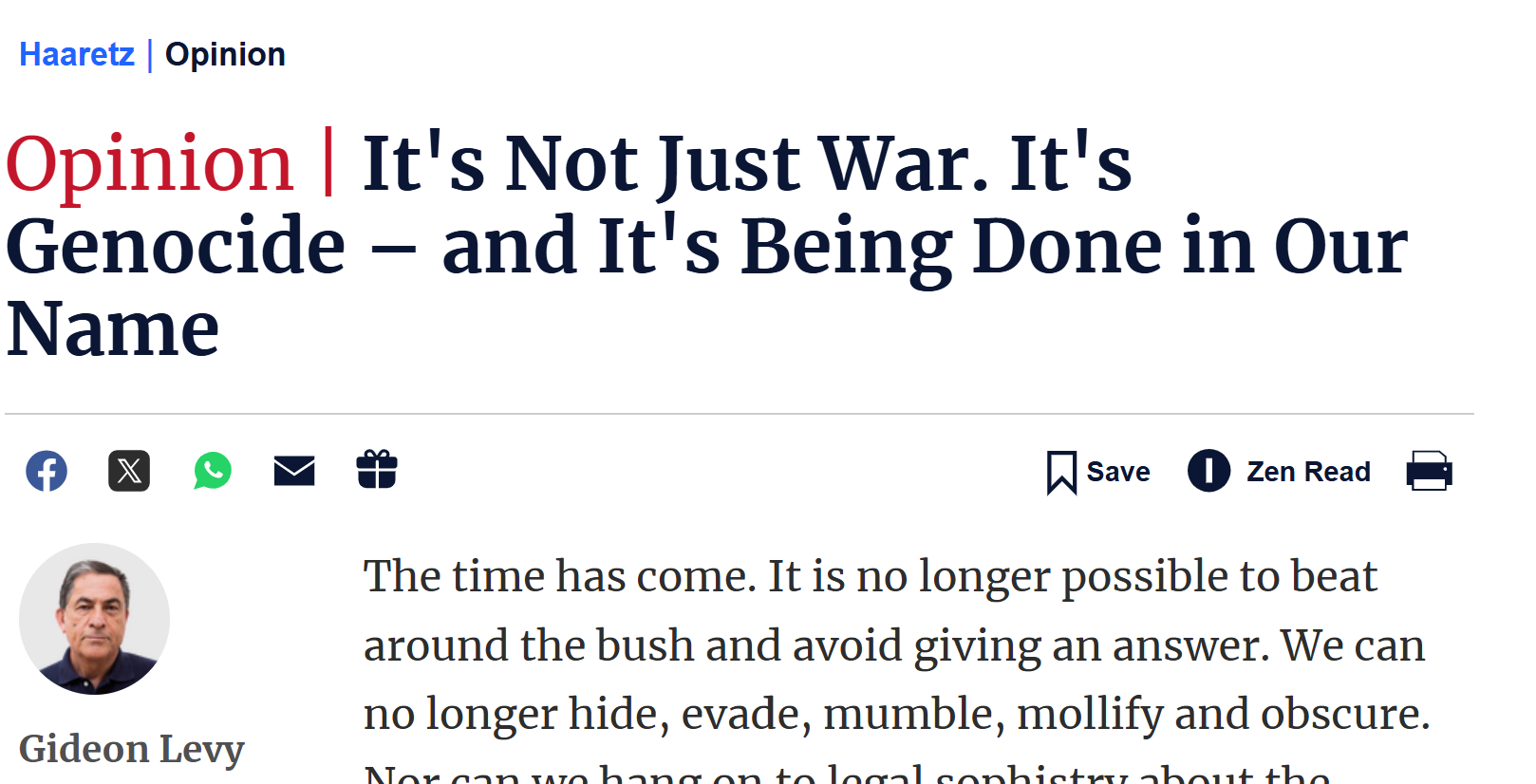
For many Jews in the English-speaking diaspora who hold pro-Israel and pro-Zionist views, Haaretz has gained the reputation of being a newspaper aligned with Israel’s harshest critics, even its enemies. Yet I rarely see serious attempts to understand this phenomenon.
In diaspora circles, one often hears dismissive “explanations”: that Haaretz journalists are simply self-hating Jews, that the paper is bankrolled by Arabs or European anti-Zionists who dictate its editorial line, or, in the vaguest of terms, that they are all just “leftists”—whatever that is supposed to mean.
To be fair Haaretz does represent the left wing of Israeli politics. But being on the left in Israel is not the same as being a leftist in America or Europe, and this label requires further analysis, which is hard to find.
In lieu of such analysis, what I often see is intellectual laziness: a refusal to engage with complexity, replaced by knee-jerk reactions to anything perceived as criticism of Israel. And admittedly, Haaretz provides ample fodder for such perceptions. Its criticism often crosses the line from legitimate scrutiny of government policy into territory that seems hostile to the state itself.
Although Haaretz has lost much of its readership—today it accounts for only about 5% of Israel’s subscription market—it remains an important and influential voice. Understanding its evolution, therefore, seems essential.
What follows is my own attempt to understand what has happened to this newspaper. I make no claim of expertise. But with some basic facts and a few analytical tools at my disposal, I hope to shed light on the matter, at least for myself. Perhaps my reflections will be of interest to others as well.
Haaretz was once the voice of Labor Zionism, rooted in dreams of a Jewish national home that would realize universal socialist ideals. It championed the Histadrut, the kibbutz movement, and the secular Jewish state envisioned by Israel’s founders. From early on, it aligned itself with notions of equality, civic responsibility, and cultural leadership.
When Ze’ev Jabotinsky introduced a revisionist, more militant strand of Zionism, later embodied by leaders like Menachem Begin and Yitzhak Shamir, Haaretz stood firmly in opposition.
Parallel to this political shift, Rabbi Zvi Yehuda Kook provided the ideological and spiritual foundation for religious Zionism, inspiring the settler movement that would later become a major force on the Israeli Right.
In more recent decades, as figures such as Ariel Sharon, Benjamin Netanyahu, Avigdor Lieberman, Naftali Bennett, Bezalel Smotrich, and Itamar Ben-Gvir rose to power, Haaretz remained faithful to the earlier vision of a different Israel. For the paper, these leaders were not merely political opponents. They represented a repudiation of the Zionist dream it once helped define.
The Second Intifada shattered the Israeli Left, collapsed the Labor Party, and buried the Oslo process. Israeli society moved steadily to the right, but Haaretz did not follow.
It looked on with dismay as the country it once helped shape transformed into something it no longer recognized. The kibbutz gave way to the startup. The Histadrut to venture capital. Secular, liberal Zionism ceded ground to an intransigent religious-nationalist politics that increasingly defines the national narrative.
Benjamin Netanyahu, first as Finance Minister and then as Prime Minister, accelerated the dismantling of the old socialist order. He privatized state assets, cut back the welfare state, and recast Israel in the image of global free-market capitalism.
In doing so, he helped bury the last vestiges of the socialist Zionist dream that Haaretz had long championed. For Haaretz and many of its readers, this was not just a political defeat. It was an existential crisis.
The Israel they believed in, and helped build, no longer existed. Somewhere along the way, many at the paper seem to have concluded, perhaps only implicitly, that if this is what Zionism has become, then maybe the entire project must be abandoned.
This, I suspect, is the root of Haaretz’s current tone and rhetoric. It is not only about Netanyahu, though he is the central villain in their narrative. Nor is it solely about the Palestinian issue, though that remains a constant theme.
At a deeper level, it is about grief, a grief for a lost vision, sublimated into anger. That anger manifests in editorial choices: Haaretz lashes out at the country and society it no longer understands.
It denigrates the government, even in wartime. It uses language that sometimes aligns uncomfortably with Israel’s enemies. It gives voice to despairing arguments that not only question policy, but the very moral legitimacy of the state.
Not necessarily because it hates Israel, but because it no longer recognizes it. Or perhaps it does hate this Israel—and is willing to sacrifice it in the name of ideological purity and unrealized dreams.
Yet this narrative exists alongside a far more complex national reality. Israel remains a mosaic of secular, traditional, and religious Jews, as well as a 20% Arab minority. Its cities and economy are largely secular. Its institutions are vibrant and contested. Politics remains a battlefield of competing visions.
But for Haaretz, the balance of power has shifted too far, too fast, in a direction it cannot reconcile with the ideals of the founding generation.
I cannot use that grief and anger to justify the tone of the paper today, but it helps me to understand it. What if this isn’t betrayal, but heartbreak?
Related Topics
Related Posts