
Consultant and writer exploring policy, society, and identity
When Antisemitism Starts Defining Jewish Identity
Gaza accusations and online campaigns can turn Jews into targets. They should not determine the meaning of Jewish life.

A Jew can be asked to explain a government they did not elect, defend a war they oppose or condemn a country before being accepted in a political discussion. At that point, a debate about Israel has become a demand directed at Jewish identity. Dana Nessel (U.S. Attorney General for Michigan) describes this pressure in her interview with David Frum. Her account is testimony about belonging and exclusion. It is not, by itself, proof of what caused the wider increase in antisemitism. That distinction matters. If we want to understand how hostility shapes Jewish identity, we must examine the evidence without allowing either fear or political loyalty to determine the answer in advance.
A war becomes a burden placed on Jews
The Anti-Defamation League’s 2024 audit recorded 9,354 US antisemitic incidents. It classified 58 percent as involving Israel or Zionism. The figures include criminal and non-criminal incidents, including qualifying rhetoric at demonstrations. That is evidence of a substantial Israel-related component. It does not mean that 58 percent were caused by accusations of genocide. References to Israel, hostility to Zionism and genocide allegations are different categories.
Britain’s Community Security Trust also describes an immediate surge after October 7, before Israel’s extensive military response. Existing antisemitism was activated as well as reshaped. The conclusion is not that the war’s subsequent course is irrelevant. It is that no single slogan can explain the entire rise.
The point where accusation becomes collective blame
Calling an Israeli policy criminal is not the same act as holding Jews everywhere responsible for it. Even an allegation as serious as genocide must be judged by its evidence and argument, not automatically classified by the identity of the state accused. The Jerusalem Declaration on Antisemitism makes a useful distinction. It protects criticism of Israel while identifying collective blame and demands that Jews condemn Israel because they are Jewish as antisemitic.
The issue is what happens to the accusation: does it remain an argument about identifiable decisions and decision-makers, or become a judgment on Jews as a people? An ADL chronology reports genocide decals placed on signs at a Toronto synagogue in December 2024. That is a reported instance of accusation reaching a Jewish religious target. It does not prove how common the mechanism is. We should name the transfer of blame precisely. Otherwise, we risk either overlooking anti-Jewish intimidation or treating legitimate concern for Palestinians as evidence of prejudice.
Where Collective Blame Begins
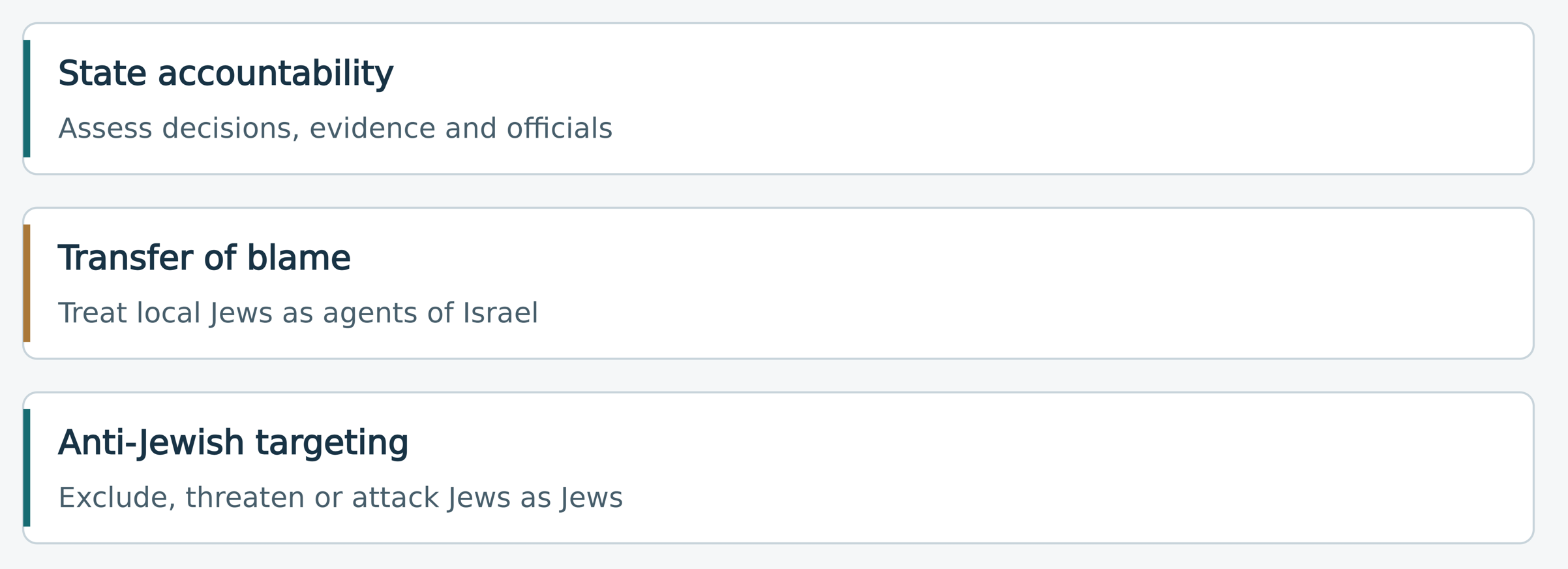
The middle step changes the target.
This is an analytical distinction, not an inevitable sequence.
Some amplification is organized
There is evidence of deliberate online manipulation. Microsoft Threat Intelligence documented Iranian operations that grew more coordinated after October 7. Its account includes an October 21 operation involving synagogue displays defaced with genocide messaging and online amplification. But organized activity is not the same as an established explanation of the overall increase. Microsoft did not measure how much subsequent antisemitic violence those messages caused.
Other actors exploited the attack differently. The Institute for Strategic Dialogue documented neo-Nazi Telegram posts encouraging attacks on Jews from October 7 itself. Their hostility did not depend on a later humanitarian argument. A campaign can make a message more visible without persuading everyone who sees it. To connect exposure to changed beliefs, and then to violence, requires further evidence. Research also resists a simple answer. In two British experiments, exposure to Gaza-war material produced more negative attitudes toward several groups in one study, without increasing the study’s antisemitism measure. The effect did not replicate in the second. These were not isolated tests of genocide language, but they show why causal claims require care.
Four different evidentiary questions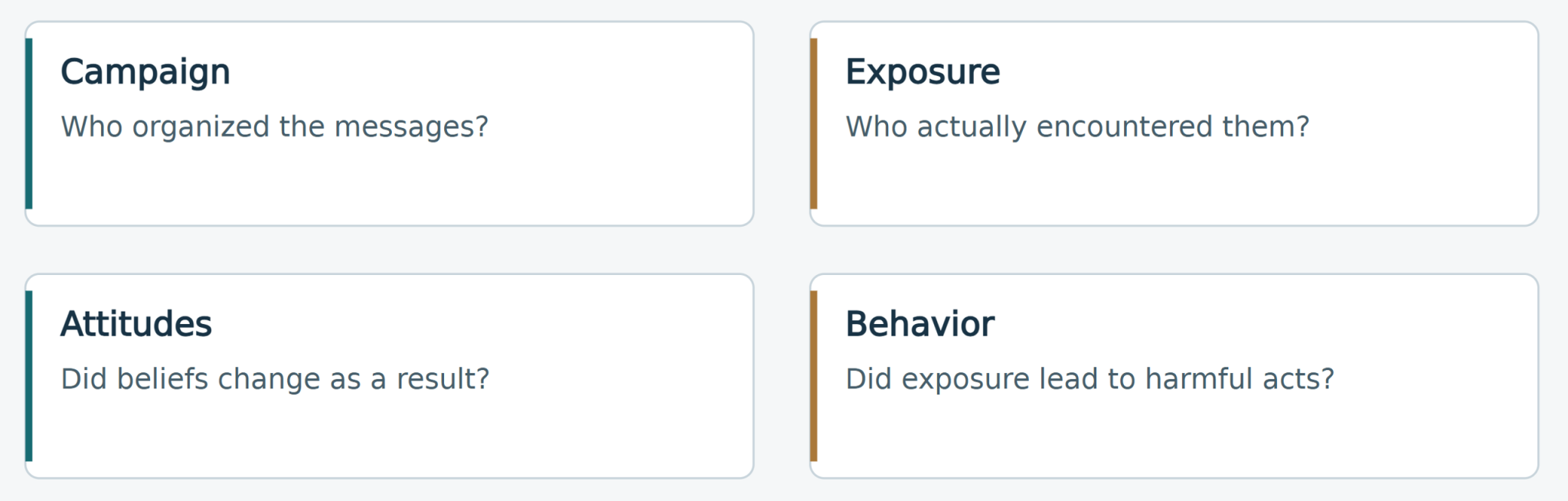
Evidence of a campaign does not by itself establish the next three outcomes.
Threat can strengthen belonging and narrow it
When people are targeted as Jews, solidarity can provide protection and relief. Reconnecting with a community can be a deliberate and meaningful response. It should not be dismissed as merely reactive. Yet there is a cost if the community becomes visible to us only through danger. Learning gives way to vigilance. Disagreement feels like abandonment. Every encounter with an outsider becomes a test of whether that person is safe.
These are possible responses, not a diagnosis of every Jew. Some people become more engaged; others withdraw or conceal their identity. Threat does not produce one uniform Jewish experience. The danger is that our persecutors acquire too much influence over the content of our belonging. They decide when Jewishness becomes salient, and we begin to speak of it chiefly in the language they have forced upon us.
Safety should leave room for a life
The answer is neither silence about antisemitism nor suspicion of every criticism of Israel. It is to defend people against collective blame while preserving space for evidence, disagreement and moral judgment. No Jewish student should have to pass a political test to belong. No Palestinian life should become less important because someone has misused Palestinian suffering to promote hatred.
For me, that consistency belongs within Tikkun Olam. A commitment to repair cannot exclude Jews, and it cannot end with Jews. Security protects the possibility of Jewish life. What we do with that possibility—what we learn, transmit and repair—must remain ours to decide. That is the subject of the final post: From ‘Never Again’ to Tikkun Olam.
Related Topics
Related Posts