
Writing on Jewish life, relationships, trauma, and resilience
When Couples Are Arguing With History
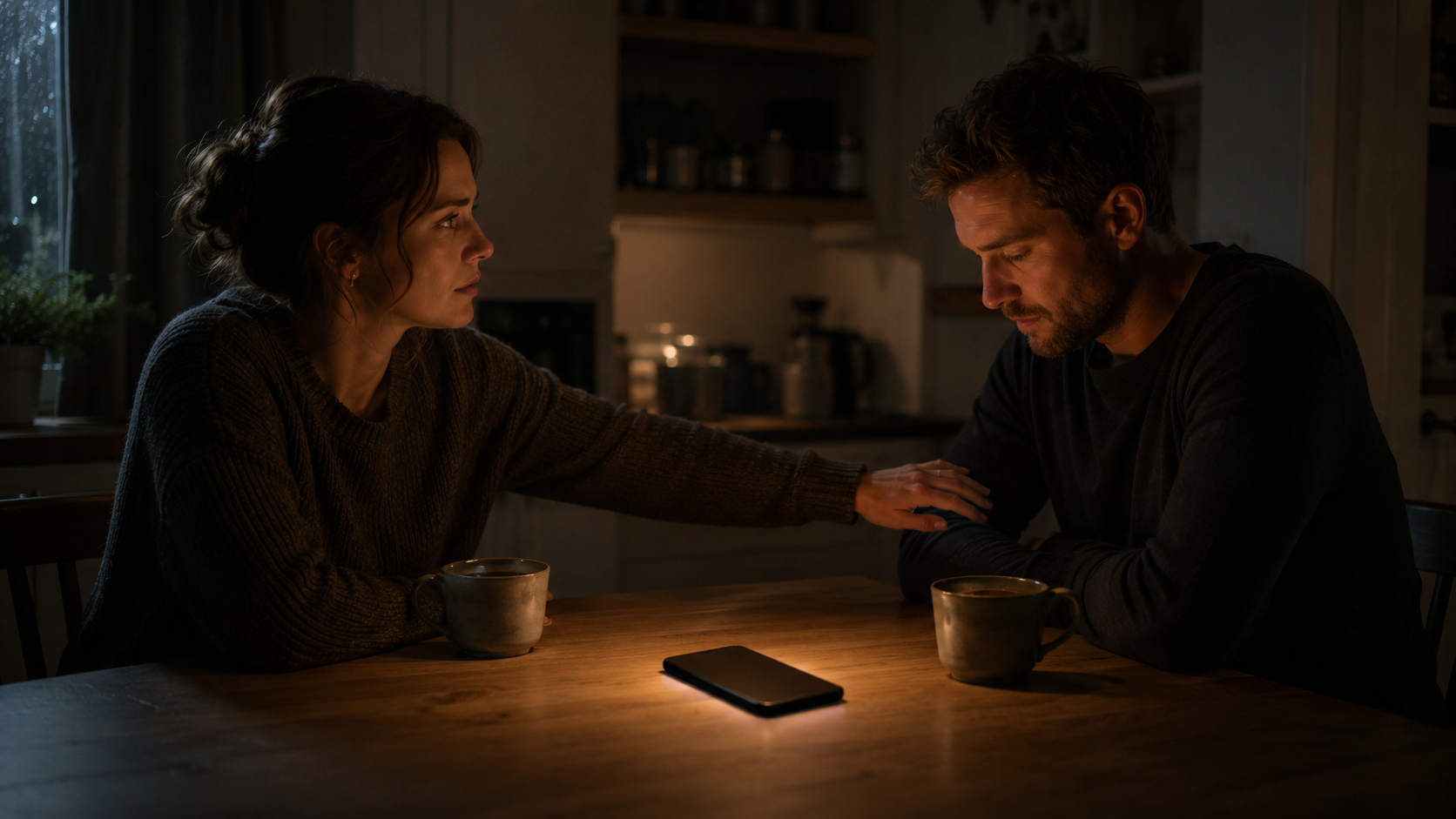
Illustrative AI image created by the author. When fear takes over, repair may begin with one small reach across the distance.
Since October 7, Jewish and interfaith couples are fighting about schools, safety, and whether to stay — arguments that are really conversations with the past. Naming that is the first step. Knowing what to do next is the second.
It is late. The kitchen is dim. Two mugs of tea have gone cold, and the phone lies face-down between you, still glowing faintly with the alert neither of you wants to read aloud. The person you love is sitting only a few feet away, yet the distance feels enormous. You are both speaking, but neither of you feels met. One of you is trying harder to be understood. The other is trying harder not to be overwhelmed.
There are moments when a couple is no longer arguing about what is happening in the world. They are arguing with history — with what the present moment has awakened inside each of them.
Since October 7, many Jewish and interfaith couples have found themselves facing questions that reach far beyond politics. Is it safe to stay? Are our children safe? Should we speak publicly or remain quiet? Why does your response feel so different from mine?
Writing recently in these pages, London couples psychotherapist Debbie Isaacs described what those questions look like from inside the consulting room: inherited Holocaust fears surfacing in second and third generations, conflicts over identity and belonging, disagreements about whether to remain in the United Kingdom, and Jewish partners feeling profoundly alone when their fears are minimized by the person closest to them.
Her observations match what we see in our work at PAIRS Foundation. And they point to something essential about intimate relationships: when survival instincts take over, even loving partners lose sight of each other. One becomes urgent, vigilant, insistent. The other becomes skeptical, quiet, or emotionally distant. Both believe they are responding to the facts. Yet the visible argument is only a small part of what is happening.
The argument is rarely the whole argument
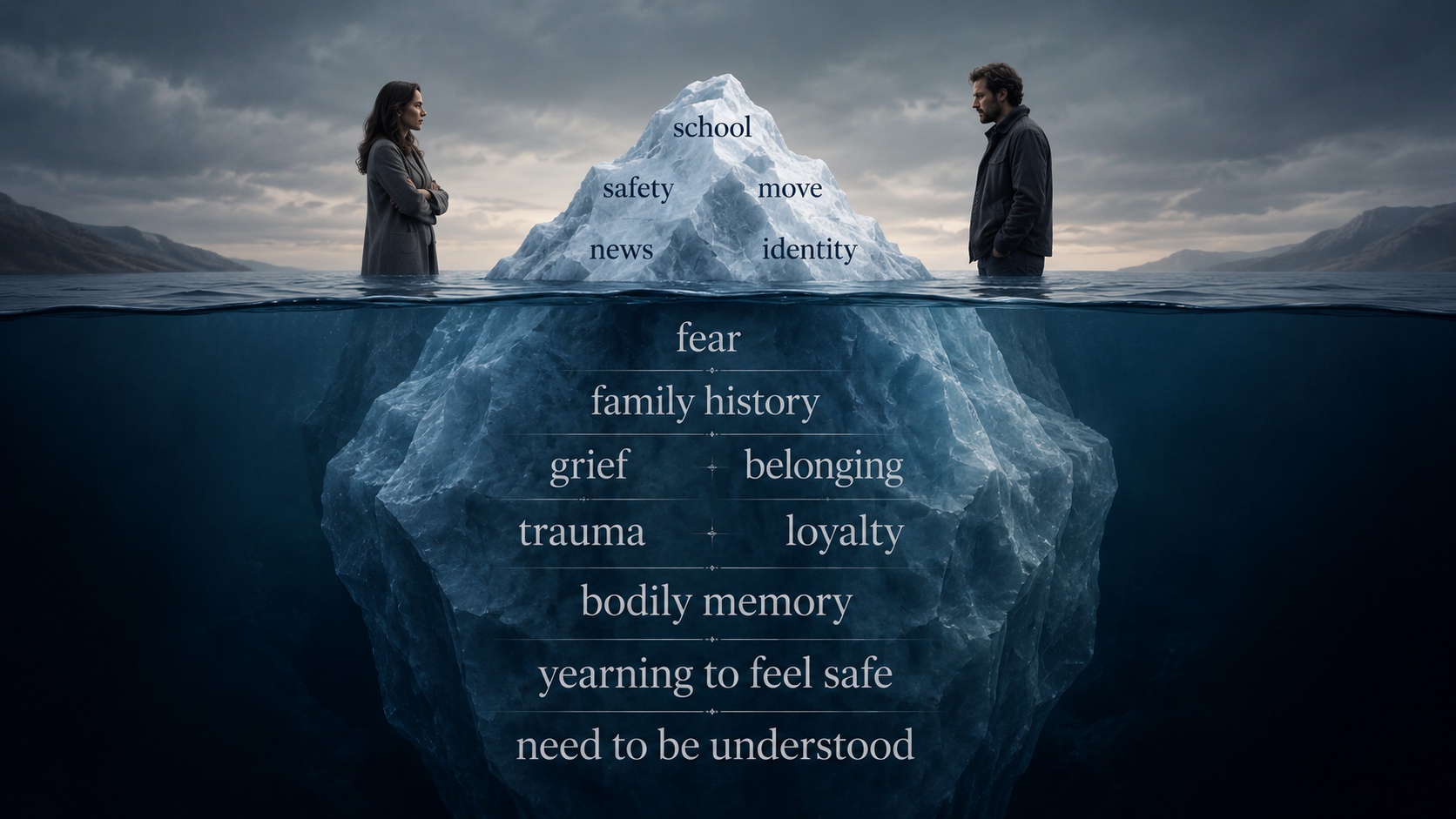
A couple may appear to be debating whether to move, where to send their children to school, or how much news to consume. Underneath, the conversation sounds more like this: Will you protect me? Do you believe me? Do I belong here? Will my fear overwhelm our family? Am I allowed to respond differently from you?
Those questions leave us exposed, so couples argue about the decision instead. A conversation about changing schools becomes a contest over whether one partner is paranoid or naïve. A conversation about leaving — whether for Israel or somewhere else — becomes a test of whether one partner truly understands Jewish fear. A disagreement about the news becomes a judgment about who is rational, informed, or loyal. Soon neither person is trying to understand the other’s experience; each is trying to prove that their own experience is the legitimate one.
What couples argue about is the visible tip of an iceberg. Beneath the surface are fear, grief, family history, loyalty, bodily memory, and the longing to feel safe and understood. Until those layers enter the conversation, couples circle the same argument without ever reaching the conversation they actually need to have.
The body may know before the mind can explain
We bring our family histories, early lessons, losses, and expectations into the relationships that matter most. Sometimes we understand the connection. Sometimes the body reacts before the mind can explain why: the jaw tightens, the breath goes shallow, the skin grows cold. Something inside says I am not safe before the mind has found a sentence. Isaacs describes exactly this in herself — goosebumps rising as a client recounts an experience of antisemitism, her body recognizing something before her mind catches up.
PAIRS calls some of these intense reactions “emotional allergies”: a present situation touches an older wound or a deeply learned fear, producing a response that feels immediate, physical, and larger than the visible event.
That does not mean the current danger is imaginary. A reaction can be grounded in what is happening now and still carry the emotional weight of generations. A grandmother’s packed suitcase and this morning’s headline can occupy the same nervous system at the same moment. When we understand this, we do not have to choose between present reality and inherited memory. Both may be active. Both deserve attention.
When protection hides the person
When people feel threatened, they do not always look frightened. Fear may sound like anger. Grief may appear as criticism. Helplessness may put on the clothes of control. Overwhelm may look like indifference.
The partner who says “you’re overreacting” may be defending against their own terror — Isaacs suggests that for some non-Jewish partners, fully taking in a spouse’s fear would mean accepting that their own children could be targets. The partner who insists “we would leave tonight if we could” may be expressing generations of learned vigilance. The partner who retreats into statistics about how safe the neighborhood really is may not be uncaring; they may have no other way to remain present without being swallowed by the intensity.
These reactions are old, familiar ways of staying safe. But good intentions do not prevent pain, and each person’s protection can become the other person’s wound. The more one reaches, the more the other retreats. The more one retreats, the more abandoned the first person feels — and the more urgent they become. Soon both are reacting not only to the danger outside the relationship, but to the loneliness growing inside it.
Beneath it all, each may be asking the same tender question: Can I remain myself and still be safe with you?
Understanding is not the same as agreeing
Couples often assume empathy requires agreement. It does not. You can understand why your partner is frightened without sharing the same interpretation of every event. You can respect the emotional weight of your partner’s family history without surrendering your own perspective. You can say, “I hear how deeply this affects you,” without pretending you feel exactly the same.
Emotional safety does not come from identical opinions. It comes from knowing that your inner world will not be mocked, minimized, corrected, or placed on trial. It also comes from speaking in a way that matches what is happening inside. Instead of disguising fear as accusation: “I am frightened, and I need to know that you take my fear seriously.” Instead of hiding overwhelm behind detachment: “I care about you. I am also afraid I will disappear inside this conversation if we do not slow it down.” Instead of “you never understand”: “The story I am telling myself is that I am alone in this. I need to know whether that story is true.”
Insight is not always enough
A couple may understand perfectly why each person reacts as they do — that one partner’s urgency comes from a family shaped by persecution and flight, while the other’s rootedness comes from generations of belonging in one place — and still be unable to discuss it without falling into accusation, defensiveness, or silence.
That is not a failure of love. It is a skills gap. That is not a failure of love. It is a skills gap—the point where insight must be joined by relationship skills: learning to slow down, speak honestly, and listen with empathy before rushing toward solutions. The goal is not to decide whose feelings are more legitimate. The goal is to create enough safety for both people to tell the truth.
A way back to each other
When a conversation becomes charged, repetitive, or polarizing, stop trying to solve the external problem. Pause. Feel your feet on the floor. Notice your breathing. Remember that the person in front of you is not the enemy.
This structure assumes both partners can participate without fear of retaliation. Where coercion, intimidation, or abuse is present, safety must come before mutual dialogue.
Take uninterrupted turns — one speaks, one listens, then switch. No rebuttal, no correction, no evidence-gathering, no quick reassurance. The speaker completes these sentences:
What I am most afraid of is…
What this brings up from my family or history is…
The story I find myself telling about your reaction is…
What I need most from you right now is…
The listener’s job is not to agree with every conclusion but to understand the speaker’s experience — listening not only to the words but for the fear, grief, loyalty, and longing underneath them. The listener might respond:
What I hear is…
That makes sense to me because…
The part I hadn’t understood before is…
Did I get that right?
Only after both people feel heard should the couple return to the practical questions: What must be decided now, and what can wait? What would help each of us feel safer? What support do we need from family, community, clergy, or professionals? Couples are far more capable of creative problem-solving when neither person is fighting for their emotional existence. The practical problem may remain difficult. But now two people are facing it together.
Love cannot erase history, but it can make room for it
Isaacs writes that the consulting room may be one of the few remaining places where two emotional realities can be held at once. The urgent question is whether couples can learn to bring some of that capacity home — because holding your partner’s reality alongside your own is not only a professional service. It is a learnable skill, one a couple can use at their own kitchen table on a night when the news is bad and the children are asking questions.
The histories we inherit do not disappear when we fall in love. They come with us — into our homes, our parenting, our identities, our bodies, and sometimes our arguments. Healthy love does not demand that those histories be left at the door. It invites them into conversation: not so one person’s history can silence the other’s, but so each partner can better understand where the other is standing.
Fear may arrive before either person has had time to choose. That first reaction may be old, automatic, and shaped by more history than either can see. But the next moment can be different. You can pause. You can say, “This is what is happening inside me,” instead of, “This is what is wrong with you.” You can remain yourself and still reach for the other.
In frightening times, love may not be able to make the world safe. But it can help create a home in which fear may be spoken, dignity is protected, and neither person has to face the world alone.
Related Topics