
Expose hate. Educate with integrity. Empower through action.
When Democracy Forgets Its Jews
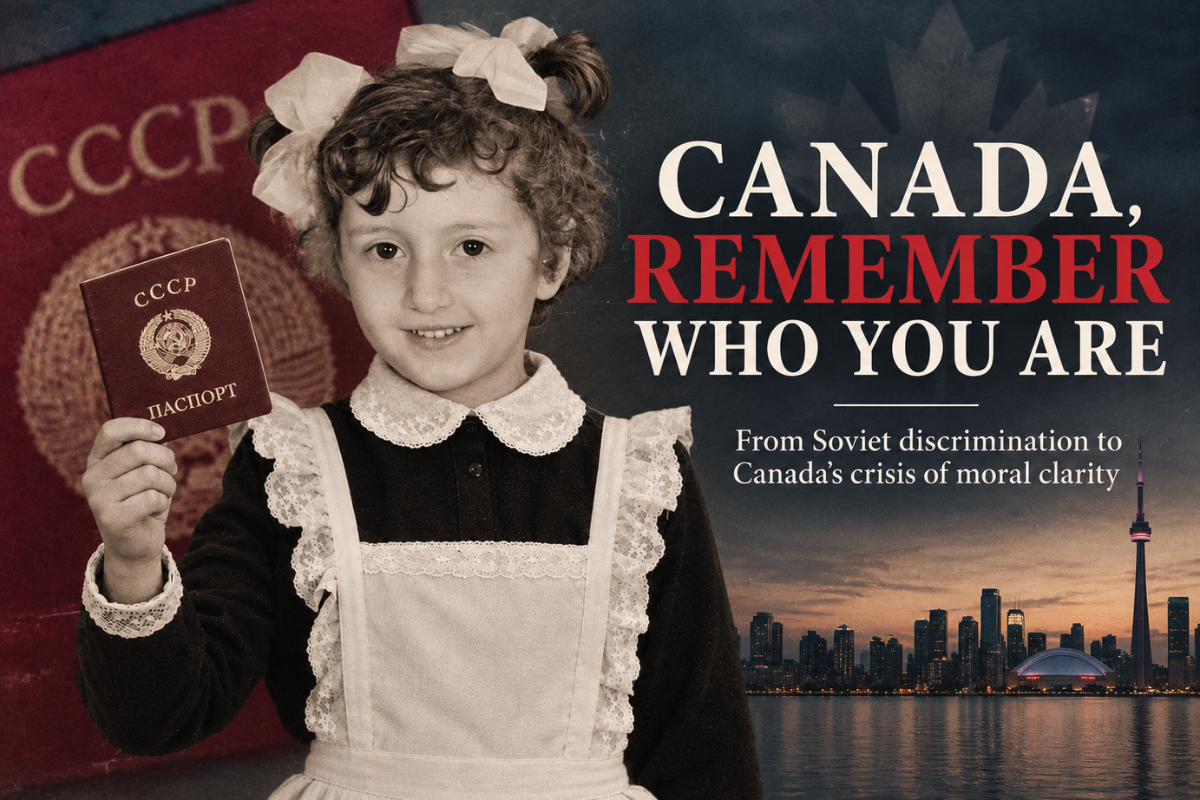
From the Soviet Union to Canada: I grew up in a country where Jewish identity could limit your opportunities. Today, I am asking Canada to remember the values that made us choose it. (courtesy)
I escaped a country that marked Jews. I never imagined Canada would forget how to protect them.
Look at the photograph of the little girl holding a Soviet passport. That girl is me.
In the Soviet Union, your passport did not merely tell the state who you were. On its infamous fifth line, it recorded your nationality. For Jews, that single word—Jewish—could follow you into a university, a workplace and encounters with state institutions.
You could contribute to science, medicine, engineering, culture, or the economy, but your accomplishments did not necessarily protect you because your identity could precede everything you had achieved.
My family knew what it meant to live in a society in which discrimination against Jews could coexist with grand declarations about equality, liberation and social justice.
That contradiction is important.
Oppression does not always announce itself as oppression. Sometimes it speaks the language of justice.
My family left that world for freedom.
Canada represented something profoundly different: democracy, individual liberty, equality before the law and the conviction that minorities should not have to fear the institutions created to protect them.
That is why what I see happening today is so painful.
When human rights lose their moral compass
The recent decision involving former Toronto Metropolitan University teaching assistant Ayman Elkasrawy should concern Canadians far beyond the Jewish community. As Tristan Hopper reported in the National Post on August 31, 2026, in “Human rights tribunal sides with TMU teaching assistant who decried ‘desecration by the Jews,’” Elkasrawy became embroiled in controversy after an Arabic-language prayer in which he was reported to have called for Jews to be slain “one by one.” His mosque and the Muslim Association of Canada condemned the prayer at the time. (National Post)
In Elkasrawy v. Toronto Metropolitan University, 2026 HRTO 1137 (Human Rights Tribunal of Ontario, July 24, 2026), the Tribunal rejected his claim that his Muslim creed was a factor in his termination. However, it found that his creed was a “small factor” in the university president’s decision to disclose his employment status to B’nai Brith, contrary to the university’s usual confidentiality practice, and awarded him $7,000 in general damages.
The legal distinction matters.
But so does the moral picture Canadians are left staring at.
How did we arrive at a moment in which a human-rights proceeding ends with compensation for injury to the dignity of someone whose own public words about Jews caused such outrage—while the dignity and fear of the Jews who heard those words seem almost peripheral to the story?
That is the question that troubles me.
Human rights cease to have meaning when they become detached from the humanity they were created to protect.
I have seen the mechanism before
This does not mean Canada is the Soviet Union. It is not.
Nor is Canada Nazi Germany. Historical analogies become useless when we erase enormous differences between societies and eras.
But mechanisms of hatred can repeat without history repeating identically.
This is precisely why, at Stop Antizionism, we teach Dr. Naya Lekht’s Three Eras of Jew-Hatred framework: to understand how Jew-hatred survives by adapting its language and ideological justification to the moral vocabulary of each era.
As Dr. Lekht’s framework demonstrates, the language changes with each era: Anti-Judaism demonized Jews through religion; Antisemitism through race; and Antizionism increasingly demonizes Jews through their collective and national identity, targeting Zionism, Israel, and Jewish national existence as uniquely immoral or illegitimate.
The vocabulary changes. The libels mutate. The ideological justification evolves. But the mechanism remains: demonization → exclusion → violence → denial.
This is the central warning of Dr. Lekht’s framework: if we learn to recognize Jew-hatred only by the language it used yesterday, we will fail to recognize it when it speaks the moral language of today.
That is the Cycle of Libels.
As Dr. Naya Lekht explains through the classical framework of logos, ethos and pathos, a libel begins as a claim presented as truth (logos); it gains legitimacy when repeated and validated by trusted authorities and institutions (ethos); and through repetition it shapes public emotion, turning suspicion into fear, anger and hatred (pathos).
Once the libel is emotionally normalized, demonization becomes socially acceptable, exclusion begins to seem reasonable, and hostility, even violence, becomes easier to rationalize. At the moral inversion, Jew-hatred becomes “virtuous hate”: hatred recast as moral righteousness.
The authority does not have to commit the violence itself. By legitimizing the libel, it can help create the moral permission for others to do so.
History warns us not because every historical moment is identical, but because human beings remain susceptible to the same processes of dehumanization.
Canada has a choice
I do not believe the measure of a democracy is whether nobody ever hates Jews. No democracy can promise that.
The measure is what its institutions do when hatred appears.
The test is whether universities confront demonization rather than rationalize it, governments defend liberal-democratic principles consistently, and human-rights institutions remember a principle that should require no explanation: Jewish dignity is human dignity.
And when institutions make mistakes, are Canadians still capable of saying: this is wrong?
Because a democracy that cannot protect its Jews is not merely experiencing a “Jewish problem.”
It is experiencing a democratic problem.
A society that becomes comfortable with the dehumanization of one minority damages the principle that protects every minority.
“Remember”
This week’s Torah portions offer an extraordinary framework for thinking about this moment.
Ki Tavo begins with memory.
The Israelite brings his first fruits, but before celebrating what he has built, he must tell the story of where his people came from: vulnerability, oppression, deliverance and arrival.
Prosperity is not permission to forget history.
That speaks powerfully to Jews who built extraordinary lives in Canada.
We became doctors, scientists, teachers, entrepreneurs, engineers, artists and public servants. We helped build the country because we believed in it.
But success must never make us forget how quickly societies can change when their moral vocabulary becomes detached from moral reality.
Then comes Nitzavim:
“You are standing today, all of you…”
Not only leaders, rabbis, or Jewish organizations.
All of you.
And then the Torah presents a choice:
“I have set before you life and death, blessing and curse… therefore choose life.”
“Choose life” does not begin after somebody has been murdered.
It begins much earlier, when a libel becomes fashionable, demonization becomes acceptable, exclusion is renamed justice, and hatred is excused because its target has been declared privileged, colonial, oppressive, or undeserving of sympathy.
The time to stop the cycle is before violence—not after another Jew is attacked.
I never imagined writing this about Canada
Perhaps that is the most painful part for me.
My family escaped a society where being Jewish could be written into a passport and used to define your opportunities.
We came to Canada because Canada represented the opposite idea: you would be judged as a human being and citizen, not reduced to the category stamped beside your name.
I never imagined that decades later I would find myself wondering whether Jews should again be thinking about where they will be safe.
I do not want to leave Canada. I want Canada to remember itself.
This country still has a choice.
Canada can continue down a path where ideology overrides moral clarity and empathy becomes so distorted that society can no longer distinguish between those who demonize and those being demonized.
Or Canada can rediscover the principles that made people like my family choose it in the first place: liberty, equality, responsibility, truth and equal human dignity.
Nitzavim does not tell us to despair. It tells us to choose.
Learn what happened before.
Lead while there is still time.
Act before demonization becomes exclusion and exclusion becomes violence.
Choose life.
Related Topics