Co-founder and director, Gesher Community Care
When Fear Makes Us Certain
By Drs. Shelly Steinwurtzel and Jessica Zmood
This week, Americans will vote in midterm elections that both parties are framing as a fight for the nation’s survival. Across Europe, protests have spilled into riots in city after city. On both sides of the Atlantic, many people no longer see political opponents as merely wrong. They see them as a threat.
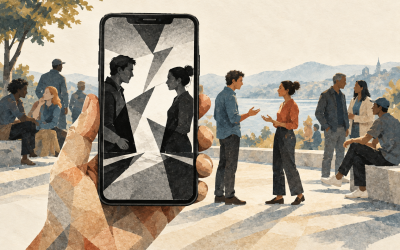
Behind the headlines lies a paradox. We’ve never had access to so much information about the world. And it has never seemed so hard to know what to believe.
War, political upheaval, protests and humanitarian catastrophe unfold in real time on our phones. Images of violence arrive faster than we can process them, each wrapped in competing narratives and demands that we take a side. Before we absorb one disturbing story, another replaces it.
As clinical psychologists, we are increasingly concerned not only with what is happening in the world but with what relentless exposure to it is doing to our minds.
We think of news as information. The brain treats it as something more. Consider the internal dialogue of an ordinary scroll: Is this real? Who should I believe? Those images are horrifying. Who is responsible? What happens next?
These aren’t only intellectual questions. They engage the brain’s threat-detection system. When danger is perceived, the amygdala and related networks sharpen attention, release stress hormones and prepare the body to act. That system serves us well when a car swerves toward us. It is poorly suited to a world in which alarming images follow us everywhere and offer no meaningful way to respond.
After the 2013 Boston Marathon bombing, researchers writing in the Proceedings of the National Academy of Sciences found that people who consumed six or more hours a day of coverage reported higher acute stress than people directly exposed to the attack. Repeated watching can itself become a source of trauma.
Uncertainty compounds the harm. We aren’t merely exposed to frightening information; we must sort it from manipulated images, selective reporting and outright falsehoods. A widely cited study in Science found that false stories spread farther and faster on Twitter than true ones. So we feel compelled to stay informed about threats while trusting less and less of what informs us. That uncertainty is itself a powerful source of anxiety.
It also degrades how we think. Sustained, uncontrollable stress impairs the prefrontal cortex, the region central to judgment, emotional regulation and flexible reasoning. Under stress we become more reactive and less able to weigh competing evidence. The more urgently we need to understand a threatening world, the harder it becomes to think clearly about it.
This matters most for young people. Adolescence and early adulthood are periods of intense sensitivity to belonging, peer judgment and identity, while the brain systems supporting self-regulation are still maturing. Place those developmental realities inside an online environment that rewards outrage, certainty and group loyalty, and rigid thinking is the predictable result. The social psychologist Jonathan Haidt has argued that the shift to a phone-based childhood in the early 2010s helped fuel a sharp rise in adolescent anxiety and depression. Researchers still debate the size of that effect, but the developmental risk is clear.
Adults aren’t immune. In our clinical work, we see how anxiety narrows perspective and makes ambiguity feel intolerable. Overwhelmed people seek relief in simpler explanations and harsher judgments.
Two concepts from psychodynamic psychology help explain what follows: splitting and projection.
Splitting is the tendency to sort experience into all good and all bad. Part of growing up is learning that the same person can be loving and disappointing, trustworthy in some ways and flawed in others. Under enough strain, adults regress. People become heroes or villains. Groups become wholly virtuous or irredeemably corrupt. Complex historical conflicts shrink into morality plays. Nuance starts to feel like betrayal: Acknowledging suffering on the other side reads as disloyalty, a question invites suspicion, and historical context is mistaken for excuse-making. Jonathan Haidt and Greg Lukianoff have warned that habits like black-and-white thinking and “us versus them” reasoning, which cognitive therapists treat as distortions, are increasingly embraced as virtues.
Projection attributes to others the feelings we can’t tolerate in ourselves. Fear and helplessness are hard to bear; anger and blame feel more manageable. Locating the source of our distress entirely in another person or group offers a brief sense of certainty and control.
These ideas were developed to understand individuals, not political movements. But they illuminate what research on affective polarization documents: Political division now involves less disagreement over policy than hostility toward the people on the other side. Social media rewards that hostility. A study in Science Advances found that likes and shares teach users to express more moral outrage over time.
The digital world didn’t create these vulnerabilities. It rewards us for acting on them. Condemnation becomes instant and collective. A statement is stripped of context, a person is reduced to a single comment, and a complicated situation becomes a loyalty test. The fear runs in both directions. The psychologist Dean McKay has described a growing number of anxious patients who scrub old emails and avoid conversations, terrified that a single misstep will get them canceled. Accountability for real wrongdoing matters. But condemning harmful behavior is different from reducing a person, or a people, to an embodiment of evil.
As Jewish psychologists, we can’t consider these dynamics without recalling the history of antisemitism. For centuries, Jews have been made scapegoats during periods of social anxiety: economic collapse, political turmoil, plague, cultural upheaval. The accusations change; the pattern doesn’t. When a society can’t tolerate uncertainty, it seeks relief in a common enemy, and Jews have too often been cast in that role. The loss of nuance isn’t merely an intellectual failing. When people stop being seen as human and become symbols of collective fear, the consequences can be devastating.
None of this is an argument for indifference or moral relativism. Some actions deserve unequivocal condemnation. Not every disagreement is a misunderstanding, and not every claim deserves equal weight. Nuance is the capacity to distinguish right from wrong without abandoning evidence, complexity or another person’s humanity.
Preserving that capacity takes more than better information. It requires noticing how our emotional states shape what we believe. We can limit our exposure to the news cycle, rely on credible sources and resist sharing provocative material before verifying it. We can notice when our certainty feels especially urgent, when disagreement feels like a threat, or when the desire to condemn outweighs the desire to understand.
Above all, we can practice holding two truths at once. A cause can be just while some of its advocates behave unjustly. We can condemn an act without dehumanizing a population. We can acknowledge another’s suffering without diminishing our own. That isn’t weakness or confusion. It is psychological maturity.
A frightened mind searches for enemies. A reflective mind searches for truth.
Dr. Steinwurtzel and Dr. Zmood are clinical psychologists and co-founders and co-directors of Gesher Community Care.
(Please note that Dean McKay is a member of the Gesher Community Care Mental Health Advisory Board)
Related Topics
Related Posts