
One of the People
When Gaza Was Great
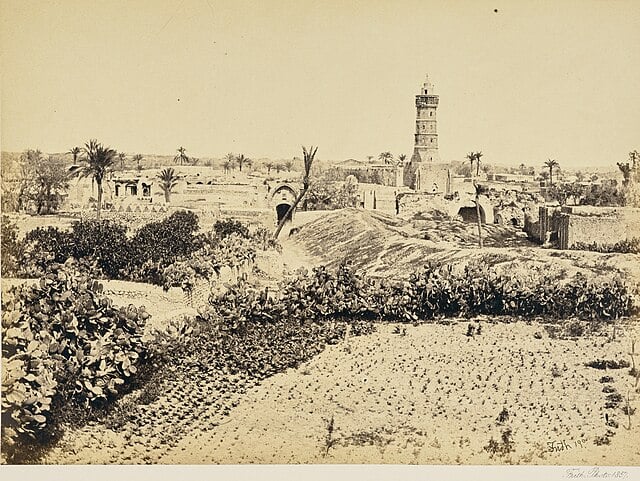
View of Gaza City (1857). Wikimedia Commons.
Gaza’s long history originates in remotest antiquity. Over the course of time, the city has experienced several peak periods when its residents and reputation flourished. Today, when there are those amid the corridors of power who would Make Gaza Great Again, it would be useful to first revisit the city’s previous epochs of distinction.
Ancient Egypt
An ancient seaport whose main town originally rested slightly inland upon a low-lying hill along the southern Coastal Plain, Gaza had oriented itself with the land of the pharaohs to the southwest ever since the days of Pharaoh Ahmose I of Egypt, founder of the 18th Dynasty and first ruler of the New Kingdom of Egypt (the Egyptian Empire), and the city’s strategic and economic significance in the Near East augmented by the middle of the second millennium BCE. Around 1469, it was conquered by the young warrior-ruler Pharaoh Thutmose III of Egypt and served as the Egyptians’ primary base of operations in Canaan throughout the subsequent 300 years of Egyptian occupation. Owing to its importance, Gaza is mentioned in both the Ta’anakh tablets (15th/14th centuries BCE) and the El-Amarna letters (14th century BCE) as an Egyptian administrative center.
Philistia
During the era of the Judges (c. 1228–1020 BCE), the Neo-Philistines (one of the Sea Peoples, Cretan or otherwise Aegean) invaded—circa 1175, possibly initially as an Egyptian garrison—the Land of Israel’s southern Coastal Plain, i.e., western Judah; they soon conquered from the tribal territory of Judah cities such as Gaza, Ashdod, and Ekron (which along with Ashkelon and Gat constituted their pentapolis) and their region became known as Philistia. The Neo-Philistine invasion brought an end to the Avvites, Gaza’s original inhabitants, and deprived the Judahites of much of their coastal inheritance. Gaza and its environs were controlled for nearly two centuries by the Neo-Philistines; only with the advent of King David of Israel and with his several victories over the Neo-Philistines, approximately 175 years later, was this region reincorporated into Judah.
Key to the importance of Gaza was the fact that it was situated along the ancient Derekh HaYam (The Way of the Sea/The Coastal Highway) international trade route connecting Egypt and Syria. The main route ran from On (Heliopolis) in Egypt to Damascus in Syria. In the south the route divided into two branches, one running along the southern Coastal Plain and the other slightly inland, between the southern Coastal Plain and the Shfeilah. These southern branches framed the Philistine pentapolis: along the coastal branch lay Gaza, Ashkelon, and Ashdod, and along the inland branch lay Gath and Ekron. The coastal branch was also known as The Way of the Land of the Philistines, and its extent across northern Sinai, between Tjaru (Sile, modern Tel el-Habua) and Gaza—stretching some 140 miles and featuring a chain of forts, each with a well—was known to the ancient Egyptians as The Way(s) of Horus.
Macedonian Empire
Following the city’s conquest by Emperor Cambyses of Persia in 529, Gaza became an imperial Persian fortress but retained a certain measure of independence and flourished. Yet it was subsequently, during the Hellenistic era (332–167 BCE), when Gaza developed major seaports to its immediate northwest, namely Anthedon (Agrippias/Agrippeum, later known as Tida in Arabic)—populated by Greek immigrants from Anthedon, Boeotia—and Neapolis (Maiumas, later known as al-Mina in Arabic, and identified with the present-day Rimal neighborhood in Gaza). Intrepid Nabateans from Arabia settled the Negev Desert region, wherein they developed the northern segments of their overland Incense Route between Oman and Sheba/Himyar (Yemen) in southern Arabia and the Mediterranean ports of Gaza and Rhinokorura (El-Arish), which doubled as gateways for Greek cultural and commercial penetration into the southern Levant. The Ptolemies of Egypt possessed Gaza as their outpost until it was wrested from them by their archrivals the Seleucids under Emperor Antiochus III the Great of Syria in 198.
Roman Empire
During the Roman era (63 BCE–313 CE), the Roman general Pompey the Great wrested the city from the Jews and the Roman general and proconsul Aulus Gabinius rebuilt and fortified the city in 57. Under Roman rule Gaza prospered, and the city became renowned for its cultic worship of the Cretan deity Marnas (“our Lord” in Aramaic), identified with Zeus as a rain god—whose temple, the Marneion, was destroyed only in the fifth century CE and replaced by a Christian church—and for its fair (panegyris) that numbered among the three main fairs in Roman Palestine.
Byzantine Empire
During the Byzantine era (324–638 CE), the fourth century Christian scholar and theologian Jerome described Gaza as a large city in his time, and the majority of Gaza’s residents were pagan gentiles. Despite much local hostility to Christianity, a bishopric was established at Gaza, and conversion of the city’s heathen inhabitants was expedited under Saint Porphyrius, bishop of Gaza, between 395 and 420. In 402, all eight pagan temples in Gaza were destroyed on the orders of Emperor Theodosius II of Byzantium; the Eudoxiana, a Greek Orthodox basilica featuring 32 large marble columns and erected upon the ruins of the Marneion in honor of Empress Aelia Eudoxia, was dedicated in 407. The considerable minority of Jews in Gaza was attested by a relief of a menorah, a shofar, a lulav, and an etrog, surrounded by a decorative wreath and featuring the inscription “Hananiah son of Jacob” in Hebrew and in Greek, which formerly appeared on a column of the Great Mosque of Gaza (the relief was defaced with chisels in 1978 and the stone has been smoothed over), and by the synagogue mosaic floor (discovered on the seashore of Gaza’s harbor in 1965) showing a crowned King David, labelled in Hebrew, strumming the lyre while robed as the legendary Greek musician Orpheus, and dating to 508/509 CE. Gaza is depicted as a large city on the Madaba Map (c. mid-sixth century) with colonnaded streets crossing its center and a large church in the middle, likely the Eudoxiana, and likewise appears in a mosaic floor uncovered at Umm er-Rasas in Jordan. The Rhetorical School of Gaza, whose scholarly luminaries included Christian rhetoricians, theologians, and philosophers such as Aeneas of Gaza, Procopius of Gaza, and Choricius of Gaza (and noted thinkers and writers including Zosimus, Timotheus of Gaza, Proclus, Ulpian, Isidore, and Commodian), flourished in the fifth and sixth centuries, and the institution—known throughout the Mediterranean region, and deemed second only to that of Alexandria—turned the city into one of the primary centers of learning and intellectual activity in the late classical era. Indeed, Aeneas referred to his hometown as “the Athens of Asia”. Christian monasticism, including the Monophysite sect of monks, likewise thrived in Gaza in this period.
Medieval Times
Gaza declined during the Middle Ages, when it was fought over by Saracens, crusaders, and even Mongols, who demolished the city in 1260 under Hulagu Khan. But its fortunes revived for a time under Sultan Baybars of the Mameluke Sultanate of Egypt, who renovated the Great Mosque of Gaza and endowed it with a vast library comprising more than 20,000 manuscripts. In 1277, the Mamelukes designated Gaza the capital of its eponymous province, and used the city as an outpost in their continual assaults against the crusaders until 1290. Good governance (especially that of Mameluke emir Sanjar al-Jawli) allowed Gaza to thrive between a series of natural disasters—earthquake (1294), bubonic plague (1348), and flood (1352)—and the notable Muslim traveler Ibn Battuta described the city as large and populous in 1355. The Jewish community of Gaza revived in the 14th century under Mameluke rule. In 1481, the itinerant Italian-Jewish gem dealer Meshulam of Volterra reported in his travelog (Massa Meshulam MiVolterra B’Eretz Yisrael) that he encountered 60 Jewish householders and four Samaritans dwelling in Gaza. At this time all of the wine in the city was produced by its Jews, and grapes—a major local cash crop—were exported to Egypt and elsewhere. In 1488, the famed Rabbi Ovadyah of Bertinoro visited Gaza and there met its chief rabbi, a certain Moses of Prague.
The Modern Age
In 1516, Gaza came under the rule of the Ottoman Turks, and thanks to the adept Ridwan dynasty the city became a prosperous religious and cultural center for more than a century, a fleeting golden age wherein peace prevailed and the city’s mosques, Turkish baths, and market stalls multiplied. Under Ottoman rule the Jewish community expanded and established an academy (yeshivah) and a rabbinical court (beit din), and some of its sages indited scholarly works. In this period the city’s Jewish community attracted several leading sages who sojourned in Gaza: Joseph ben Moses di Trani (Maharit), in 1587; Abraham ben Mordekhai Azulai, in 1619; and David Conforte/Conforti, c. 1645. Dynasts of the rabbinical Najara family were among the local Jewish community leaders: Israel Najara and Jacob Najara both served as chief rabbis and chief justices on the rabbinical court of Gaza in the mid-17th century.
In 1665, depressed messianic pretender Shabbtai Tzvi sojourned in Gaza, where he lodged with chief rabbi Jacob Najara and where he consulted the brilliant young kabbalist and spiritual healer Nathan of Gaza, who promptly confirmed Shabbtai’s messianic vocation and became his herald. Nathan invited Jerusalem rabbis including Moses ben Jonathan Galante and Samuel Primo to Gaza to seek rectifications of the soul (tikunim) and to join Shabbtai’s entourage. During Tikun Leil Shavuot (the custom of overnight study on Pentecost), in Nathan’s house among a group of rabbis, Nathan fainted and convulsed on the ground in a trance, his limbs twitching uncontrollably, and announced Shabbtai’s high rank publicly in an apparent prophetic episode. Gaza soon became the center of the Shabbatean movement. Shabbtai declared himself Messiah (“the anointed of the God of Jacob”) in Gaza; he rode around on horseback and appointed among his followers representatives of the 12 tribes of Israel, who were to accompany him to Jerusalem to offer a sacrifice atop Temple Mount, marking the beginning of the rebuilding of the Temple. Nathan declared Gaza the new holy city, thereby affirming his own centrality in the messianic scenario. Jewish pilgrims flocked to Gaza seeking spiritual rectifications from Nathan, such that the houses and courtyards were full and people slept in the city’s streets and bazaars.
Since the early 19th century, Gaza has been culturally dominated by neighboring Egypt. In 1832, the rebellious Ottoman governor of Egypt, Muhammad Ali, conquered Gaza. The city subsequently came under Egyptian military administration following Israel’s War of Independence (1947–1949) and the armistice agreement that ensued; its population swelled more than fourfold due to a massive influx of Arab refugees from the war. After the Six-Day War of 1967, large manufacturing plants for food and textiles were constructed to supplement the local economy of sea fishing, agriculture, and small commerce and industries…but nothing even remotely approaching greatness has graced the city—dominated by war, terrorism, destruction, and gross misgovernance—for more than 350 years.
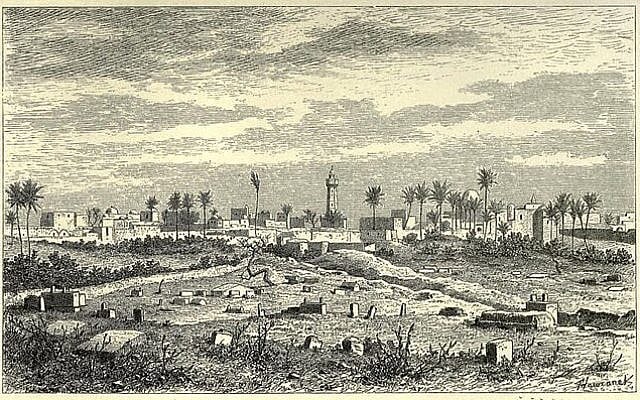
Great Again?
Gaza’s past comprises some four millennia. It’s been a major trade hub along land and sea routes alike, and its situation along the eastern Mediterranean coastline affords it tremendous potential for the tourism and hospitality industries as well as commercial and residential real estate development opportunities. A review of the historical record makes plain that it was commerce, education, and responsible government that made Gaza great before, not just once but repeatedly, and suggests that these same elements will be requisites in the worthy endeavor of making the city thrive once more.
Related Topics