
The perpetual cyberabbi!
When Jewish Life Becomes Content
I belong to a generation that began college before personal computers. I learned to use one in graduate school. A few years later came the internet. Since then I have watched technology move from something we occasionally used to something woven almost invisibly into everyday life. Today I publish digitally, stream services, edit video, communicate instantly across continents, and increasingly work alongside artificial intelligence in ways I could not have imagined when I entered college. I am grateful for all of it. But gratitude does not relieve us of the obligation to ask what these technologies are doing to us.
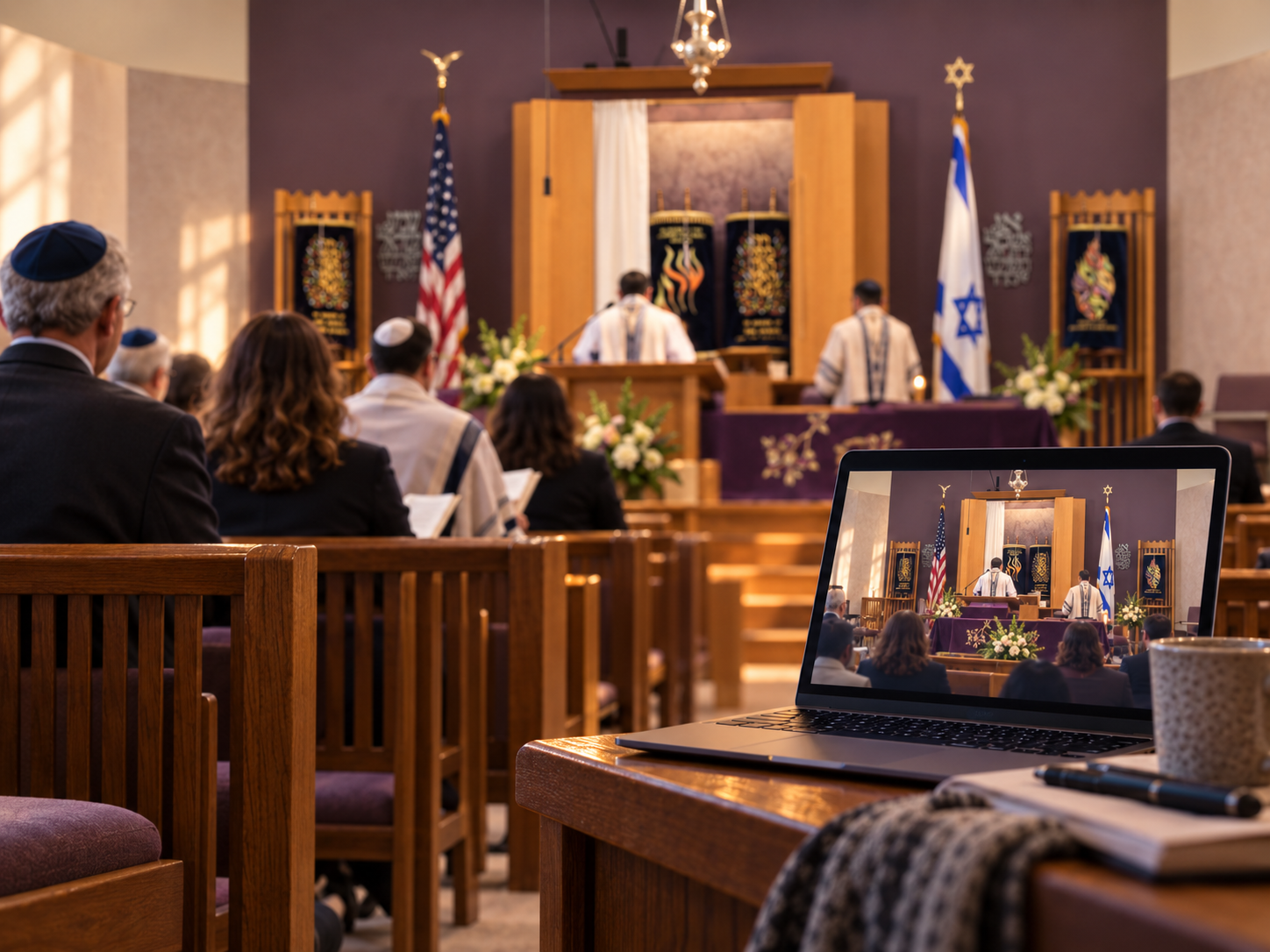
That question became unusually personal for me during the High Holiday season we have just completed. Our congregation, like many others, streams its services. For the homebound, the ill, those traveling, and people who simply cannot be physically present, that technology is a genuine blessing. It allows someone who might otherwise be excluded to see familiar faces, hear familiar melodies, listen to Torah, and remain connected to a community that matters to them.
This year, however, we noticed something else. The number of people physically present in our sanctuary declined substantially, while the number connecting electronically increased. At first glance, that might sound encouraging. Perhaps participation had simply migrated from the pew to the screen. Then I looked at another number. The average online viewer stayed with us for approximately fourteen minutes. Fourteen minutes during services that lasted several hours. I confess that number unsettled me. We cannot know what every viewer did after leaving our stream. Some may have returned later. Some may have had other obligations. But several of us wondered whether we were witnessing something different from remote participation. Were people browsing Jewish worship?
One congregation may have magnificent music. Another may feature a compelling sermon. Another may offer a more traditional liturgy, a shorter service, a famous cantor, or simply a more entertaining experience. Without leaving home, someone can move from one electronic synagogue to another as easily as changing channels. And suddenly I found myself asking an uncomfortable question:
Have we allowed the synagogue to become another form of content?
I do not ask that dismissively. I understand the attraction. I use these technologies myself every day. But Judaism has never understood communal prayer primarily as something to be consumed. A congregation is not an audience. A minyan is not a viewership statistic. And a shaliah tzibbur is not merely a performer delivering religious content to customers.
The shofar offers an especially revealing example. A person watching our Rosh Hashanah service online may hear the shofar beautifully through excellent speakers.
Yet according to the halakhic position our congregation follows, and that of many poskim, hearing an electronically reproduced shofar does not fulfill the mitzvah in the ordinary course. The obligation is to hear the actual sound of the shofar, which is why many of us make a point of visiting those who cannot come to synagogue and sounding it for them in person. Technology can bring them the service. It cannot always bring them the mitzvah. There is a lesson in that distinction. Sometimes physical presence is not an inconvenience surrounding the religious act. It is part of the religious act. And worship is only one place where this question now appears.
Consider Jewish education. For a Jewish child growing up in a military family stationed far from a synagogue, an online Hebrew school may be transformative. Technology can provide access where geography would otherwise make Jewish education almost impossible. But what about the child who lives twenty minutes from a synagogue and receives all Jewish instruction through a screen? The lessons may be excellent. The Hebrew may be learned. The prayers may be mastered. But what is not being learned? That child does not walk through the synagogue doors each week. There are no other Jewish children sitting nearby. There is no hallway conversation, no accidental encounter with the sanctuary, no teacher noticing something that has nothing to do with the lesson.
The same distinction between instruction and formation becomes especially visible in bar and bat mitzvah preparation. In many congregations, bar and bat mitzvah tutoring has done more than teach trope and pronunciation. A student spent months in the office of a cantor or rabbi. A relationship developed. Questions surfaced. The child gradually became familiar with people who embodied Jewish learning and communal responsibility.
Online instruction can transmit skills remarkably efficiently. But Judaism is concerned with more than instruction. It is concerned with formation.
The concern becomes even sharper around lifecycle events. Families today can find someone online who describes himself or herself as a rabbi, cantor, officiant, or Jewish spiritual professional. The ceremony can take place almost anywhere. A Torah can be obtained. A huppah can be erected. A service can be created around the preferences of the family. The problem is not that the ceremony occurs outside a synagogue building. Jews have celebrated sacred moments in homes and outdoors for centuries. The deeper issue is relationship and accountability.
Who trained the officiant? To whom is that person accountable? What standards guide the conversion process? Who accompanies the family after the ceremony is over? Where does the child return after the bar mitzvah photographs have been taken? Who visits when illness comes? Who sits beside the family during shiva? A synagogue is not merely a vendor of Jewish ceremonies. It is supposed to be a kehillah, a community.
That community also creates something less visible but no less important. It is one of the places where Jews meet other Jews, build friendships, develop relationships, form families, raise children, volunteer, argue, celebrate, mourn, and discover that Jewish identity is not something one practices entirely alone. When communal affiliation weakens, what is lost is therefore larger than attendance. An ecosystem weakens.
National surveys suggest how fragile that ecosystem can be. Among American Jews who attend services only a few times a year or less, 57 percent say they are simply not interested, while 23 percent say they do not know enough to participate. Yet among those who attend at least monthly, 92 percent cite spiritual meaning and 87 percent a sense of belonging. That contrast should command our attention. The very things congregants say they value most, meaning and belonging, are precisely the things that are hardest to reduce to a stream.
Meanwhile, sustaining the institutions capable of providing them is becoming more difficult. A recent Jewish Federations of North America study estimated that Jewish communal institutions in the United States spent more than $1 billion on security in 2025. That is before maintaining buildings, paying educators, employing rabbis and cantors, hiring skilled Torah readers, producing serious worship, providing pastoral care, teaching children, and sustaining the countless structures through which Jewish community actually happens. These are not merely expenses. They are the infrastructure of Jewish continuity. And therein lies the paradox.
At precisely the moment when maintaining Jewish communal life has become more expensive and demanding, technology makes it increasingly possible to receive selected portions of that life without belonging to the institutions that sustain it.
We can hear the sermon without knowing the rabbi.
We can learn Hebrew without entering a classroom.
We can celebrate a lifecycle event without joining a congregation.
We can watch prayer without becoming part of the people praying.
None of this makes technology the enemy. The distinction I am struggling to understand is between access and substitution.
When technology allows someone who cannot reach the community to participate, it extends the community. When technology persuades someone who could enter the community that there is no longer any reason to do so, something different is happening. And eventually substitution can become disintermediation. We may discover that we have constructed a Judaism in which almost every religious service can be obtained individually, while the community that once connected those services to one another slowly disappears. This is where halakhah has an indispensable role to play.
Halakhah has survived for centuries not because it refused change, nor because it accommodated every innovation. Its strength has been its insistence on asking which forms protect essential Jewish purposes, and which forms may change so those purposes can continue to live.
Technology will continue presenting us with circumstances previous generations could not have imagined. The question cannot simply be, “Can we do this?” Nor can it only be, “Is this technically permissible?” We must also ask:
What kind of Jewish life will this practice create if it becomes ordinary?
Will streaming extend the sanctuary, or gradually empty it? Will remote education bring Judaism to children who otherwise could not reach it, or teach those who can that Jewish learning requires no Jewish community? Will technology strengthen belonging, or transform belonging into a subscription we can cancel whenever something more interesting appears on another screen?
I do not want to return to a world before these technologies. They have enriched my life and my rabbinate enormously. But neither do I want Judaism to become an endless menu of religious content available on demand. A synagogue should be accessible. It should also ask something of us. Because the purpose of halakhic adaptation is not simply to make Judaism easier to live with. It is to ensure that Judaism remains something we actually live together.
Related Topics
Related Posts