When Power Becomes a Show, It Turns Against Itself
There is something profoundly revealing, however troubling, about the current standoff between Israel’s Minister of National Security, Itamar Ben-Gvir, and the country’s legal institutions. This is not a legal dispute, nor even a clash of political views. It is far more basic, and thus more dangerous: an absolute dismissal of the simple principle that elected power must be constrained by institutional roles.
Ben-Gvir is not disputing specific legal allegations. He denies that anyone has the authority to define, review, or limit his role altogether. In his view, being elected confers exclusive ownership of the office and immunity from what he deems “political” criticism.
Under such a “democracy,” the Attorney General, the Supreme Court, and professional norms become obstacles. Not legitimate oversight mechanisms, but barriers to unlimited power that must be brushed aside. There is only one mandate – that of the elected official.
Not a legal argument. Simply reinventing democracy.
The facts themselves are straightforward. Israel’s Attorney General has repeatedly warned that the minister is acting beyond his authority by directly engaging in operational law-enforcement activities. She formally demanded that the prime minister intervene. When he declined, she turned – following standard democratic procedure – to the Supreme Court, requesting that it require the prime minister to explain why he had not acted. A minor inconvenience in authoritarian systems, perhaps, but an essential mechanism of accountability even in semi-functioning democracies.
As usual, the public debate has shifted to emotionally convenient discussions. Rather than engaging with the institutional question, the discourse gravitates toward a unified governmental narrative: unelected bureaucrats are usurping the will of the voters; legal elites are staging a coup; democracy itself is jeopardized.
What this narrative carefully avoids is any discussion of what governance actually requires. But governance is more than comfortable slogans and social media posts.
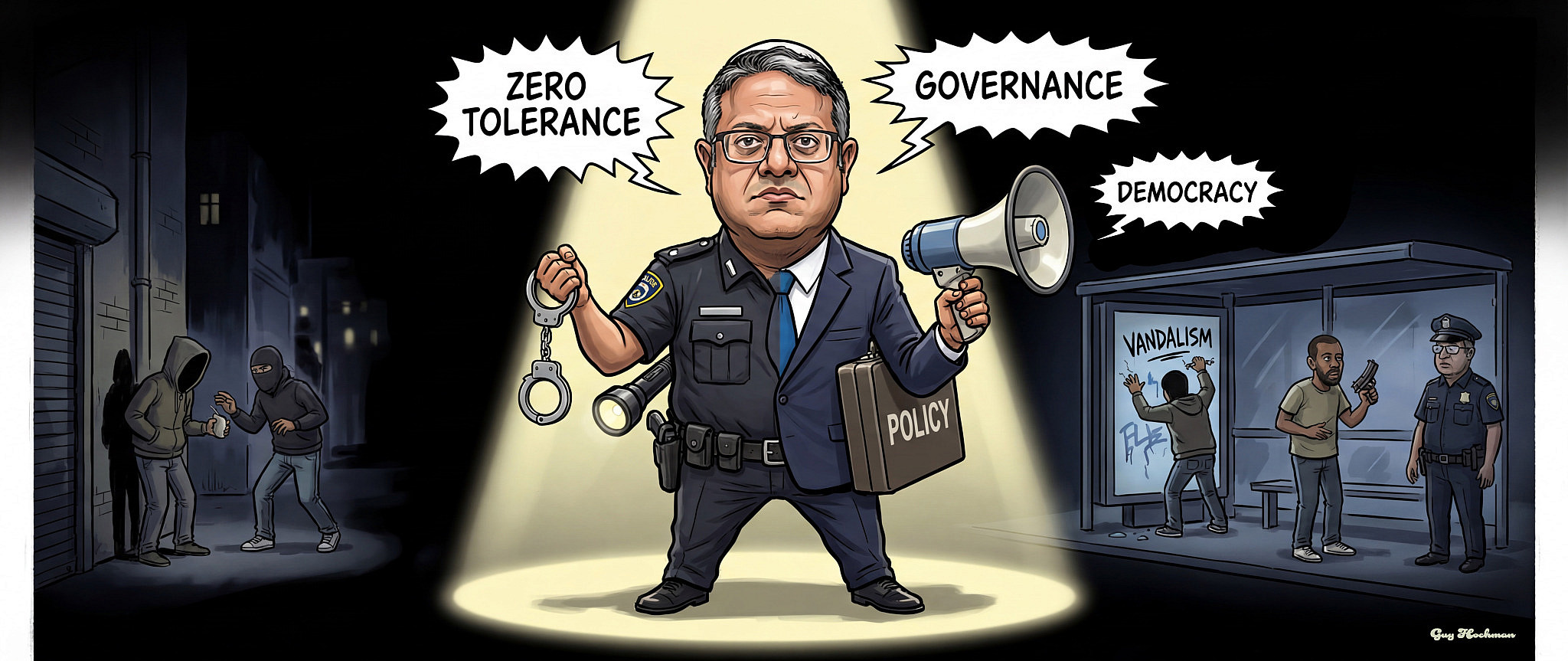
A recent show, documented and shared by Ben-Gvir himself, speaks louder than any argument. A surprise nighttime inspection at 2:42 a.m., conducted by the minister to ensure that his “zero-tolerance” policy is properly enforced during a formal police operation. A carefully worded caption accompanying a dramatic image that screams “true governance.”
Not a criminal smoking gun. But nonetheless, an unintentional confession to the logical failure of the government’s claim. The minister himself provides evidence that he proudly disregarded the rule and the limits of his authority.
Democracies can survive controversies, but not persistent defiance. Especially after the warnings, clarifications, and explicit instructions to stop. Which were answered by more revealing posts. At that point, it’s clear the problem is functional incompatibility rather than political prosecution.
The point is simple. Policymakers are not meant to design policy during the day and execute it at night. Execution must be entrusted to professionals who are both qualified and structurally insulated from political interests.
Proper systems practice this principle. Ministers of defense do not conduct surprise inspections during night raids. Ministers of finance do not open doors at 2 p.m. to check tax collectors. And health ministers do not scrub in for emergency surgeries to observe how their policies are implemented.
Not because they lack concern, courage, or conviction. Not even because they lack expertise. But because the moment they do so, they can’t perform their job. Ministers who run operational work are neither “hands-on” nor better governors. They are absent from their post.
True leadership requires distance, restraint, and accountability. Implementation requires training, professionalism, and field experience. Blurring the two does not strengthen governance; it hollows it out.
This is why the claim that the controversy reflects an attempt by the legal system to override the voters’ will is deeply misleading. No one is trying to undermine a minister’s right to shape policy. The issue is whether they abandon their responsibility in favor of shows that photograph well and convey “power.” All while undermining institutional boundaries, providing neither voters’ will nor governance.
The irony runs deeper still. What is presented as an assertion of sovereignty is, in practice, a surrender of it. A system that redefines roles, blurs chains of authority, and puts on operational shows is not more sovereign. It is less governable.
Even just organizationally “sane” systems understand that those entrusted with coercive power must meet higher standards of restraint, role discipline, and legitimacy. That is why democratic systems draw clear boundaries between political leadership and the exercise of force. And that is why ignoring those boundaries is not a show of strength, but a warning sign.
Except the irony doesn’t stop there. The system did the opposite – entrusting responsibility for Israel’s national security to someone convicted on multiple counts related to extremist activity (which would have been called terrorism by Ben-Gvir, if made by an Arab). To a person legally banned from serving in the military or working in law enforcement.
The problem extends beyond any specific minister or policy. Entrusting national security policy to someone who is not even legally qualified to execute it, while justifying personal interventions in police operations as “lead by example,” cannot constitute proper governance. After all, no one would even consider putting very hungry cats among their pigeons.
The institutional absurdity is stunning. Yet any objection is immediately recast as an assault on democracy itself, a violent overturning of the voters’ will.
Our ideology or political views don’t matter. Understanding that roles exist for a reason, and that power exercised without discipline is a dangerous show, not governance, does.
The tragedy is not that we applaud the show. It is that we fail to realize that in such democracies, governance becomes nothing more than that.