When Rav Kook Met President Calvin Coolidge
Rabbi Abraham Isaac Kook—the first Ashkenazi chief rabbi of Palestine—was famous for harmonizing the secular and the sacred and for his love of all humanity. But did you know that this posek, poet, bridge builder, theologian, and educational visionary also traveled to North America late in his life—and even met President Calvin Coolidge?
In the spring of 1924, Rav Kook embarked on an eight-month fundraising and diplomatic mission across North America. Known historically as the Delegation of the Rabbis, the trip proved to be a significant moment for American Orthodoxy, European yeshivot, and the early Zionist movement.
Following World War I, Jewish communities and yeshivot in Eastern Europe were facing severe financial difficulties. At the same time, the growing Jewish community (yishuv) in Palestine urgently needed financial support to build infrastructure and sustain its religious and educational institutions.
The Central Relief Committee (CRC) in America organized a high-profile emergency campaign to raise $1 million—an enormous sum of money at the time—to help rescue hundreds of Torah institutions across Europe and Palestine. The delegation ultimately raised a little more than $300,000.
To lead this campaign, the CRC brought together three of the era’s most prestigious rabbinic leaders: Rav Avraham Yitzchak haKohen Kook, Chief Rabbi of Palestine; Rav Moshe Mordechai Epstein, Rosh Yeshiva of the famed Slobodka Yeshiva; and Rav Avraham Dov Baer Kahana Shapiro, Chief Rabbi of Kovno and president of the Agudat haRabbanim of Lithuania.
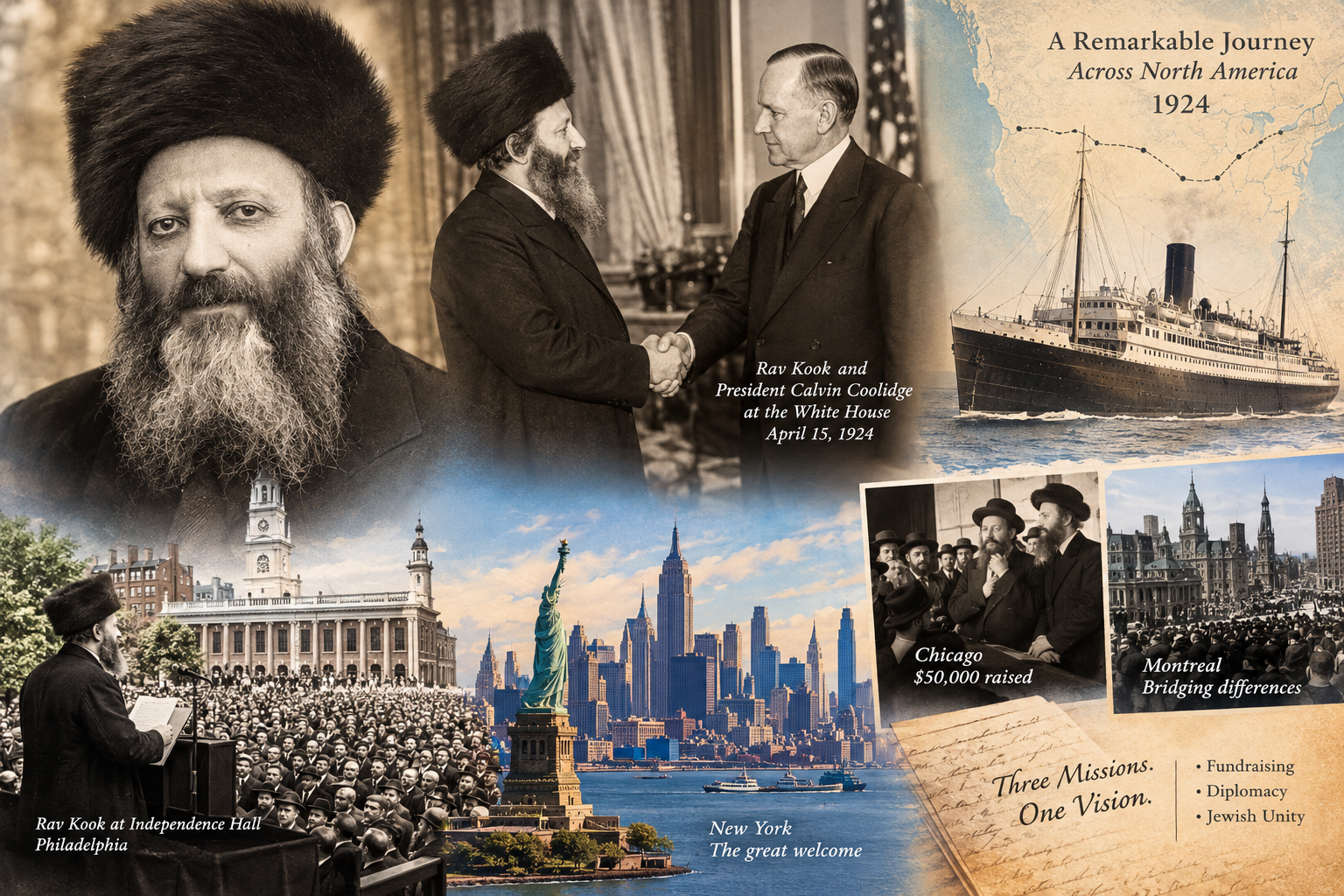
When the ship carrying the delegation arrived in New York Harbor in March 1924, it was greeted with tremendous enthusiasm. Hundreds of Jewish leaders welcomed the rabbis, and Mayor John F. Hylan arranged an official city reception. Accompanied by a motorcycle escort and a 50-car motorcade, the rabbis were formally welcomed at New York City Hall.
In April 1924, the delegation traveled to Washington, D.C., where President Calvin Coolidge received Rav Kook and the delegation at the White House. It was a rare honor to be granted a formal audience with a sitting U.S. president.
In his message to the president, Rav Kook expressed gratitude for America’s support of the Balfour Declaration and the establishment of a Jewish National Home in Palestine. He praised America as a haven of liberty and religious freedom. President Coolidge, in turn, expressed America’s friendship and support for Jewish humanitarian needs.
In addition to meeting President Coolidge, Rav Kook met with prominent American political figures, diplomats, and international representatives, including the British ambassador to the United States, to discuss Jewish rights and the future of Palestine.
After visiting the nation’s capital, the rabbinic trio toured major Jewish centers, including Montreal, Pittsburgh, Cleveland, Detroit, Philadelphia, Baltimore, and Chicago. Everywhere they went, they addressed packed synagogues, community gatherings, and mass rallies.
His visit to Montreal was especially interesting. The Orthodox community there was embroiled in a serious dispute over kashrut and communal authority. Rav Kook stepped in as an intermediary between opposing rabbis, including Rabbi Yehudah Yudel Rosenberg and Rabbi Hirsh Cohen. He succeeded in bringing the opposing rabbis together for a face-to-face meeting, and the atmosphere subsequently changed dramatically.
While in Philadelphia, Rav Kook spoke at Independence Hall, invoking the American ideals of freedom and equality. He connected the American conception of liberty with the Jewish people’s hopes for Zion. There is something particularly striking about that image: the Chief Rabbi of Palestine, standing in Independence Hall in 1924 and speaking about Jewish national renewal in the language of liberty.
And in Chicago, the delegation raised more than $50,000. Rav Kook also delivered a shiur at Hebrew Theological College.
The American press was fascinated by Rav Kook. One non-Jewish reporter, apparently struggling to find an American equivalent for the office of Chief Rabbi of Palestine, referred to him as “the Jewish pope.” The comparison was obviously inexact, but it gives us a sense of the public curiosity surrounding this remarkable visitor.
Interestingly, the CRC deliberately made Rav Kook the principal spokesman for the delegation. The organizers recognized that his position as Chief Rabbi of Palestine gave the fundraising campaign an extraordinary emotional and symbolic appeal.
Looking back, Rav Kook’s 1924 American journey was really three trips in one:
1) A fundraising campaign to help save Torah institutions and Jewish communities devastated by World War I.
2) A diplomatic mission that included meetings with President Coolidge and the British ambassador.
3) A meeting between two emerging centers of Jewish life: Palestine and American Jewry.
Why was this historic trip so important?
There are several reasons.
Most importantly, the funds raised during the trip helped sustain European yeshivot during the interwar crisis, when many were struggling simply to keep their doors open. The campaign also contributed to the relocation of the Slobodka Yeshiva to Hebron in Palestine later that year—a crucial step in establishing prestigious Torah centers in the Holy Land.
In addition, by engaging directly with the president of the United States and foreign diplomats, Rav Kook brought international attention to the newly established Chief Rabbinate of Palestine and its role in representing the Jewish community.
American Orthodoxy in the 1920s was fragmented, and American Jewish religious life was often overshadowed by the great centers of Torah scholarship in Europe. The presence of these world-renowned rabbinic figures provided an enormous moral boost to American Orthodox Jews and highlighted the importance of supporting Torah education and communal institutions.
By the end of the journey, Rav Kook had come to recognize America as an increasingly important center of Jewish life. He compared the relationship between America and Palestine to the ancient relationship between Babylonia and Eretz Yisrael. He had arrived expecting to appeal to American Jews for help; he left with a much greater appreciation of the importance of American Jewry itself.
Finally, the trip offered a powerful example of Jewish unity. Rav Kook, of course, was a passionate religious Zionist, while his fellow delegates, Rabbis Epstein and Shapiro, came from traditional European yeshiva circles that did not share his Zionist outlook. Yet these three distinguished rabbis traveled together, raised money together, and advocated for Jewish communities together.
Their ability to work side by side despite their ideological differences demonstrated something both simple and profound: Jews who disagree on important questions can still come together in pursuit of a shared, sacred cause.
And that may be one of the most enduring lessons of Rav Kook’s remarkable journey to America a century ago.