When Senate Candidate Angie Nixon and I Found Common Ground
A Conversation About Our Ancestors, Shared History, Israel, and the Future
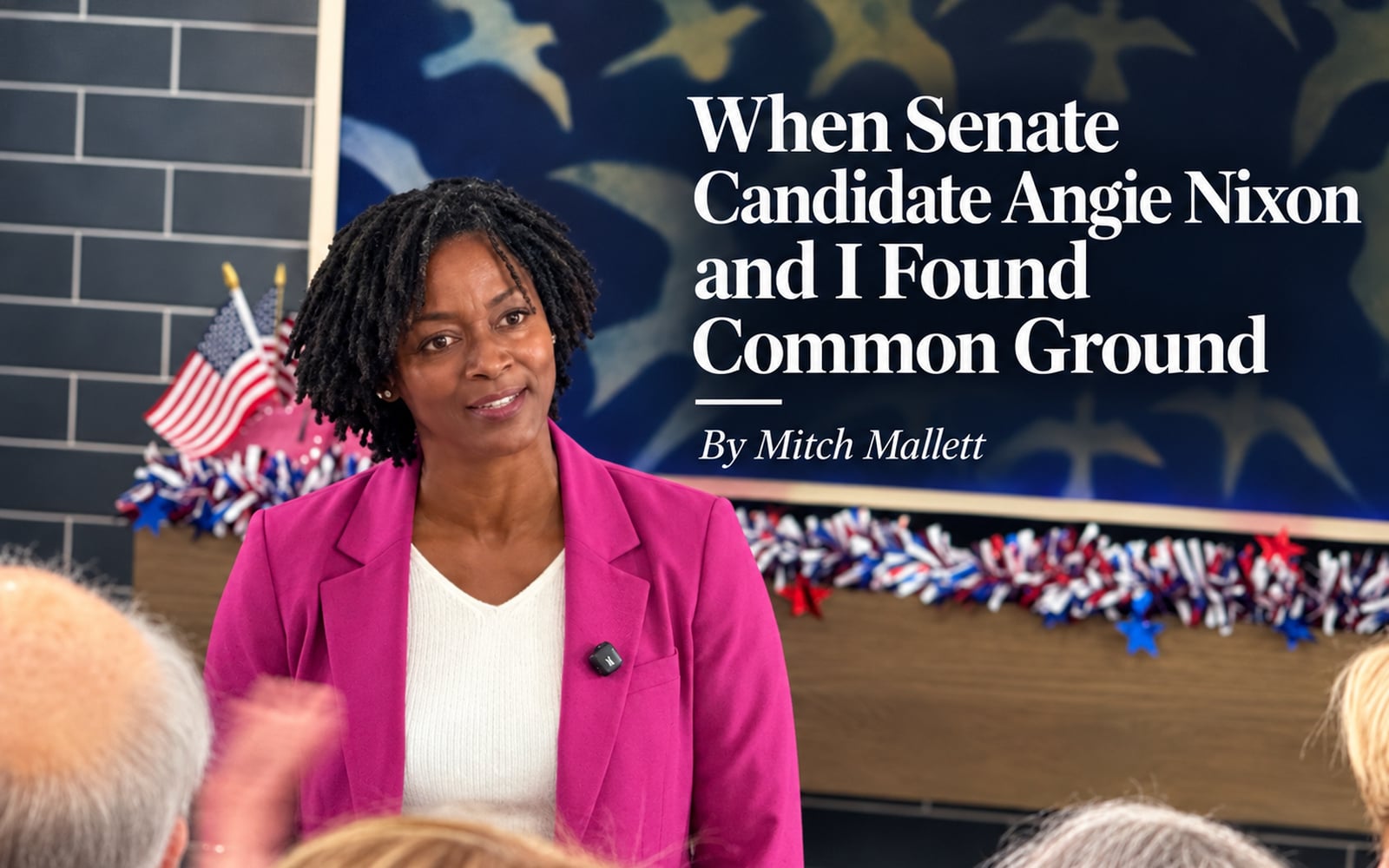
What began as a political reception in Sarasota, Florida, became an unexpected moment of understanding between Florida Senate candidate Angie Nixon and me. Through a conversation about our ancestors, the African American and Jewish experiences, and the importance of historical memory, we discovered common ground that went far beyond politics.I walked into a political reception Thursday evening hoping for the best. I left feeling that the outcome was better than I had expected.I had gone to meet Angie Nixon, a Democratic candidate for the Florida Senate, hoping to have a conversation about Israel, the rise of antisemitism in America, and the concerns of Florida’s Jewish community.
As a lifelong liberal Democrat and Zionist, I already knew Angie and I shared many values on civil rights, women’s rights, and economic justice. But some of her comments during the primary had concerned me. I was also troubled by the growing hostility toward Israel within the DSA and the sense of isolation many Jewish Americans were feeling. I wanted to understand how Angie viewed those issues and whether she understood the historical experiences that make Israel and Jewish identity so deeply personal to so many of us.
For several weeks, I had been thinking about what I wanted to say to her and how I might approach the conversation. I expected I might have an opportunity to speak with her privately.
Instead, something happened that I had not anticipated.
Before more than 70 people gathered at a private home, in Sarasota, Florida, Angie said something during her speech that brought together many of the thoughts I had been struggling to express.
And when I responded, we experienced what I believe was a genuine moment of understanding.
It was a moment that reminded me of the long relationship between African Americans and Jewish Americans, two communities whose histories have been shaped by persecution, survival, and the determination to create a better future for their children.
Angie said “I Are Living Our Ancestors’ Dreams” “We Are Living Our Ancestors’ Dreams”
During her remarks, Angie spoke about her African American ancestry.
She described herself as a descendant of enslaved people and spoke about the generations who endured slavery, discrimination, and oppression so that their descendants might someday live better lives.
She reminded us that we are living the dreams of our ancestors.
Then she expanded that thought, observing that all of us are descendants of people who had their own experiences, struggles, and hopes for future generations.
As I listened, I began thinking about my own family history.
I am a descendant of Jews who survived the pogroms of Eastern Europe.
Many American Jews share that history. Others are descendants of Holocaust survivors. Some families carry the experiences of both.
Our parents, grandparents, great-grandparents, and great-great-grandparents endured persecution or escaped from it. Countless relatives did not survive.
And those of us here today are the descendants of those who did.
We are living our ancestors’ dreams, as well.
It occurred to me that Angie had just provided the perfect opportunity to explain something I believe many Americans do not fully understand about the Jewish people.
Why, with the dramatic rise in antisemitism in America, do so many Jews feel increasingly isolated and vulnerable?
Why does Israel mean so much to us?
The answers are deeply rooted in our shared historical experiences.
For generations, Jews knew what it meant to have nowhere to go, no country willing to accept them, and no refuge when persecution threatened their lives.
With Israel, the Jewish people now have a homeland and a place of refuge.
That does not mean all Jews agree with the policies of every Israeli government. I certainly do not.
But it does mean that Israel’s existence carries a historical and emotional significance that cannot be understood simply through today’s political arguments.
And I realized that Angie had just explained something about the African American experience that I could connect directly to the Jewish experience.
I did not need to recount centuries of Jewish history.
Just as Angie did not need to describe every chapter of slavery and segregation for her audience that night, to understand what those experiences meant, I did not need to explain every pogrom or every horror of the Holocaust.
The history was implied. I believe the whole room understood.
The shared experience was the point.
A Conversation I Hadn’t Planned
When Angie finished speaking and opened the floor for questions, I raised my hand. I was told I would be the last question.
I introduced myself as president of the Sarasota-Manatee Democratic Jewish Caucus and a member of the Florida Democratic Jewish Caucus State Board.
I began by telling Angie that I supported her on the domestic social issues she had discussed. Our views on civil rights, women’s rights, economic opportunity, and social justice were closely aligned. I did not list them; they were implied.
I also told her that I had been encouraging members of our caucus to vote for her.
Then I returned to her remarks about ancestry.
I explained that when she spoke about being descended from enslaved Africans, and how we are living our ancestors’ dreams, I immediately thought about my own ancestry and the history shared by so many American Jews.
We the Jews are descendants of survivors.
We carry the memory of pogroms, the Holocaust, persecution, displacement, and generations who had nowhere to run.
And that shared historical experience helps explain why Israel is so important to us and why the rise of antisemitism has become so troubling and overwhelming for many Jewish Americans.
I was not trying to compare whose ancestors had suffered more.
I was recognizing that our communities had experienced different histories of oppression that left us with a common understanding of vulnerability, survival, and the importance of security and freedom.
I deliberately kept my remarks brief.
I could easily have spent fifteen minutes discussing Jewish history, the Holocaust, Israel, and the relationship between our communities.
But I did not want to stand there delivering a lecture.
Angie had made her point beautifully, and I wanted to use her own words to make mine.
What followed was more meaningful than anything I could have prepared in advance.
Angie’s Response
When I finished speaking, I did not know how Angie would respond.
She looked directly at me and began talking about the historical relationship between African Americans and Jewish Americans, which I believe most in the room were familiar with. I was.
She acknowledged how our two communities have supported one another over more than a century, particularly during the long struggle for civil rights.
And she made clear that she had not forgotten that history.
I was genuinely and quietly thrilled to hear her say that.
There was a time when Jewish immigrants and their descendants, many of whom had fled persecution in Europe, were beginning to find greater acceptance in American society.
As Jews gradually gained opportunities that had previously been denied to them, many could have concentrated exclusively on securing their own place in America.
But important elements of the American Jewish community recognized the oppression that Black Americans continued to endure.
Jewish leaders, organizations, and ordinary citizens became involved in the struggle for civil rights, working alongside African American leaders and communities.
I believe many Jews recognized something familiar in the struggle of African Americans.
Our own history had taught us the dangers of discrimination and exclusion.
Working together offered the possibility of a safer, more just, and more accepting America for both communities.
I did not have to recount that history to Angie, nor did she have to recount it to the room. We all understood.
When she began speaking about the relationship between our peoples, I knew she understood the connection I was making.
And then came the moment that has stayed with me.
As Angie finished responding, she was looking directly at me.
I looked back at her.
For a moment, we held each other’s gaze, and I nodded my head in agreement.
I felt a genuine connection.
I cannot speak for everything Angie was thinking, but I know what I felt.
We had found common ground in the shared experiences of our ancestors.
And in that moment, I felt that she was connecting not simply with me, but with the Jewish history and community I had come there to represent.
We had far more in common than we had differences.
Two Articles I Wrote With Angie in Mind
Before concluding my remarks, I also told Angie about two articles I had published in The Times of Israel over this past week.
I explained that I had written both with her in mind, hoping they might offer perspectives she had not fully considered.
The first, published on October 7, 2026, is titled Free the Palestinians: The Questions We Avoid That Could Lead to Regional Peace.
I did not attempt to summarize the entire article at the reception. There simply wasn’t time.
Instead, I encouraged Angie, and everyone else present, to read it.
The article offers what I believe is an alternative path forward for Israelis and Palestinians, one that moves beyond the familiar arguments and explores regional peace, Palestinian dignity, economic opportunity, and genuine freedom of choice. To move forward, we need to change the narrative. I hope Angie and others embrace this. The article asks questions that I believe need to be asked. Let the conversation begin.
I believe Palestinians deserve the freedom to determine their futures, including meaningful opportunities to remain in their communities or voluntarily pursue lives elsewhere, without coercion or restriction.
I also believe they deserve a future free from jihadist rule.
Iran’s regime has supported Hamas and other armed Islamist jihadist movements, and I regard that influence as a major obstacle to peace.
In my view, there is no future of genuine freedom for Palestinians under the domination of jihadist movements backed by Iran, just as there is no future of genuine freedom for the Iranian people under the rule of their own jihadist repressive regime.
The Palestinian people deserve better.
So do the people of Iran.
And so do Israelis, who deserve to live without the constant threat of terrorism and war.
My article asks readers to consider alternatives that could create a better future for everyone involved. A live link is found at the end of this article.
The second article examines how Americans’ perceptions of Israel have changed, the role of competing narratives and propaganda, and why so many Americans have failed to understand the events following October 7, 2023.
It also addresses the troubling rise of antisemitism and why that hostility has been so deeply unsettling to American Jews.
I explained that I hoped Angie would read both articles.
She told me she would.
After the formal discussion, we spoke briefly again, and she repeated her willingness to read them.
I was grateful for that.
I went to the reception hoping to open a dialogue and offer information that might contribute to Angie having better understanding. Goal achieved.
A Candidate’s Journey
As I drove home, I continued thinking about what had happened.
A political campaign is a learning experience.
Candidates begin with their own backgrounds, convictions, experiences, and priorities. But as a campaign progresses, they meet people from many different communities, listen to their concerns, and gain a broader understanding of the people they hope to represent.
The issues that excite a candidate at the beginning of a campaign are important.
But so are the concerns of the people they encounter along the way.
And if elected, a senator has a responsibility to represent all the people of the district, including communities whose experiences may be quite different from the candidate’s own.
Through my conversations with fellow members of the Florida Democratic Jewish Caucus, some of whom have also met with Angie, and through my own experience at the reception, I have developed the impression that Angie has been listening and learning.
I sense that she has grown during this campaign.
That is my personal assessment, and I hope it is correct.
I believe the concerns of Jewish Americans deserve serious consideration, particularly at a time when antisemitism has become increasingly visible, troubling and hostel.
I also believe that understanding the Jewish people’s historical connection to Israel can help political leaders develop a more complete understanding of the Israeli-Palestinian conflict.
That does not require abandoning concern for Palestinian civilians or their legitimate aspirations.
Quite the opposite.
I believe a better understanding of both peoples’ histories and circumstances is essential if we hope to move toward a peaceful future.
And I hope Angie will continue considering these perspectives as her campaign enters its final weeks, as well as she enters the US Senate.
Better Than I Expected
Following the reception, several people approached me to discuss what I had said.
Some were Jewish attendees. Others were interested in the subjects I had raised and the articles I had written.
What had begun as a conversation between a candidate and one member of the audience had been heard by more than 70 people.
I had expected an opportunity for a private discussion.
Instead, the exchange became a public moment of understanding.
When I returned home Thursday evening, I began writing this article while the experience was still fresh in my mind.
I wanted to capture what had happened, not turn it into something larger or more dramatic than it was.
Because what happened was meaningful enough on its own.
Angie spoke about her ancestors.
Her words reminded me of mine.
I explained that connection.
She responded by recalling the long history of cooperation between African Americans and Jewish Americans.
And for a moment, looking directly at one another, I felt that we understood each other.
When I introduced myself to Angie that evening as president of the Sarasota-Manatee Democratic Jewish Caucus, I told her that I had been urging our members to vote for her. I felt comfortable making that statement then.
Now, reflecting upon the evening and the exchange we shared, I feel even more confident and enthusiastic about having said it.
My hope, and indeed my prayer, is that when Angie is called upon to cast votes, shape legislation, and participate in public policy, she will remember that the Jewish people are not simply a religious community. We are also a people, an unique ethic group with a shared history, heritage, and identity.
And just like African Americans, Palestinians, and every other ethnic group, the Jewish people deserve the same dignity, equity, understanding, and respect.
That is what I hope Angie takes away from our conversation. Not that she must agree with me on every question concerning Israel, but that she understands the Jewish experience and gives it the same thoughtful consideration she gives to the histories and aspirations of other peoples.
I hope Angie reads the two articles I shared with her as wll as this one. I hope they contribute to her understanding of the Jewish experience, the concerns of American Jews, and the possibilities for a better future for Israelis and Palestinians.
Based on what I experienced Thursday evening, I am optimistic.
I believe Angie has the potential to become a great U.S. senator from Florida.
And I hope the connection we made is one she will remember.
Because sometimes the most meaningful political conversations do not begin with an argument.
They begin when we recognize our own history in someone else’s story.
The Two Articles I Encouraged Angie to Read
- Free the Palestinians: The Questions We Avoid That Could Lead to Regional Peace
 Imagine just a few years from now: the Abraham Accords have expanded, Israelis, Palestinians and Arab nations are building a shared regional economy, and new communities are rising from the desert with homes, schools, farms, businesses, clean energy and modern infrastructure. Peace is no longer just a diplomatic promise. It is something people are building, investing in and living every day.
Published October 7, 2026 — The Times of Israel
- October 7: The Fight for Israel Has Come to America
 Since October 7, 2023, the battle over Israel’s image has intensified across America, dividing longtime friends, political allies, and communities. Understanding how those divisions developed is the first step toward bridging them. עם ישראל חי
Published October 13, 2026 — The Times of Israel
https://blogs.timesofisrael.com/october-7-the-fight-for-israel-has-come-to-america/
Additional article of mine about the “Pogroms” Jewish Experience
- If I Stay, There’ll Be a Jew; In 1891, my great-grandfather Nissan Meyerson awoke to a pogrom. He fled Russia and came to America, but instead of entering through Ellis Island, he arrived at the immigration center in Sag Harbor aboard only the second immigrant ship to land there. When it was time to board the train for New York City, he looked around and said, “It’s beautiful here.” He stayed, helped establish Temple Adas Israel, and carved the ark that still stands there today. Many American Jews whose families arrived between the 1880s and the early 1920s have a similar story. Our ancestors escaped persecution, crossed an ocean, began again in unfamiliar places, and built the Jewish communities that became our inheritance. Every family history begins with a decision. His was simple: “If I stay, there’ll be a Jew.”
Published August 4, 2026 — The Times of Israel
https://blogs.timesofisrael.com/if-i-stay-therell-be-a-jew/
For readers interested in a deeper understanding of the shared Jewish experience that I discussed with Angie, I invite you to read an earlier article I wrote, If I Stay, There’ll Be a Jew.
The article explores the legacy of Jewish persecution, the pogroms, and the determination of generations of Jews to preserve their identity and ensure the survival of the Jewish people.
It offers additional historical context for understanding why antisemitism remains such a deeply personal concern for Jewish families and why the existence of Israel carries such profound meaning.
It also helps explain why Angie’s words about living our ancestors’ dreams resonated so deeply with me.
Mitch Mallett is president of the Sarasota-Manatee Democratic Jewish Caucus, serves on the Florida Democratic Jewish Caucus State Board, and is a contributor to The Times of Israel.