
Retired Board-Certified Clinical Psychologist/Author
When Survival Takes the Wheel
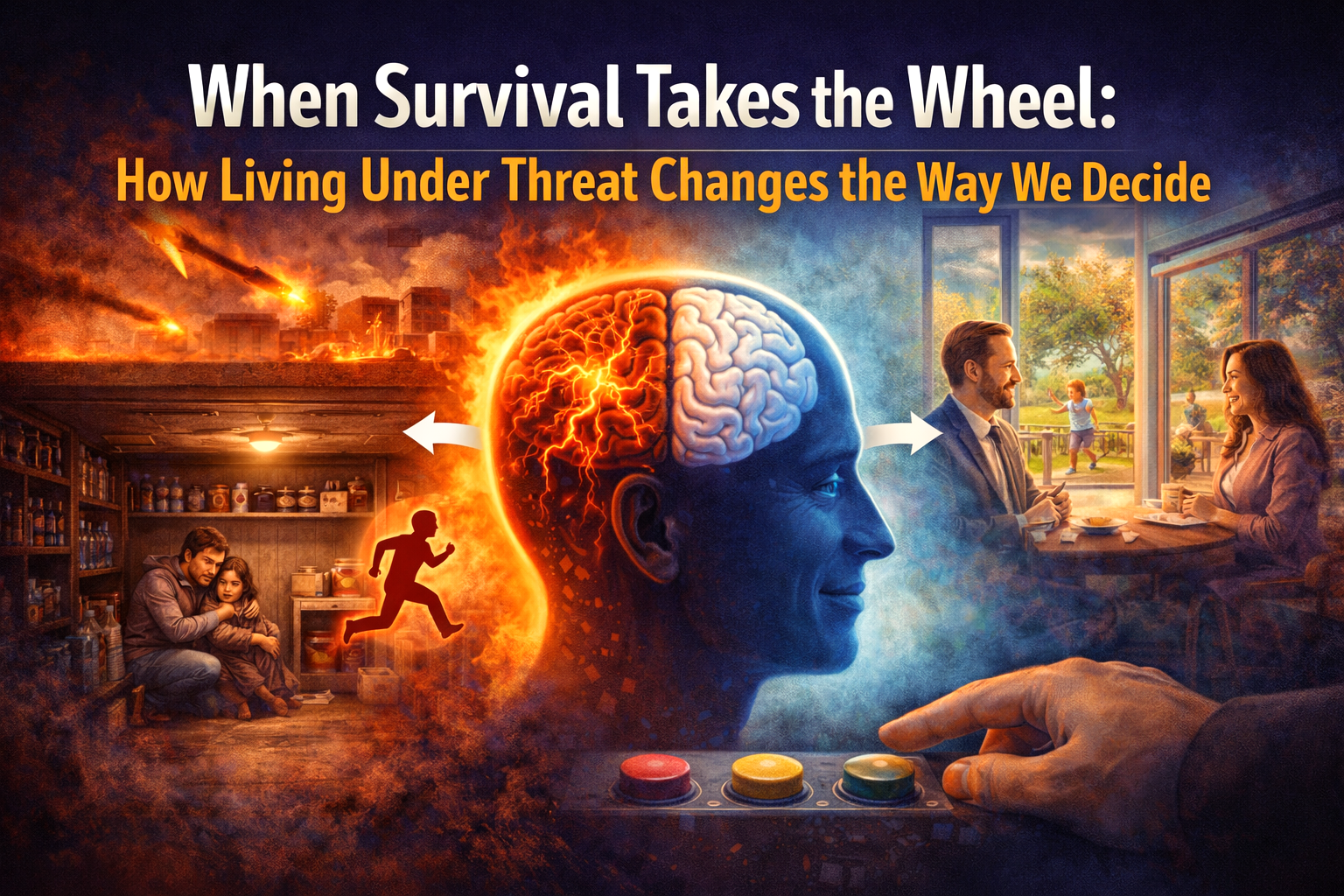
When Survival Takes the Wheel: How Living Under Threat Changes the Way We Decide
Next month, I will walk into a building in Budapest known as the Glass House. From the outside, it is unremarkable. But during the final months of the Holocaust, it became a place where thousands lived under constant threat — where survival depended on decisions made quickly, often without the luxury of reflection.
My mother was there as a young woman. From within those walls, she helped forge documents that saved lives. In one extraordinary moment, she pulled her younger brother out of a forced march toward the trains and brought him back to safety.
I have thought about that act many times — not only as an example of courage, but as a window into what happens to the human mind when hesitation is no longer an option, and when survival demands that decisions be made in an instant.
This is not only history.
In Israel today — and in other parts of the world where civilians live under ongoing threat — people are being asked, day after day, to function under conditions that are psychologically similar. Life continues. People work, raise children, maintain relationships. But internally, something shifts.
There is a particular kind of fatigue that comes from living this way. It is not just fear. It is the constant background awareness that something could happen — that safety is no longer fully reliable. You check your phone sooner. You listen more closely. You feel a quiet urgency in moments that once felt ordinary.
Over time, without necessarily realizing it, the way you make decisions begins to change.
The brain adapts to threat by becoming faster, more alert, and more sensitive to anything that might signal danger. The part of the mind that allows for reflection — for weighing options and considering long-term consequences — does not disappear, but it steps back. A more instinctive system moves forward.
This shift is protective. It is how human beings survive. But when threat is prolonged, the same adaptation begins to shape everyday decisions in ways that are less visible — and sometimes less helpful. People find themselves responding more quickly than they intended. Decisions are made just to move things along. Patience for uncertainty decreases. Reactions to situations that are ambiguous become stronger, more immediate. It may feel harder to pause. Harder to take a step back and ask: ‘Is this really what I want to do?’. This is not a failure of judgment. It reflects a mind that is carrying more than it was designed to carry over extended periods of time.
There is also a deeper strain that people often recognize only in hindsight: it becomes harder to filter — to hold back a comment, to sit with a feeling, to allow time for reflection. At other times the opposite occurs. People withdraw, avoid, or feel stuck.
Both are expressions of the same underlying reality: the mind is working in survival mode.And survival mode prioritizes immediacy over reflection, certainty over nuance, and action over pause.
This has real consequences — and there are specific areas of life where it is worth paying close attention.
Major decisions about work, finances, or long-term direction can quietly become more driven by the need to feel safer right now than by what is most appropriate over time. If such decisions are not urgent, giving them more time can make a meaningful difference.
Important conversations — especially those involving conflict or strong emotion — are also vulnerable. Under stress, it is easier to misread tone, to feel hurt more quickly, or to respond more intensely than intended. Timing matters more than we often realize.
Decisions made in the heat of strong emotion deserve particular caution. When something feels urgent and emotionally charged, it often feels like it must be addressed immediately. But that sense of urgency is not always a reliable guide.
A simple principle: ‘if a decision cannot easily be undone, it is worth waiting — if waiting is possible.’
And then there are the quieter decisions — the interpretations we make about other people. Under pressure, the mind is quicker to assume the worst. A neutral comment can feel critical. A delayed response can feel intentional. Simply slowing down these interpretations — even slightly — can prevent disconnection that doesn’t need to happen.
Not everything should be delayed. Daily routines, responsibilities, and ordinary decisions provide structure and a sense of stability. They are not the problem — they are part of what keeps us grounded.
What matters is not second-guessing everything. It is recognizing where the stakes are higher, and where your internal state may be influencing you more than you realize.
Over the course of my mother’s life, I came to understand something else.
When the war ended, not everything returned to what it had been before. Some aspects of her vigilance remained. Certain reactions were faster. The world never felt entirely predictable again. What had once been necessary for survival did not simply disappear — it became part of how she moved through life.
We now understand this far more clearly. The human mind does not reset when danger passes. It adapts — and some of those adaptations persist long after the threat itself has changed.
This is not pathology. It is the imprint of survival. But it also creates a responsibility. Because survival requires one kind of mind. Living fully requires another. And the transition between the two does not happen on its own.
The ways we think, react, interpret, and decide under prolonged threat can become deeply ingrained. Without awareness, what once helped us survive can quietly continue shaping our lives long after the level of danger has changed. Which is why awareness matters — not in a general sense, but in very specific ways.
- Noticing how quickly we respond. How we interpret others.
- How we make decisions under pressure.
- How often urgency replaces reflection.
These are not small things. They are the places where survival patterns live on.
If we do not consciously revisit how we think and respond after prolonged threat — in our decisions, our interactions, and our sense of safety — we risk continuing to live as though the danger is still fully present, allowing what was once adaptive to become permanently fixed.
Reclaiming balance is not automatic. It requires noticing, pausing, and at times deliberately choosing a different response. But that is not a step backward. It is how we move, gradually, from surviving — back to living.
–
Dr. Ivan Gulas, Board-Certified Clinical Psychologist Author of ‘Changing the Odds: A New Understanding of PTSD and the Path to Recovery’ and ‘Asylum Without Walls’
Related Topics