
When the Media Shapes the Battlefield
“Operation Epic Fury, Meet Operation Colossal Blunder.”
That headline, by Scott Anderson in The New York Times, condemning the war, is not an outlier. It reflects a broader tone that has defined much of the recent coverage of U.S. tensions with Iran.
Scan the media landscape and the pattern becomes clear: warnings of escalation, emphasis on internal divisions, projections of failure, and predictions of catastrophe before outcomes are known. On CNN, segments routinely lead with “what could go wrong.” On MSNBC, commentary often treats U.S. strategy as reckless from the outset. Even straight reporting tends to emphasize disagreement over objective. Fox News and conservative outlets have shown similar patterns in past conflicts, amplifying doubt about Democratic administrations’ military decisions with equal consistency.
Each of these elements, taken alone, is legitimate. Repeated daily, they form a consistent narrative; one that influences public opinion and frames American policy in terms of uncertainty, division, and doubt.
There is nothing un-American about questioning a war. But there is a difference between scrutiny and a steady narrative that signals failure before strategy has had time to unfold.
This signal is read abroad – in Tehran, Moscow, and Beijing – shaping our adversaries’ strategy to America’s disadvantage. Our adversaries do not need classified intelligence to assess American resolve. They rely on open sources: political debate, public commentary, and media coverage. When those signals consistently suggest uncertainty and hesitation, they shape strategic expectations and our adversaries adjust accordingly. Our enemy can simply wait for the US to fold. Patience becomes a weapon.
Media emphasis also influences public opinion. Research by Maxwell McCombs and Donald Shaw shows that the issues most emphasized in the media become the issues the public sees as most important. Polling reflects that environment.
This matters when polling is then used to judge the very policies that helped shape it.
A similar pattern appears in coverage of the economic impact—particularly fuel prices. Reports frequently highlight rising costs as a central consequence of foreign policy decisions. Those costs are real—but often presented without proportion.
While energy prices affect the broader economy, media coverage tends to focus on the price at the pump. Put in perspective, a rise from roughly $10.34 to $13.39 in weekly fuel expenses amounts to about three dollars per week for the average driver. Meaningful at the margin, yes but hardly the kind of shift that should dominate national strategic judgment.
Yet when presented repeatedly and prominently, even modest figures take on outsized importance. Concern rises, polling reflects that concern, and those same polls are then cited as evidence of widespread economic strain.
At this point, perception begins to drive narrative rather than reflect it.
This is where the distinction between the particular and the general becomes essential. The particular is immediate: prices, household budgets, short-term discomfort. The general is strategic: deterrence, stability, and long-term security.
Policy shaped primarily by the particular risks losing sight of the general.
That tension is reinforced by a cultural preference for individualism. Yet a functioning society requires a shared burden. For some, that burden is profound. For most, it is modest: absorbing inconvenience, accepting temporary costs, tolerating uncertainty. Freedom and Liberty—our defining ideals—exist only within a stable national framework. Yet increasingly, these modest economic burdens are elevated into primary arguments against our military engagement.
That shift aligns with a broader isolationist instinct: the idea that avoiding entanglement is inherently safer. But isolationism, taken too far, does not simply avoid conflict. It narrows perspective. It elevates immediate cost over long-term consequence.
Societies can become constrained by how narrowly they define their interests. When attention collapses entirely into immediate concerns, the capacity to think in broader terms weakens.
History offers a clear warning.
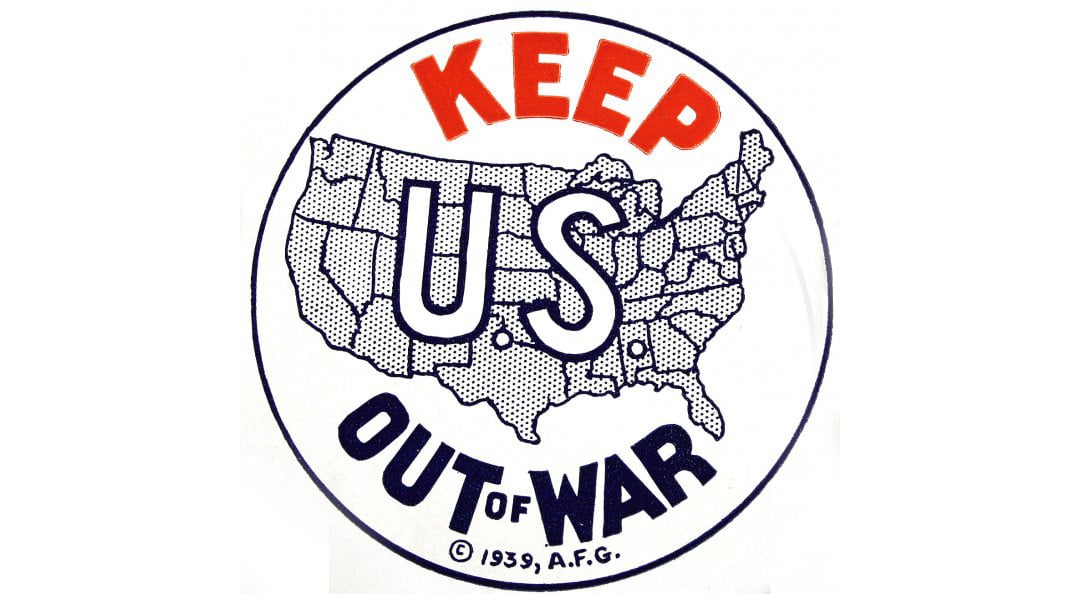
Before entering World War II, the United States pursued neutrality. It did not preserve stability; it delayed engagement until conditions deteriorated. Isolationist sentiment—including from the America First Committee, persisted until events made it untenable. American involvement ultimately proved decisive (see Richard Overy, Why the Allies Won).
None of this suggests that the press should align with government policy. It should not. Rigorous scrutiny of military strategy, casualty reporting, diplomatic failures, and executive decisions remains essential to democratic accountability. The issue is balance. Coverage that emphasizes doubt and cost without equal attention to strategy, objectives, and context risks distorting public understanding.
The best war reporting — from Ernie Pyle to the Pentagon Papers — has always combined unflinching honesty about cost with serious engagement with purpose. That standard asks not whether to question policy, but whether the questioning is proportionate, contextualized, and resistant to its own narrative momentum.
While isolationism can delay engagement, it does not eliminate the underlying threat. Nor does it offer a strategy for confronting it. It prevents involvement and in doing so, it risks sending a message—not just to Americans, but to their adversaries—that the United States is less certain, less patient, and less prepared than it actually is.
In war, that message is not commentary. It is leverage.