CEO of Time to Stand Up for Israel
When the Victim Becomes the Accused
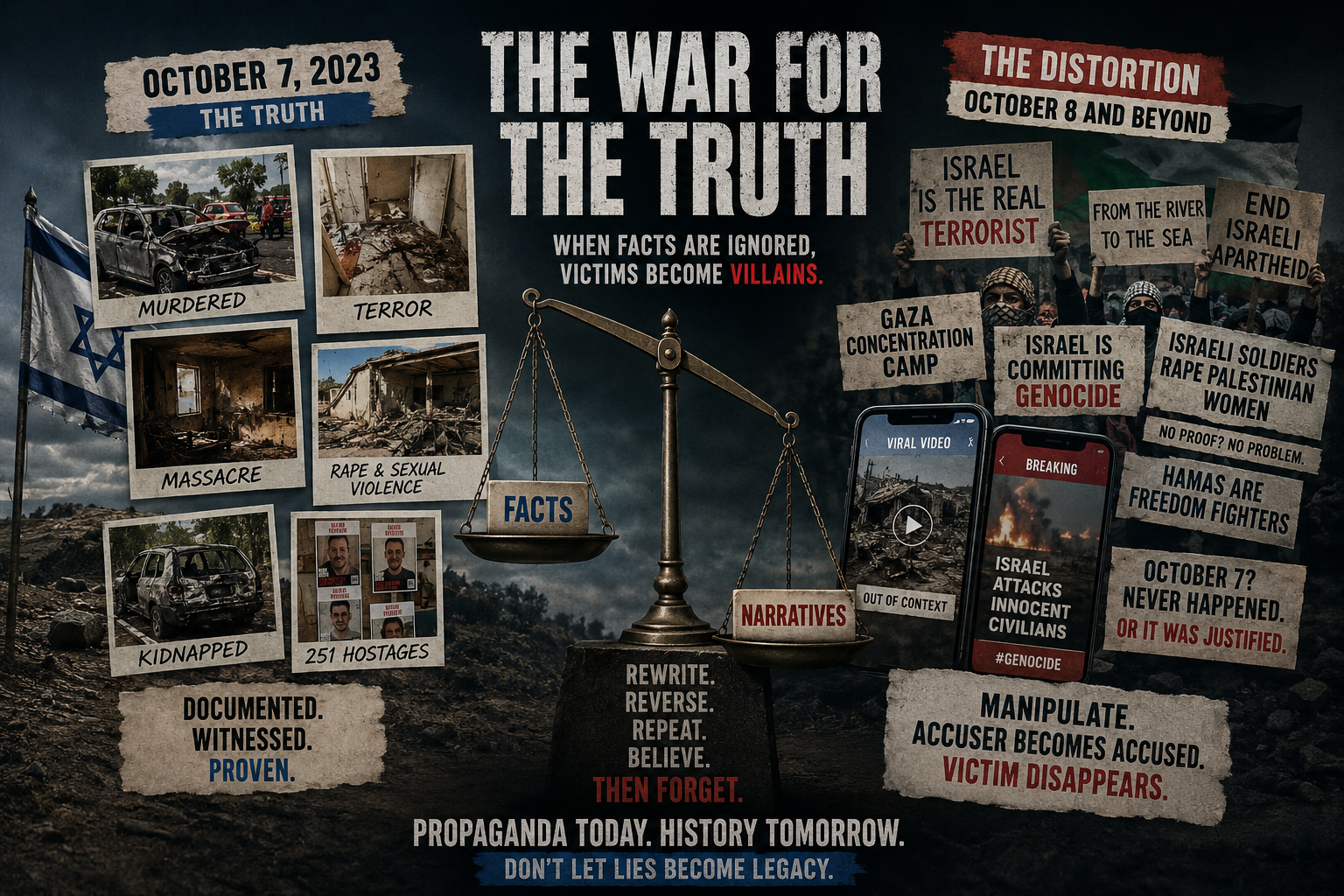
Photo Credits:Sabine Sterk (ai)
There is something deeply disturbing happening in the way the Israeli Palestinian conflict is being recorded for future generations. It goes far beyond criticism of Israel, disagreement with its government, or opposition to a military operation. We are witnessing a battle over memory itself, where history can be rewritten almost in real time and where the victims of atrocities can suddenly find themselves accused of committing versions of the very crimes inflicted upon them.
For the Jewish people, this should set off every possible alarm.
The manipulation of history did not begin on October 7, 2023. For decades, language surrounding Israel has gradually changed in ways that have transformed how millions of people understand the conflict.
Before the establishment of Israel in 1948, the word “Palestinian” was commonly used as a geographic description for people and institutions within British Mandatory Palestine. Jewish institutions openly carried the name. The Palestine Post eventually became The Jerusalem Post. The Palestine Symphony Orchestra became the Israel Philharmonic Orchestra. Jews living in Mandatory Palestine could be described as Palestinians while simultaneously identifying nationally and culturally as Jews.
Over the decades, however, the meaning of the word changed as a distinct Palestinian Arab national identity developed and became internationally established.
There is nothing unusual about national identities evolving. History is full of them.
The problem begins when a newer political identity is used to erase an older historical one.
That is increasingly what has happened to Jewish history.
Jews, whose historical, religious, archaeological and cultural connection to the Land of Israel stretches back thousands of years, are routinely described as foreign colonizers. Judea, the geographical name from which the word Jew itself originates, is somehow presented as territory to which Jews are strangers.
Even Jesus, a Jew born into Jewish society during the Roman era, is increasingly reinvented in activist rhetoric as a “Palestinian,” imposing a modern political identity upon a person who lived almost two thousand years before today’s Palestinian nationalism developed.
But since October 7, something even more disturbing has happened.
We are witnessing not merely historical revisionism but historical inversion.
Hamas and other armed groups crossed into Israel on October 7 and murdered approximately 1,200 people and abducted 251 hostages. Homes were invaded, families were slaughtered and communities were devastated. Evidence gathered since the attack has documented sexual and gender based violence associated with the assault, although individual allegations and the precise circumstances of particular cases continue to be investigated and debated.
Yet watch what has happened to the international narrative.
First came minimization.
Then came denial.
Then came justification.
And finally came reversal.
The country attacked on October 7 increasingly became portrayed as the aggressor without October 7 even being mentioned. Israelis became the villains in a story that conveniently began on October 8.
Even more disturbing is the way allegations involving sexual violence have entered this process of narrative inversion. Instead of confronting documented evidence concerning sexual violence during the Hamas led attack and against hostages, some activists shifted almost immediately toward presenting Israel itself as the primary perpetrator of systematic sexual abuse.
Allegations against Israeli soldiers must, of course, be investigated seriously. No democracy should demand immunity from scrutiny, and any proven criminal act should be prosecuted.
But allegations are not interchangeable with established facts, and accusations against individual Israelis cannot ethically be used to erase or reverse documented crimes committed during October 7.
This distinction is disappearing from social media at frightening speed.
A claim becomes a headline.
A headline becomes a slogan.
A slogan becomes a protest sign.
A protest sign becomes a social media graphic.
Thousands repeat it.
Eventually someone writes it into an article, documentary or academic paper, and suddenly repetition has created the appearance of historical certainty.
That is how propaganda becomes memory.
The same mechanism appears throughout the language surrounding Israel.
A complicated urban war becomes a slogan.
Terrorists become resistance fighters.
Hostages virtually disappear from demonstrations supposedly concerned with human rights.
Jewish historical presence becomes colonialism.
Ancient Jewish communities become foreign settlements.
And October 7 becomes detached from the war that followed it.
Perhaps the most extraordinary transformation is that Israel is increasingly expected not merely to defend its military decisions but to prove that events we watched unfold almost live actually happened.
Videos were uploaded by perpetrators themselves. Survivors testified. Bodies were recovered. Hostages returned with accounts of captivity. Investigators collected enormous quantities of material.
And still the rewriting began almost immediately.
This matters because wars eventually end, but narratives survive them.
A generation growing up on TikTok, Instagram and other platforms may never read an intelligence report, historical archive or serious investigation. They will remember thirty second videos, emotionally charged captions and slogans repeated thousands of times.
That makes information warfare a genuine strategic challenge for Israel.
Israel invests enormous resources in protecting its physical borders, developing missile defense systems and gathering intelligence about military threats. Yet protecting the historical record should also be regarded as essential national infrastructure.
Evidence must be preserved.
False material must be exposed quickly.
Manipulated photographs and videos must be identified.
Claims must be investigated rather than simply shouted down.
Archives should be accessible to journalists, historians and researchers.
Survivor testimony must be preserved for generations.
And when accusations against Israel are legitimate, Israel should investigate them transparently rather than allowing propaganda networks to exploit uncertainty.
The answer to misinformation is not censorship. It is evidence.
Because freedom of expression includes the right to criticize Israel, its government and its military. It even includes opinions that Israelis may find offensive.
But deliberately manipulating history is something else entirely.
The Jewish people know better than most what happens when lies are repeated until society becomes comfortable with them.
We should therefore recognize what is happening now.
The battle is not only about territory.
It is about language.
It is about identity.
It is about October 7.
It is about who will be remembered as the victim and who will be remembered as the perpetrator.
And ultimately, it is about who gets to write history.
Israel can win battles on the ground and still lose the battle over how those battles are remembered.
That cannot be allowed to happen.
Because once propaganda becomes history, correcting the record can take generations.
History matters.
Evidence matters.
Truth matters.
And Jewish history does not belong to those who find it politically convenient to rewrite it.
Related Topics
Related Posts