
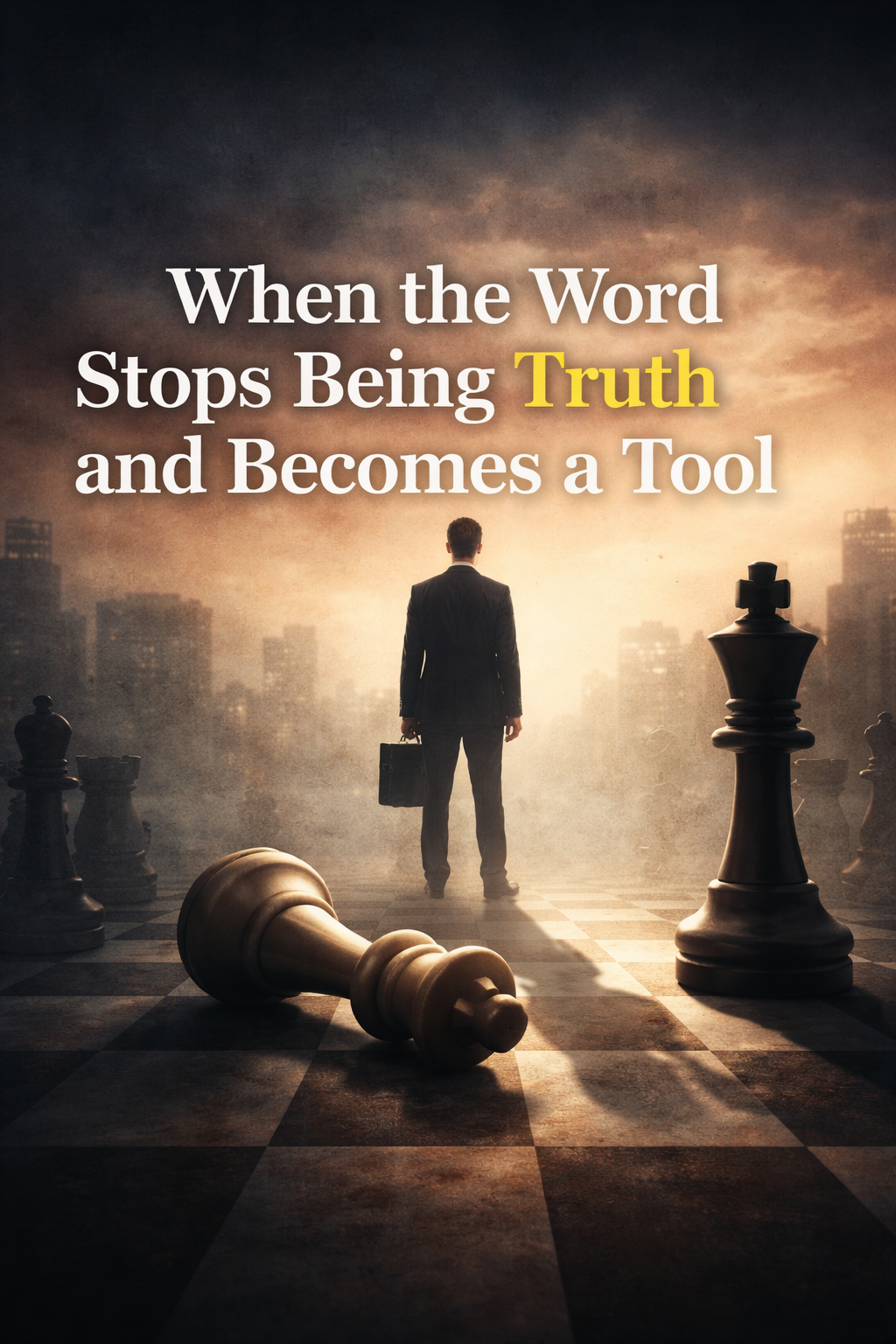
When the word stops being truth and becomes a tool
You know that feeling?
Someone is talking, smiling, saying the right things. They’re even “kind.”
And still… your body leans back.
Not because you caught them lying.
Because they’re not there.
It’s hard to explain this without sounding paranoid.
But I’ve learned to trust it.
In German there’s a word: zwielichtig.
It literally belongs to twilight. Half-light. Double-light. The hour where everything is “almost” visible.
That’s the problem with twilight:
you can mistake the predator for the protector.
A zwielichtig person isn’t always a criminal.
That’s what makes it worse.
They can be perfectly legal.
Perfectly polite.
They can even tell the truth sometimes.
But they don’t inhabit truth.
They inhabit reality like a chessboard.
Their life isn’t presence — it’s positioning.
Their word isn’t revelation — it’s leverage.
Their relationships aren’t encounter — they’re transactions.
And you feel it. Before proof. Before arguments.
You feel the fracture.
A healthy person can be messy. Contradictory. Sometimes weak. Sometimes wrong.
But still… you can sense a centre.
They may stumble, but you still know where they stand.
The zwielichtig person doesn’t have that unity.
Not because they’re broken — because they stopped caring about being whole.
Identity becomes interchangeable.
They swap faces depending on the room.
And that’s exactly when distrust is born:
when someone stops feeling like a person
and starts feeling like an actor.
Language was made to reveal what’s inside.
To make the invisible visible.
But there’s a kind of intelligence that uses language to hide.
And I don’t mean lying like “saying something false.”
I mean lying as an ontological rupture:
breaking the bond between word and being.
That’s when twilight begins.
Because now words aren’t rooted.
They float. They adapt. They sell.
They’ll talk about integrity while quietly eroding yours.
They’ll praise loyalty while measuring what it costs you.
They can sound convincing — and still smell wrong.
The scary part is how normal it can look.
Ambition itself isn’t the problem.
Desire itself isn’t the problem.
The problem is ambition without form.
Desire without limit.
When ego becomes the centre, everything turns into material:
people become resources,
institutions become tools,
ethics becomes make-up.
And it can all remain “legal.”
Legality is not truth.
Legality is just permission.
Some people specialise in staying “within the law”
while constantly violating the spirit.
Power reveals this.
Not because power changes someone.
Because power makes masks unnecessary.
When someone gains power without inner restraint, the world starts bending around them.
Limits become insults.
Criticism becomes danger.
Disagreement becomes betrayal.
And suddenly power isn’t service anymore.
It’s ego with a bigger reach.
The shadow isn’t making mistakes. Everyone makes mistakes.
The shadow is contempt for the limit.
That’s the moment where you see what’s inside:
they don’t feel shame for harming people,
they feel rage for being exposed.
They don’t suffer because they hurt someone.
They suffer because they lost control.
That’s where trust dies.
Because it shows there is no inner “no.”
No moral interiority.
No sacred boundary.
And here’s the thing: your body reads this fast.
A pause. A look.
The tone when they’re contradicted.
That little flash of pleasure when they dominate — disguised as certainty.
You don’t always need evidence to detect manipulation.
Sometimes the nervous system detects it first.
You feel when someone has:
not truth, but versions
not love, but possession
not presence, but performance
Even if nothing can yet be proven, one thing is already clear:
this person isn’t anchored.
And unanchored people don’t just drift.
They pull others into the current.
A zwielichtig person lives in twilight because they don’t want to be seen.
They don’t want to be known — they want to be interpreted.
They don’t want to be loved — they want to be desired.
They don’t want respect — they want fear.
They don’t want truth — they want effectiveness.
And when a human being trades truth for effectiveness, twilight is born.
That’s why zwielichtig isn’t just a social adjective.
It’s an ontological category:
existence without an axis.
Life turned into strategy.
Being turned into performance.
And yes — even when it’s not illegal, it’s dangerous.
Because what destroys a community isn’t only crime.
It’s the slow erosion of trust —
when nobody can be sure
that someone means what they say.