Carrie Bradshaw of the Middle East
Featured Post
When your home shakes: The earthquake in Colombia
I left my birth country as a young child, but my strong ties to the place came to the fore when my Abuelita didn't answer her phone after the 7.4 quake
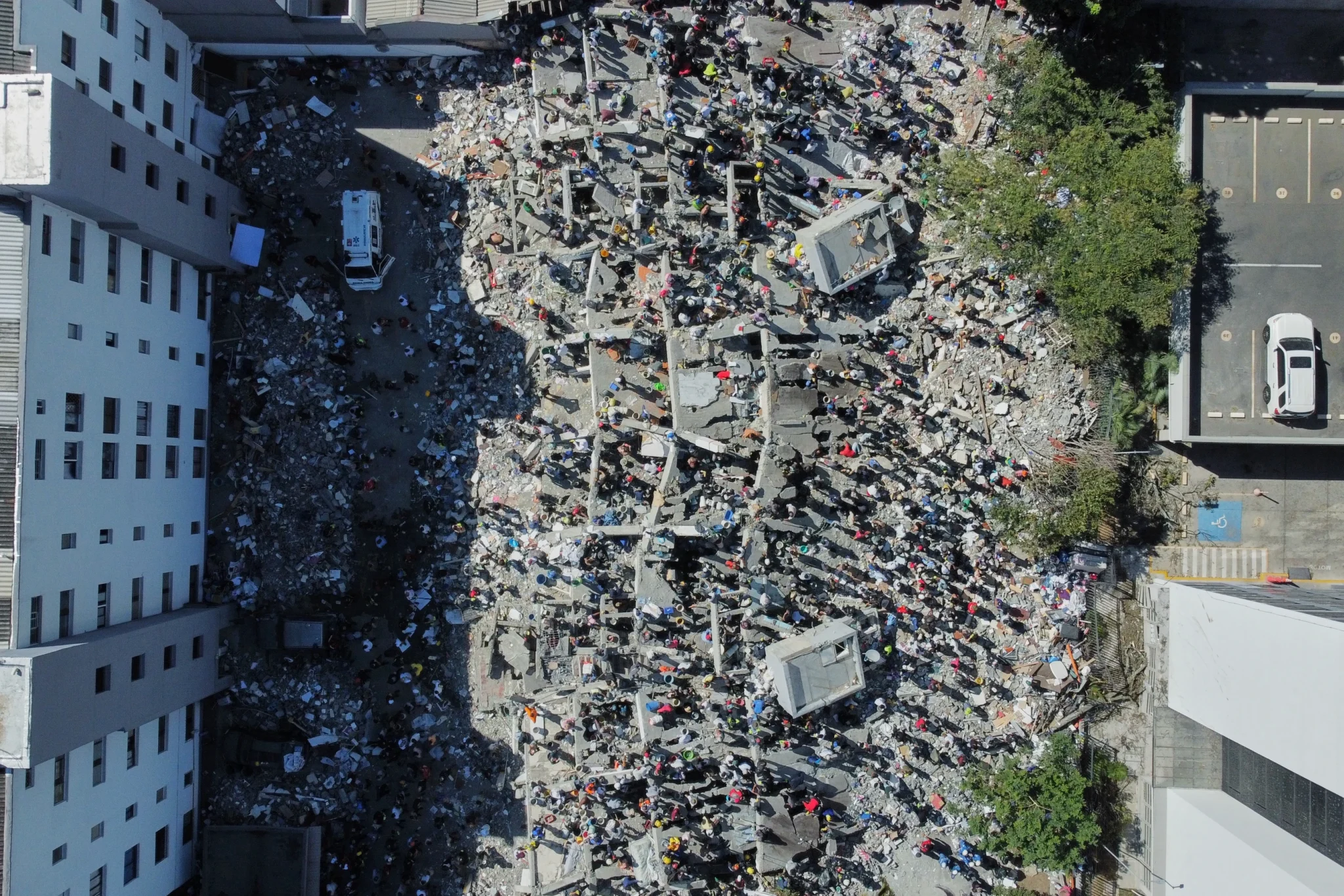
Residents and rescue workers search through the rubble after an earthquake struck Cali, Colombia, August 10, 2026. (AP Photo/Santiago Saldarriaga)
The morning we left Cali, Colombia for Israel, our nanny woke us up earlier than I was used to. At 5 years old, I remember the exact shade of blue the sky was. It was soapy blue. I wondered where the sun was. The words to describe leaving a place weren’t part of my vocabulary yet, but not knowing the word for pain doesn’t negate its existence.
When you immigrate from your birth country, you can choose to let it go like a phantom limb, or you can carry the grief of immigration with you. Instinctively, I chose the latter and learned that pain and love were entangled, intrinsically linked to my relationship with Colombia. Every hello would mean a goodbye. Every goodbye would mean versions of a life I turned my back on.
On August 10, 2026, my eyes opened at 5:37 a.m. to a familiar soapy blue seeping in from outside the blinds. I got up for a glass of water and went back to bed, compelled to look at my phone though I knew that would mean I’d be relinquishing sleep. Two hours ahead, it was now 7:45 a.m. in Colombia and notifications of a 7.4 magnitude earthquake had reached me. I had woken up as the worst was happening, realizing the epicenter was San José de Palmar, a town not too far from mine in the Colombian Pacific.
I tried to separate my anxiety from reality and called my Abuelita (grandmother) about 10 times, debating if this was now a crisis that my parents needed to be woken up to. It was. Being told about the worst earthquake your country has faced in decades as sleep clings to you feels unrealistic. We thought we would manage contact with Abuelita quickly and the day would go on as usual. But there was no answer, and the images of places we knew tumbling to the ground, as trusted news outlets struggled to weave the moment together, made it impossible to discard the event as just another earthquake.
San José de Palmar and the rest of the Chocó department aren’t known for being affluent, and, though it was the epicenter, the attention has landed on cities like Pereira, Manizales, and my own Cali, larger cities with more journalists and resources. The largely Afro-Colombian population has lacked proper representation. As I’m writing this on the morning of August 11, 2026, there have been 239 deaths in all of Colombia, at least 1,310 injuries, and around 3,000 missing people in a country that has reported 100 times that from our decades-long internal conflict.
When my parents joined me in Los Angeles, something they had little choice in, they knew it would mean leaving Abuelita alone when she might need us the most. As my mom made coffee and we gathered around the television, switching between channels, hoping for developments, we called everyone we knew. Everyone was accounted for. Everyone made it out. They were now seeking refuge on the streets. Some had lost everything, while others wondered if they could reenter an unsafe structure. My 85-year-old Abuelita lives alone, and we still didn’t know how she was, or how impacted her neighborhood had been. My mom cried thinking about Abuelita, her mother, lying in bed without her hearing aids. How would she know what was happening? How would she know to get to safety? I tried not to joke, but did let her know that’s not how earthquakes work.
We got a call from our family in Venezuela, who were still facing the aftermath of a disaster under a corrupt government. I had initially sought out ways to join volunteer efforts for Venezuela and was now realizing that would have to be pointed inward, though, just a few hours after the earthquake, no one was sure what was needed most. I held back tears, tried my Abuelita again, and wished I could be on the ground picking up a shovel.
My friend Juliana picked up the phone. She was all right. Her family was all right. She immediately asked about mine and offered to drive to Abuelita’s. My childhood friend and I don’t speak too often, but we’re family. It had been three hours since the earthquake and Juliana called me: Abuelita was alright. The apartment… not so much.
I’ve spent a lot of time in that apartment, drinking coffee from my grandmother’s balcony and listening to the birds chirping away. Juliana sent me pictures and begged me not to let Abuelita back inside. I couldn’t believe she and her boyfriend had walked into a building that was fighting to stay upright for me and my family.
Abuelita had, in fact, been woken up by the earth shaking. A strong, unshakable woman who was the first female champion sharpshooter in Colombia’s history, she fumbled into the corridor and locked herself in the bathroom, clutching her rosary alone and hoping home wouldn’t come crashing down. The image of her huddled on the floor by herself, living through the worst of it, is the price we pay for immigration. Just a week away from my parents making their way back to the little city we call la succursal del cielo, a branch of heaven, I realized I would now be paying it by myself.
In Spanish, we have a name for this feeling. We call it dolor de patria, pain for the homeland. They are words that coil into your heart, not like wires, but like the roots of a tree calling you back. It’s hard to learn to love something in its absence. My life has been defined by being away from my birthplace, and that absence has made my love for it stronger.
As my parents ready boxes to ship off to a home that hasn’t been declared livable yet, every bone in my body wishes I were there to pick up a shovel instead of a pen. To prepare a meal. To hold a stranger. Sometimes I wonder if I write to do with words what I can’t do otherwise.
Other calls came in when we knew Abuelita was safe. One of them was from a friend, my best friend. She and I no longer speak. Immigration and the politics that divides my country built an iron wall between us, making reconciliation an impossibility, and it had been about three years since I last saw her name pop up on my phone. The call lasted two minutes. She wanted to know if Abuelita was okay. I wanted to know if her family was okay. We exchanged safety reports and hung up. There was nothing more we could do to chip at that wall, but for two minutes, it had shaken.
Related Topics
Related Posts