Former Jewish Prison Chaplain / Co-Founder: L’chaim
While Judaism Affirms Life, Israel’s Latest Execution Law Serves Death
Image: The Eitz Hayim - the Tree of Life - features as the centerpiece of the official logo of "L'chaim! Jews Against the Death Penalty," a group founded in 2020, with thousands of members in Israel and across the world.
By the end of his life, Holocaust survivor, Nobel laureate and staunch death penalty abolitionist Elie Wiesel famously said of capital punishment: “Death should never be the answer in a civilized society.” We, the thousands of members of “L’chaim! Jews Against the Death Penalty” from across Israel and and the world stand with him and all of civilized humanity now in categorically condemning the “Prosecution of Participants in the October 7 Massacre Events Law (5786–2026)” that passed into law in the Knesset today after a unanimous 93-0 vote. (Of note, those members of the Knesset disgusted by the bill left the chamber ahead of the vote in protest.) We unequivocally oppose this law’s insidious fixation with vengeful killing. Instead, we support the victims of the October 7th acts of terror by siding with restorative justice – and life.
Israel’s “Punitive and Retributive Spectacle” Contradicts Jewish Life-Affirming Blessings
Israel’s barbaric new law establishes a special military tribunal to adjudicate Palestinians held in Israeli custody on suspicion of participation in the heinous Hamas-led terror attacks of October 7, 2023, and the subsequent hostage-holding in Gaza. It achieves this through a process that strips suspects of basic procedural protections essential to a fair trial and empowers the tribunal to impose the death penalty. Alongside the new Death Penalty Law that entered into force just in time to desecrate the start of Passover on March 30, 2026, this law places Israel in direct opposition to the international trend toward abolition and to binding obligations under international humanitarian law, including the prohibition of cruel, inhuman, and degrading punishment. Furthermore, this legislation strips suspects of basic procedural protections essential to a fair trial, rendering any death sentence imposed an arbitrary deprivation of life, absolutely prohibited under international law and potentially a war crime. The law also targets a specific, identifiable category of suspects, a form of personal legislation prohibited under both Israeli constitutional principles and international law. The law focuses on the roughly 300-400 detainees from Gaza suspected of involvement in the October 7th attacks and who remain in Israeli custody without charge or trial, amid a documented policy of systemic torture.
It so happens that the Knesset passed this veritable shanda (shame) the week before Rosh Chodesh Sivan (the new month of Sivan) in the Hebrew calendar. While this may seem irrelevant, a closer look at the wisdom of Jewish liturgy would teach otherwise. As an ordained cantor, in addition to being the co-founder of L’chaim, I am keenly aware of the liturgy that accompanies the end of the week before any Rosh Chodesh (new month). The central prayer at this liminal juncture is the Blessing of the New Month (Birchat Hachodesh). I will be reciting this very prayer once again this Shabbat for my home congregation. This short blessing invokes the word “Chaim” – “Life” – no less than twelve times as the congregation prays for all that is life-sustaining to come to fruition in the coming weeks. It reflects Judaism’s millennial arc of affirming life, a fact that renowned Orthodox Rabbi Yitz Greenberg eloquently affirmed in his anti-death-penalty op-ed in the Jerusalem Post earlier this year. (It is precisely for this reason that we named our Jewish death penalty abolitionist group “L’chaim” at our founding in 2020.)
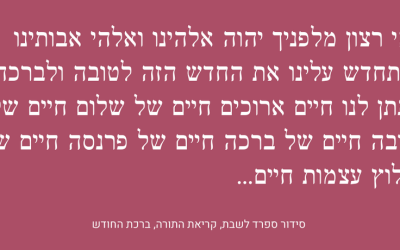
Image: Screenshot of the opening of Birchat HaChodesh, the Blessing of the New Month, to be recited this Shabbat, May 16. No copyright.
Most observant Jews like Rabbi Greenberg will be reciting this prayer across Israel and the world this upcoming Shabbat, Saturday, May 16. They will do so now against the backdrop of this Knesset-approved invitation for serving death throughout Israel in the coming months and years. It so happens that I will be reciting this prayer on my own 45th birthday, which falls on this Shabbat. It is a birthday that I am honoured to share with my elder Rabbi Greenberg, whose wisdom I greatly respect. I will be reflecting on my own celebration of life on this occasion, and – while I certainly cannot speak for Rabbi Greenberg – perhaps he shall be doing the same.
Israeli Minister of National Security Ithamar Ben Gvir, on the other hand, will most certainly not. A primary architect of and advocate for Israel’s new death penalty laws, Ben Gvir also claims to be an observant Jew, and as such, likely will be listening to the same blessing of the month in his home shul (synagogue) this Shabbat. As he does so, he assuredly will willfully ignore or rationalize this invocation’s repeated pleas for life, instead gloating over this law’s latest fulfillment of his recent 50th birthday’s death-wish and macabre execution fantasies, symbolized by the noose-laden cake that his wife Ayala presented to him.
Ahead of the passing of this latest legal abomination, various Israeli human rights groups released a statement listing their grave concerns over the bill. Their conclusion is most poignant and bears repeating in full here:
“The Tribunal bill allows for the death penalty for Palestinians under substandard judicial proceedings. By empowering procedurally deficient, military-controlled courts to impose the death penalty on a specific, identifiable group of suspects, live-streaming proceedings before any guilt is established, and permitting convictions based on evidence obtained through torture, the bill subordinates every principle of fair criminal justice to a punitive and retributive spectacle. It violates the right to life, the prohibition on cruel, inhuman, and degrading punishment, the presumption of innocence, and the foundational guarantees of judicial independence and due process under both Israeli constitutional law and binding international law. Justice for the victims of October 7 is a legitimate and urgent imperative. Those individuals responsible for grave atrocities must be held accountable. However, accountability must be pursued through a process that includes rather than abandons the principles of justice. It must be pursued through fair trials, in which the prosecution must prove its case, defendants have a meaningful right to defend themselves, and no one is put to death.”
We, the members of L’chaim, could not agree more. We would add to this statement words that Wiesel offered upon the subject of the death penalty for a 1989 recording he made with other death penalty abolitionists entitled Lighting the Torch of Conscience, in which he stated the following:
“Death should be opposed, not served. I have seen too much death in my life. I have met too many people who served death in my life…
There is no reason in the world why death should be imposed by people of good will, of intelligence, of kindness – people in the name of justice – on other people. Those who sinned – those who committed crimes – can be punished in other ways, but not with death. When we impose death on others, we are doing something to ourselves…
With every cell of my being and with every fiber of my memory, I oppose the death penalty in all forms…
I belong to a tradition – a Jewish tradition – that says that when a Sanhedrin in ancient times pronounced one death sentence in its entire tenure, that Sanhedrin – that Supreme Court – was called murderous.”
It is not difficult to discern from Wiesel’s stated position how he would respond to the notion that the modern Israeli government might execute not one, but potentially hundreds of convicted terrorists.
Standing with all Victims while Supporting the Jewish Value of Life
Let there be no doubt, whether ahead of the new month’s life-affirming blessing or any day, the thousands of L’chaim members would stand united against this medieval law. It should be obvious that our position does not mean that we stand against the victims of the horrors of October 7th. Tragically, individuals misinterpret our opposition to this law, repeatedly calling us “Kapos” for being against the death penalty. Their accusations, however vile, often stem from an understandable visceral emotional response to the horrors that were reaped upon Israel on October 7th, triggering the singular intergenerational collective trauma of the Holocaust, in which the ancestors of many L’chaim members like myself were systematically murdered on a scale that the world has never before seen.
These critics’ recriminations demonstrate that there is indeed a need to clearly state that L’chaim members firmly stand with the October 7th victims in the hope of creating a safe, secure, and peaceful Israel, and working toward restorative justice for the perpetrators who so heinously murdered their loved ones and traumatized them. Our approach very much applies even to October 7th family members like former Gaza hostage Eliya Cohen, who asserted that hostages should be given “the honor of pressing the button” to carry out death penalties for Hamas terrorists. Mr. Cohen wrote on Instagram, “Raping, murdering, smashing heads, desecrating bodies, burning babies, kidnapping civilians, and torturing them 24/7, is that not a violation of the international convention?” Mr. Cohen has every right in the world to feel this way, and no one should judge him, nor any direct or indirect victims, for this opinion. The “civilized” society to which Wiesel referred in his abolitionist stance can – and must – indeed honor and support these victims without succumbing to the vengeful collective urge to execute, which of course would only further endanger Israel and Jews across the world.
The Jewish world indeed changed forever with the monstrous Hamas terrorist attack of Oct. 7, 2023. The unjustifiable terror unleashed on that day – born of Hamas’ foundational mandate to destroy Israel –undoubtedly was an act of unmitigated horror. In what constituted the worst assault on the Jewish people since the Holocaust, Hamas terrorists murdered 1,195 Israelis and foreign nationals, including 815 civilians, and captured 251 hostages, many of whom eventually died in unfathomable, grotesque conditions in tunnels underneath Gaza.
The unfathomable scale and scope of this atrocity led to a redoubling of L’chaim’s mission to uplift the Jewish value of life. In the immediate months following October 7th, L’chaim marched for the safe return of the hostages, carrying posters emphasizing Judaism’s central tenet of reverence for all life. This action reflected L’chaim’s life-affirming approach to protesting every execution that takes place in the United States and the world. For each American state killing event, L’chaim members gather to recite traditional mourning prayers for the victims of the crimes that led to the death sentence being meted out, offering kavanot/prayerful intentions as well for their loved ones in mourning. Members then also chant prayers for the condemned men and women that the state is putting to death for those same crimes, creating new victims in the insane cycle of violence. In the case of the infamous October 27, 2018, Pittsburgh Tree of Life synagogue shooting, L’chaim members followed this model by publicly intoning the Eil Malei Rachamim traditional Jewish memorial prayer for the eleven martyrs killed that fateful day as part of an anti-death penalty protest at the US Supreme Court in Washington, DC.
Guided by Wiesel’s foundational principle of affirming the value of life, L’chaim’s intentionally absolutist approach to capital punishment has always included convicted Hamas terrorists who perpetrated the October 7th attack. Members, therefore, deplore Israeli National Security Minister Itamar Ben Gvir’s moral regression of seeking to resurrect executions in the Jewish state, aiming to put to death those guilty of October 7th’s carnage and other terrorist acts. Doing so would only give ammunition for those who seek to equate the Netanyahu regime with the terrorism of Hamas, whose members continue to employ executions regularly across Gaza. The net result of such a policy would be to increase already rising incidents of antisemitic violence across the world. Far from “deterring” would-be terrorists, the threat of a death penalty would only incite and invite further shaheeds seeking martyrdom.
Just as L’chaim members never deigned to speak for the eleven Tree of Life victims while advocating against the death penalty for Pittsburgh synagogue shooter Robert Bowers, so, too, we would never attempt to do so for victims of the unimaginable terror that Hamas perpetrated on October 7th. As a chaplain, I regularly counsel mourners that, when they grieve, they should allow themselves to experience the full range of human emotions, including rage and, where applicable, the desire for vengeance. Let no one ever judge anyone in such a position. If I myself were to lose a loved one to murder, I, too, might find myself advocating for the death of my loved one’s killers. Humanity has a collective responsibility to protect and honor all such mourners, while also upholding the fundamental human rights upon which the world stands. Most basic to these liberties is the right to life. This mandate is one of the reasons why more than 70% of the world’s nations have abolished the death penalty in law or in practice.
An Invitation to join L’chaim’s Chorus
A longstanding anti-death penalty slogan asks: “Why do we kill people who kill people to show that killing people is wrong?” This paradoxical question has plagued the human condition since time immemorial, during periods of both war and peace. In response, L’chaim stands with rabbinic sages like Rabbis Tarfon, Akiva, and Maimonides, and modern Jewish human rights and philosophy icons Elie Wiesel and Martin Buber – along with countless historical and contemporary voices of reason – in disavowing the penalty of death “in all forms,” replacing these avenues of killing with the proverbial Tree of Life. Like the Blessing of the New Month, Jewish liturgy often highlights and reiterates the exclamation of the author of the Book of Proverbs that “she is a Tree of Life to those who grasp her.” (3: 18) May humanity, for the sake of its survival, choose never to let go of that tree’s branches.
Even this L’chaim co-founder once supported the death penalty. It was my role as a Jewish prison chaplain that helped ledd me to see the error of my ways. May the citizens of Israel who today support this law’s celebration of death soon experience the same transformation. As I did for my views, may they make collective teshuvah (repentance) for allowing this monstrous law to take effect. And may they begin to work now for its unconditional repeal. In doing so, they will one day join L’chaim and civilized humanity’s resounding chorus – this Rosh Chodesh, and always – chanting: “To Life!”
Cantor Michael J. Zoosman, MSM, BCC
Co-Founder: L’chaim! Jews Against the Death Penalty
Advisory Committee Member: Death Penalty Action
Related Topics
Related Posts