
Middle East Analyst
Who Are the Palestinians?
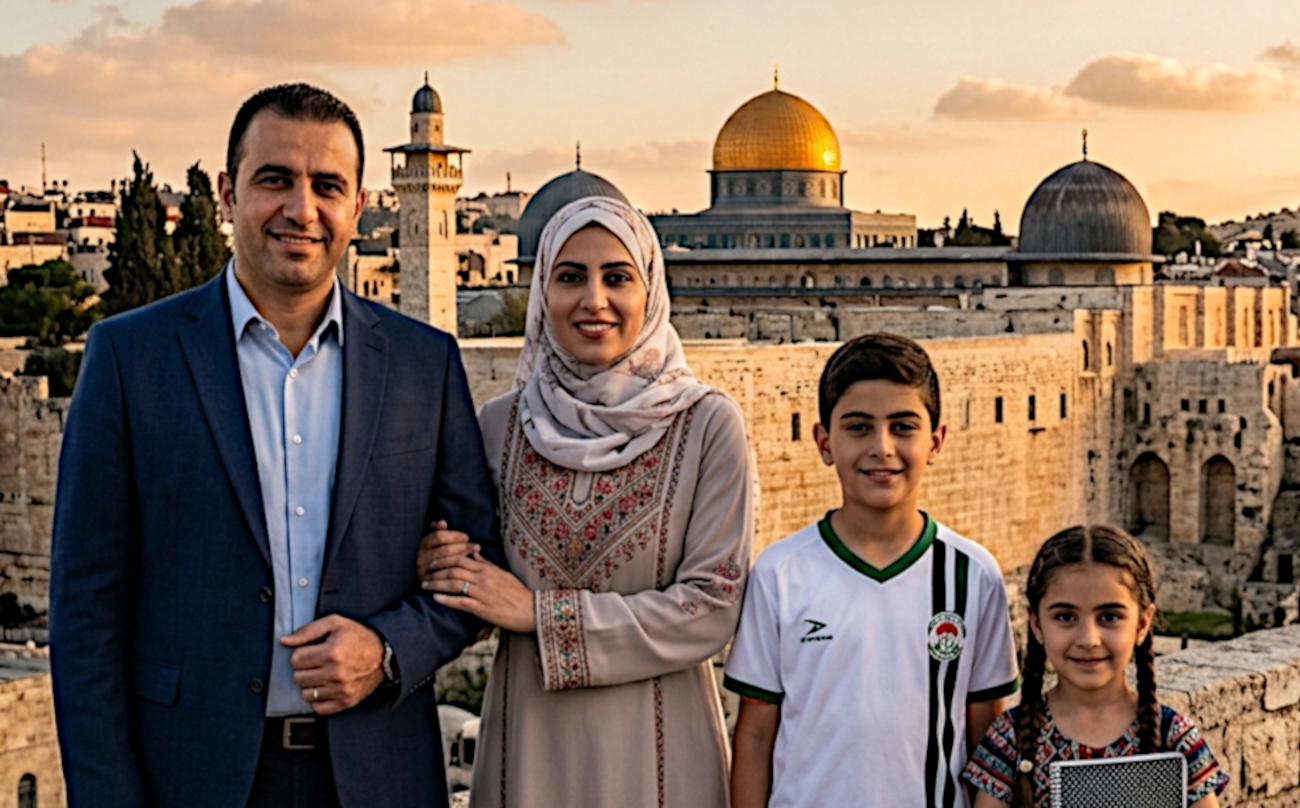
by author (AI)
Three Questions Rolled into One
The question sounds simple enough to answer with a sentence, but it is not, because it bundles three separate questions that popular argument routinely collapses into one: who are the biological and cultural ancestors of the people living in the land today; where did the word “Palestine” come from and whom did it originally describe; and when did “Palestinian” become the name of a modern people pressing a claim to statehood. Each requires different evidence — archaeological and genetic for the first, linguistic and historical for the second, political and legal for the third — and confusing them produces some of the most persistent myths in the Israeli-Palestinian debate.
The Name Before the People
The word itself is older than any population now arguing over it. Peleset appears in Egyptian inscriptions of the twelfth century BCE among the “Sea Peoples,” and the Hebrew Bible refers to the same population as the Philistines, who built a pentapolis along the southern coast: Gaza, Ashkelon, Ashdod, Ekron and Gath. Ancient DNA from Ashkelon, published in *Science Advances* in 2019, found ancestry patterns most consistent with an influx of European-related populations coinciding with the Philistines’ arrival, plausibly from the Aegean, and found that signal fading within roughly two centuries — evidence of intermarriage and absorption rather than a durable, genetically distinct population. The Philistines nonetheless kept a distinctive material culture for centuries after that genetic absorption, and none of this establishes a continuous biological line from them to the modern Palestinians who now carry a version of their name.
The name outlived the people. By the fifth century BCE, Herodotus was using *Palaistinē* for what he called “the district of Syria” running from Phoenicia toward Egypt, and Greek and Roman writers kept using variations of it for centuries after him. After the Bar Kokhba revolt, the Roman province of Judaea was renamed Syria Palaestina in the second century CE — a change most historians read as a deliberate attempt to sever the province’s name from the defeated Jewish rebellion, though the ancient sources don’t record Hadrian’s reasoning directly and a minority view treats it as a routine administrative merger with Syria. What isn’t disputed is that Palaestina became part of Roman administrative geography, and passed from there into Arabic as Filastin: after the seventh-century Muslim conquest, the Umayyads and Abbasids organized part of the territory as Jund Filastin, capital eventually at Ramla. The etymological line back to Peleset is solid; what it doesn’t establish is that modern Palestinians are simply ancient Philistines under another name.
The People Beneath the Name
The genetic evidence underneath that naming history points to a shared origin rather than two separate ones. Both modern Palestinians and Jewish Israelis trace much of their ancestry to the same ancient Canaanite population that inhabited this land thousands of years ago — a continuity documented in ancient-DNA research including Bronze Age genomes recovered at Sidon. In the most basic biological sense, the two peoples arguing over this territory are, to a significant degree, descended from the same homeland’s original inhabitants. They aren’t genetically identical, and neither is “pure”: both have layered additional ancestry onto that common Canaanite base through millennia of migration and intermarriage. That shared ancestry is a finding about descent, not a verdict in the separate political argument over indigeneity that both sides already invoke for their own purposes — a category defined by continuous habitation, self-identification and dispossession that ancient DNA can’t adjudicate.
What the genetic record does support is a narrower point: the Arabization of the Levant after the seventh century was a linguistic, religious and cultural transformation, not a demographic replacement in which the existing population was displaced by migrants from Arabia. “Arab” here denotes language and culture more than descent. Palestinians became overwhelmingly Arabic-speaking and predominantly Muslim, while Palestinian Christians remained within the same Arabic linguistic world, without any of that requiring an ancestral migration from Arabia. Continuity combined with transformation is the more accurate description than either extreme, and it cuts both ways: neither population needs to be a foreign transplant for the other to have a genuine history there.
From Toponym to Administrative Category: The Ottomans
For most of Ottoman rule, Palestine was not a single province — the territory was divided among sanjaks (Jerusalem, Nablus, Acre) within larger administrative structures. The name survived anyway as a geographic description: nineteenth-century Ottoman correspondence uses *Arz-i Filistin*, “the Land of Palestine,” and by the late Ottoman period works like the *Filistin Risalesi* mapped Palestine as a recognizable territorial entity roughly matching the later Mandate borders — a reminder that a territory can have a geographic identity without a matching province.
The term didn’t initially sort the population by religion or ethnicity: a Jew in Jerusalem, a Christian in Nazareth and a Muslim in Nablus were all, geographically, Palestinians. That began changing only at the century’s end. Khalil Baydas’s use of *Filastini* in 1898 is the earliest documented instance of an Arab writer using the term for himself and his countrymen, and after the 1908 Young Turk Revolution eased press censorship, the term spread rapidly through the new Arabic-language press. This wasn’t a fully formed national movement yet — it was a specifically Palestinian civic vocabulary taking shape alongside competing Ottoman, Arab, Syrian and Zionist identities.
The Mandate: One Name, Two National Projects
Britain occupied Palestine in 1917–18 and received the League of Nations Mandate in 1922, incorporating the Balfour Declaration’s commitment to a Jewish national home alongside a duty to protect the existing non-Jewish population’s civil and religious rights. The legal category the Mandate created was Palestinian citizenship — the 1925 Palestine Citizenship Order applied it to Jews, Muslims and Christians alike, and Mandate passports identified holders as citizens of Palestine. That’s why Golda Meir could accurately say she once held a Palestinian passport: a person could be legally Palestinian without treating “Palestinian” as a national identity at all, which is exactly where most Mandate-era Jews stood.
Two incompatible national projects developed inside that one legal category. Zionism was already a well-organized movement pursuing Jewish sovereignty; the Arab population was developing a specifically Palestinian political identity, increasingly defined against Zionist immigration and the Mandate itself. By the 1930s “Palestinian” carried two meanings at once — legal citizenship for everyone, and an emerging ethnonational identity claimed by the Arab population specifically. The 1948 war resolved the ambiguity by force: Israel’s Jewish citizens became “Israeli,” and “Palestinian” narrowed to the Arab population of the former Mandate — those inside Israel, those under Jordanian or Egyptian control, and the refugees and their descendants across the region and diaspora.
The Modern National Movement
Exactly when Palestinian nationalism became a coherent national consciousness is genuinely debated: Rashid Khalidi traces it into the late Ottoman period’s press and institutions, James Gelvin emphasizes reaction to Zionism and the Mandate, others place its full emergence later still. None of that supports the claim that Palestinian nationalism was simply invented after 1967 — a distinct political identity clearly predates the Six-Day War, and the institutional record is hard to dispute. The PLO was founded in 1964, three years before the occupation began; Fatah and Arafat came to dominate it after 1967; the 1968 National Covenant articulated an explicitly nationalist program; and the 1974 Rabat summit recognized the PLO as the Palestinians’ sole legitimate representative, with UN observer status following that year. The PLO declared the State of Palestine in Algiers on November 15, 1988, implicitly accepting partition and a two-state framework, and more than eighty states recognized it within weeks. The 1993 Oslo Accords created the Palestinian Authority as an interim government — not a sovereign state, and not a resolution of borders, Jerusalem, refugees, settlements or sovereignty, all of which remain open.
The UN Ledger
Palestine’s international position is more substantial than “unrecognized state” suggests, and still short of sovereignty. The UN increasingly used “Palestine” as the designation for the proclaimed state after 1988; Palestine joined UNESCO in 2011; and in 2012 the General Assembly voted 138–9 to grant non-member observer state status, the category also held by the Holy See. A 2024 resolution expanded participation rights further, but full membership requires a Security Council recommendation, which the US blocked by veto in April 2024. Palestine acceded to the Rome Statute in 2015, giving the ICC jurisdiction over Gaza and the West Bank, including East Jerusalem.
Bilateral recognition has moved faster: most of the Arab, African, Asian and Latin American world recognized Palestine around 1988; Sweden became the first Western European EU state to do so in 2014; and the pace accelerated sharply after October 2023, with Norway, Ireland, Spain, Slovenia and Armenia in 2024, then the UK, Canada, Australia, Portugal and France in a September 2025 wave. By the end of that wave, roughly 157 of 193 UN member states recognized Palestine — a little over four-fifths, for comparison to Israel’s own roughly 165.
The most consequential recent addition came on November 17, 2025, when the Security Council adopted Resolution 2803 endorsing President Trump’s Comprehensive Plan for Gaza, 13–0 with China and Russia abstaining. Unlike earlier UN action, it places Palestinian self-determination inside a Security Council-endorsed reconstruction framework, establishing the Board of Peace as a transitional authority for Gaza and conditioning any handover to a reformed Palestinian Authority on specific benchmarks. Its own text is carefully hedged: “After the PA reform program is faithfully carried out and Gaza redevelopment has advanced, the conditions may finally be in place for a credible pathway to Palestinian self-determination and statehood.” It recognizes no existing state, sets no borders, and guarantees nothing automatically — it conditions a pathway on PA reform and reconstruction, and calls for a US-led dialogue toward a political horizon.
That conditionality drew real objections, including from Council members Algeria, France, Pakistan, Guyana and Sierra Leone, who noted the resolution reaffirms none of the standing body of prior Security Council resolutions and never mentions the 2024 ICJ advisory opinion holding that Palestinian self-determination cannot be conditioned on negotiations with the occupying power. Read that way, 2803 converts an existing right into a conditional privilege tied to demilitarization and governance benchmarks Israel isn’t asked to meet — and critics reasonably ask why one party has to earn a right the other doesn’t.
The more persuasive answer is practical, not legal. The Palestinians aren’t negotiating from parity; they’re a defeated, occupied population whose armed faction in Gaza just lost a war, and the real choice isn’t between a conditional pathway and an unconditional one — it’s between a conditional pathway some outside actor is actually willing to fund, police and administer, and an unconditional right that decades of international law have recognized without producing a single additional acre of sovereign territory. Benchmarks aren’t proof the resolution treats Palestinian statehood as a lesser right; they’re the price of getting a great power and a regional coalition to actually build the thing rather than just affirm it. Israel isn’t asked to meet parallel benchmarks because Israel isn’t the party whose sovereignty is in question. Whether that’s fair is a different question from whether it’s functional — and after decades of recognition without a state, functional may matter more.
Conclusion
Three different kinds of evidence, three different answers. Genetically, Palestinians and Israelis share deep Canaanite roots — a fact about descent, not a verdict on the separate political fight over indigeneity. Philologically, “Palestine” predates any Palestinian national identity by two thousand years, and that history alone proves no ancient nation. Politically, Palestinian identity is a modern development with real institutional depth — documented from 1898, organized well before 1967, and now, through Resolution 2803, tied to an actual (if conditional and contested) pathway rather than accumulated recognition alone. A modern identity doesn’t need to be ancient to be real, and ancient ancestry doesn’t by itself produce a state. Neither the “recent invention” argument nor the “no real connection to the land” argument survives contact with the evidence.
Related Topics
Related Posts