CFO | Empower Society for Good I Author
Who Has the Courage to Speak the Truth?
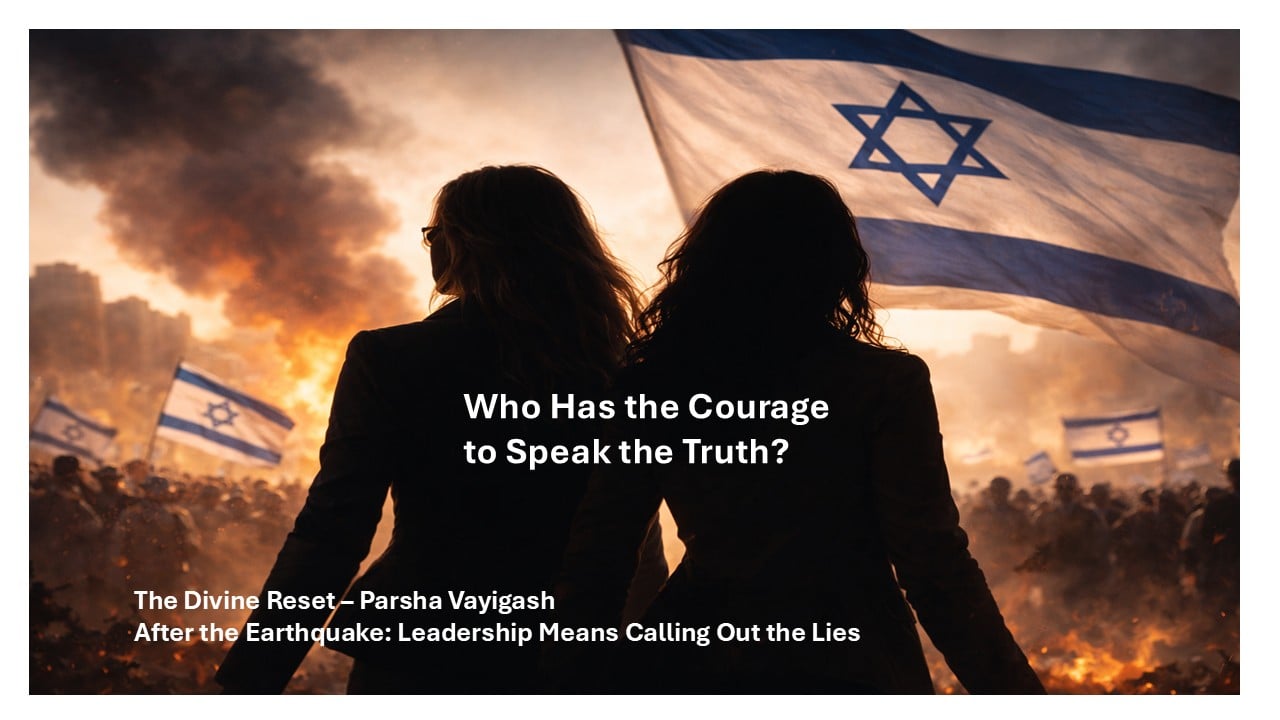
Leadership begins with courage, not power. In Parashat Vayigash, Judah steps forward to confront Joseph and speaks the truth without knowing the outcome. After October 7 — a moral earthquake for Israel and Jews worldwide — that ancient moment feels urgently contemporary. This piece is inspired by the growing number of women — Zionist and allied — who have refused moral confusion and chosen clarity, even at personal cost. Their courage reminds us that leadership does not wait for permission.
This week’s reading opens in dramatic fashion.
“Vayigash eilav Yehuda” — And Judah approached him.
(Genesis 44:18)
Parashat Vayigash opens not with armies or strategy, but with courage. Judah steps forward to confront Joseph — the most powerful man in Egypt — and does something that defines leadership: he speaks truth without knowing the outcome.
The Torah does not say Judah conquered, defeated, or outmaneuvered. It says vayigash — he approached. Leadership begins not with power, but with the willingness to step forward and speak.
Judah’s approach is also Judah’s transformation. The same brother who once enabled betrayal now offers responsibility. Earlier, when confronted by Tamar, Judah uttered three words that still define moral leadership: “She is more righteous than I.” No spin. No excuses. No deflection.
Leadership begins where ego ends.
Two Models: Joseph and Judah
Vayigash brings together two essential leadership models.
Joseph represents pragmatic leadership: reading reality clearly, preparing for famine, managing crisis, and saving nations. He does not explain reality away; he takes responsibility for it.
Judah represents moral leadership: confronting truth, admitting failure, and standing in the breach for others.
Healthy societies need both. But when moral leadership collapses, pragmatism alone becomes hollow. That is the danger of our moment.
October 7: A Moral Earthquake
October 7 was a moral earthquake — not only for Israel, but for Jews worldwide.
For many of us, that day did not only change what we think about Hamas. It changed what we think about the world that reacts to Hamas. Jews woke up to something painfully simple: evil can be filmed in real time, and still be explained away within hours.
And then came the aftershocks.
The Bondi Junction attack in Sydney — Jews murdered in an ordinary place of daily life — was not the same quake in scale, but it was an aftershock in meaning for world Jewry. It reinforced a truth many preferred to keep at arm’s length: antisemitism is not a Middle East export. Jews are targeted not because of policy disagreements, but because they are Jews.
Earthquakes do not invent fault lines. They expose them.
The Cowardice of False Neutrality
In the face of this rupture, leadership was tested — and too often found wanting.
“This is complicated.”
“We must hear both sides.”
“We need balance.”
These phrases have become the refuge of weak leadership.
Balance between truth and falsehood is not morality — it is surrender. After October 7, refusing to name Hamas as genocidal or radical Islamist ideology as a real threat to Jews and to Western democracy was not diplomacy. It was abdication.
Rabbi Jonathan Sacks warned that when truth is relativized, power fills the vacuum. When leaders do not name reality, the loudest narrators win — even when their narrative is a lie.
A Necessary Clarification: Criticism vs Delegitimization
This is not a call to suppress criticism of Israel. Democracies thrive on debate. Israel itself is proof of that.
But criticism that excuses terror, erases October 7, denies Jewish peoplehood, or turns Jewish self-defense into a crime is not critique. It is moral distortion. When a movement cannot bring itself to condemn Hamas clearly, yet feels entitled to lecture Israel endlessly, it is not pursuing justice. It is laundering hatred.
The Zionist Lionesses — and Why Their Courage Matters
Against this backdrop, some of the clearest voices defending truth and Jewish sovereignty have been women — not because women are automatically wiser or more moral, but because courage has a way of surfacing where conformity is least rewarded.
These women are not symbolic figures. They are lionesses: leaders willing to pay a price for clarity.
Einat Wilf has been among the most intellectually rigorous voices exposing a central lie: that the conflict is primarily about borders rather than the refusal to accept Jewish sovereignty in any borders at all. She insists that “from the river to the sea” is not a metaphor but a declaration of intent.
Noa Tishby has emerged as one of Israel’s most effective global communicators, refusing the premise that Israel must endlessly justify its right to exist. She confronts misinformation directly, and since October 7 her clarity has cut through distortion.
Natasha Hausdorff, an international lawyer, has brought legal precision to a debate dominated by slogans. She has been unafraid to call out the weaponization of international law — how legal frameworks meant to protect civilians are repurposed into lawfare designed to delegitimize Jewish self-defense.
Melanie Phillips warned for decades that Western moral relativism enables extremism. Long before October 7, she argued that radical Islamism targets Jews first, but never stops there.
Fleur Hassan-Nahoum, former Deputy Mayor of Jerusalem, represents unapologetic Zionist diplomacy — confident, articulate, grounded in historical truth, and unpersuaded by the lie that Jewish self-determination is colonialism.
Within Israel, Sharon Haskel and May Golan, very different in style and politics, share a refusal to blur moral lines for international approval. They articulate what too many avoid: a society unwilling to defend its identity and values will not survive.
And beyond the Jewish world, several women have modeled the same moral clarity.
Opposition leader Kemi Badenoch in the UK has been willing to state plainly that Islamist extremism threatens Western democracy, not only Jews, and that antisemitic incitement cannot be sanitized as activism. She is the kind of leader too many parties are afraid to produce: someone who calls out lies even when it is costly.
In Australia, Erin Molan has spoken with unusual clarity in defense of Israel and against antisemitism, refusing to bow to intimidation or fashionable moral inversion.
In the United States, Nikki Haley has consistently rejected moral equivalence, stating openly that Hamas is evil and that Israel has the right — and obligation — to defend itself.
None of these women paid no price. Each has faced vilification, professional risk, or personal threats. That is precisely what makes them leaders rather than performers.
Learning from Golda Meir and Margaret Thatcher: Truth, Responsibility, and Israel’s Right to Defend Itself
We have been here before. Leadership after crisis is not theoretical; it has precedent. Golda Meir, Israel’s prime minister during the 1973 Yom Kippur War, faced one of the gravest failures in the country’s history. While the Agranat Commission did not assign her direct legal blame, Meir recognised a deeper responsibility and resigned in 1974. She had long rejected comforting illusions about the conflict, capturing its moral core with stark clarity:
“Peace will come when the Arabs will love their children more than they hate us.”
— Golda Meir
It was not a statement of despair, but of moral realism — a recognition that peace requires choice and responsibility, not slogans.
Outside Israel, Margaret Thatcher demonstrated the same clarity. A consistent supporter of Israel’s right to exist and defend itself, she resisted the growing tendency to blur moral lines and distort facts. She stated plainly:
“Israel has a perfect right to exist and to defend itself.”
— Margaret Thatcher
Both of these statements are telling and enduring, especially at moments when facts are misaligned, Israel’s legitimacy is questioned, and its right to self-defence is treated as conditional. In a region where threats — including the current and explicit Iranian threats against Israel’s existence — are neither theoretical nor rhetorical, such clarity is not provocative; it is essential. Like Judah in Vayigash, both leaders understood that leadership means approaching uncomfortable truth and accepting responsibility — even when the cost is personal or political.
Not All Women Lead This Way
It is important to say this clearly: being a woman does not automatically confer moral clarity.
Leadership is not a matter of gender. It is a matter of courage.
Some prominent women have chosen the opposite path — either diluting moral boundaries or participating in the very inversion that fuels antisemitism.
Public voices such as Candace Owens, for example, have increasingly drifted into conspiratorial rhetoric and moral provocation that blurs antisemitism rather than confronting it.
And figures such as Francesca Albanese, the UN Special Rapporteur, illustrate how institutions meant to uphold impartiality can become vehicles for delegitimization — singling out Israel in ways that encourage moral distortion rather than protect human rights.
These examples matter because they clarify the real issue: the crisis is not representation; it is responsibility.
The Test After the Earthquake
Vayigash reminds us what leadership looks like: approaching, owning truth, and accepting responsibility — regardless of the cost.
Some will argue that naming lies inflames tensions, that silence preserves stability. History teaches the opposite. It is the refusal to name evil early that allows it to metastasize.
October 7 exposed more than a security gap. It revealed a moral vacuum.
We do not lack experts or commentators. We lack leaders willing to say:
This was evil.
This was not resistance.
This ideology is dangerous.
We failed.
We are responsible.
Judah approached. He spoke. He owned truth.
After October 7 — and after the aftershocks — the question is simple: who else will?
Related Topics
Related Posts