
Sense maker, AI-augmented builder | founder @ talenthunt.work
Who owns the AI budget?
We keep being told AI will replace employees. Fine, or not, you choose. The question nobody asks is where in the organization the AI budget should sit, and who else will want a share of it.
In Israel, the Finance Ministry has already started asking.
The AI budget is a labor budget
Think about what HR owns in most companies: job architecture, pay bands, who gets hired and at what level. Basically, where the money for getting work done by humans goes.
AI now does a chunk of that same work, and it costs real money. Tokens, seats and usage, billed every month and climbing as you lean on it more.
So who owns that budget?
Engineering. Finance. Whoever signed up for the API first. But if AI does the work, that spend is a labor budget. It just never lands on a payroll line.
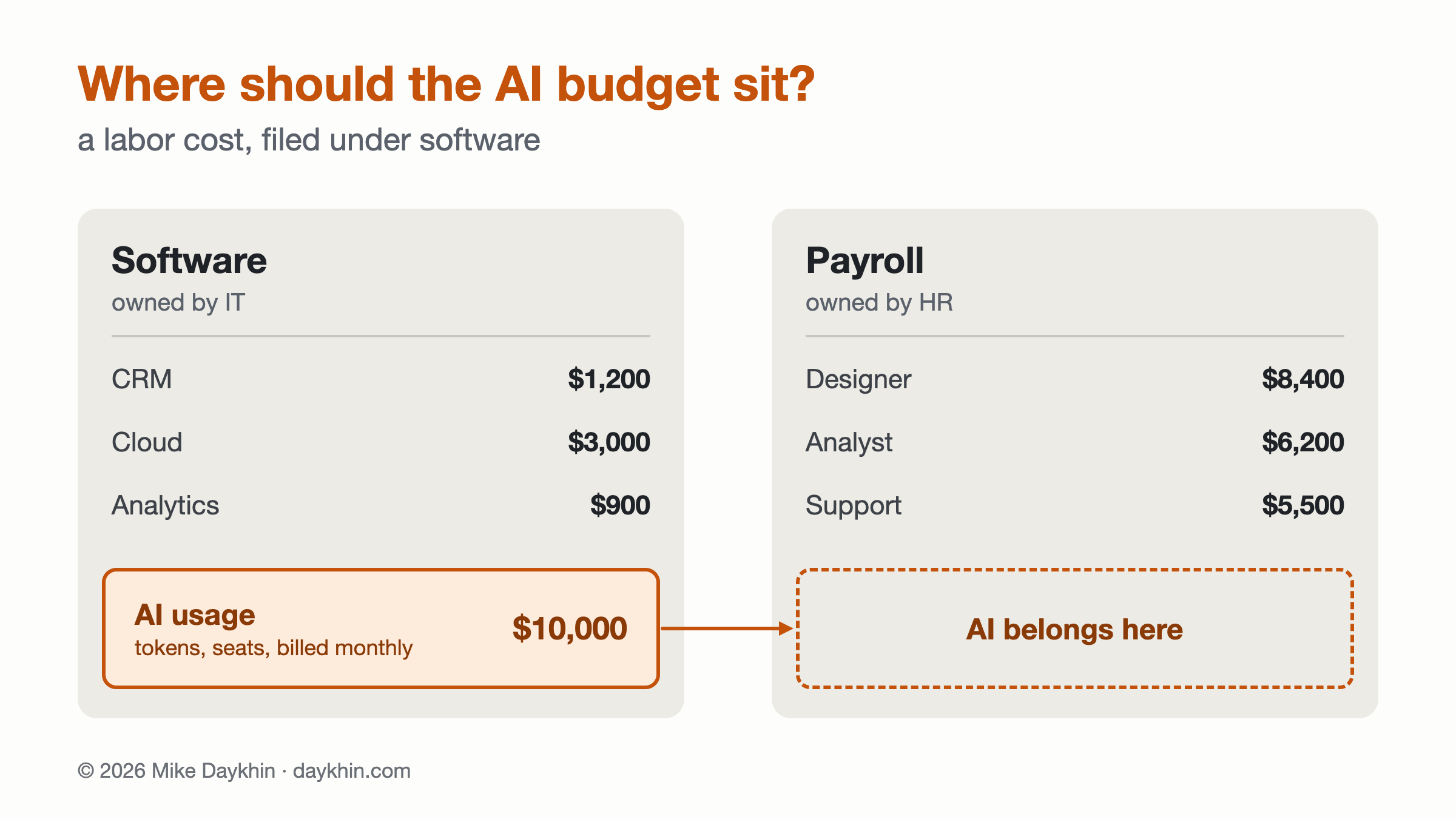 Startups don’t have this problem, because the founder owns both. It shows up as you scale, when the two budgets end up in different rooms with different bosses.
The first company to fix it has to do something awkward: put the AI budget and the headcount budget on the same table, give them one owner, and trade them off. One more seat on AI, or two more hires? That’s not an IT call. That’s about as HR a question as it gets.
HR didn’t ask for this and probably isn’t ready for it. But the money already moved.
The owner I forgot: the state
Every salary you pay in Israel sends a share back to the state.
The state takes Bituach Leumi and health tax, then income tax, then 18% VAT when the person spends the rest. Taxes on labor bring in more than a third of the state’s tax revenue, by the Chief Economist’s figures for 2024, and high-tech pays more than a third of all income tax on wages, according to the Bank of Israel.
Move part of that payroll to agents, and the money goes to whoever runs the model. Governments don’t see that spend as payroll either, and for them the missing money matters much more than it does for HR.
Israelis lean on these models harder than almost anyone. In Anthropic’s index of Claude usage per working-age person, Israel came first in the world in August 2025, at seven times what its population would predict. In February 2026 it came second, behind Singapore. Those bills go abroad.
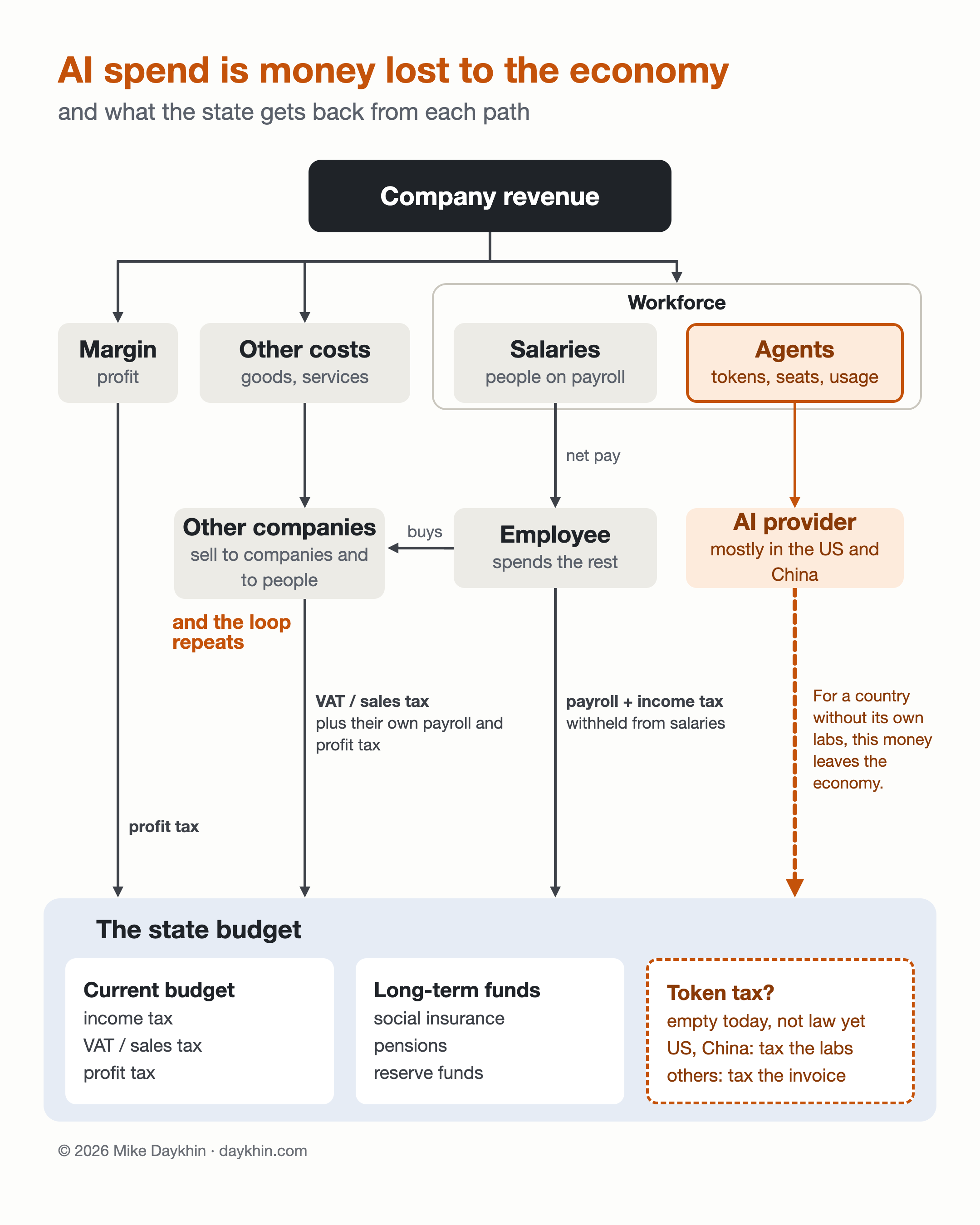 America can tax the labs, because the labs are American. In August, Democrats in the US Congress proposed a law to tax major AI companies, with a rate that grows as unemployment grows. Israel watches the money leave. Nobody pays Bituach Leumi or income tax on it, and no local shopper spends it. Give it two or three years, and a budget built on labor taxes will look for a new base. The easiest one left is what crosses the border, and that will be your token bill.
We’ve seen this before
Taxing a tool that makes you more productive sounds wrong. But when Netflix and YouTube took the audience from local cinemas and TV, France made them pay a tax to its national film fund in 2017. In 2022 Swiss voters approved their own “Lex Netflix”, which makes international streamers put part of their Swiss revenue into Swiss film.
Israel has tried to make the same companies pay and hasn’t managed yet. The Tax Authority holds that VAT on what Netflix, Disney, Google, Apple and Amazon sell to Israelis already applies in principle, but it can’t collect it, because those companies don’t register here as dealers. The Treasury tried to fix that in 2021 and failed to get the Knesset on board, then tried again in 2023 and put the revenue at about NIS 500 million a year, Calcalist reported. In March 2026 the government dropped a draft rule that would have made big streamers invest 6.5% of their Israeli revenue in local content.
Tokens are the same story, only this time the missing base is payroll.
And the labs that would pay mostly sit in the same country whose president got the streaming rule dropped.
I’m not the only one thinking about this. Bill Gates wrote that you pay payroll tax on a hire but can usually write off a robot right away, so the tax system nudges you toward machines. He suggested taxing robots and AI tokens.
The Treasury has started counting
In July the Finance Ministry asked the public how Israel should tax in the age of AI. This autumn the Chief Economist, Dr. Shmuel Abramzon, sent Finance Minister Bezalel Smotrich his preliminary answer. Among the risks to the tax base, his review lists “the replacement of Israeli workers with digital services provided from abroad”. That’s my token bill, in the Treasury’s words.
The review recommends against taxes aimed at AI. Instead the ministry proposes taxes on undeveloped land, equity compensation and luxury goods, and puts the VAT on imported digital services, the “Netflix tax”, back on the list. In October the head of the Tax Authority, Shai Aharonovitch, gave the example of a tech company that needed 50 people and now manages with 20, and said tax collection from salaries would drop considerably.
Where this could go differently
None of this is law yet. In May, Bloomberg Tax couldn’t find a single government that taxes AI. Nobody agrees on what to tax either: the IMF argues against a dedicated AI tax and would rather raise taxes on capital, and the Vanderbilt Policy Accelerator counted 34 ways to tax AI. For now, our Treasury sides with the IMF.
But a Netflix tax reaches what households pay for subscriptions. It does nothing about the payroll a company stopped paying, and a finance ministry watching that line shrink won’t wait for economists to agree.
One table, three lines
So next time you weigh one more AI seat against two more hires, put three lines on the table: the token bill, the payroll it replaces, and a tax line next to the tokens. Today the tax line says zero. I wouldn’t plan on zero for three years.
Either agents are workforce, and sooner or later HR plans them and the state taxes them like workforce. Or they’re software, and then stop saying they replace people.
This autumn the Treasury said no to a token tax.
How long do you think that answer holds?
Related Topics
Related Posts