
Russian-American-Israeli Palestinian. Palestine is Israel.
Why Arab Identity Laundering?
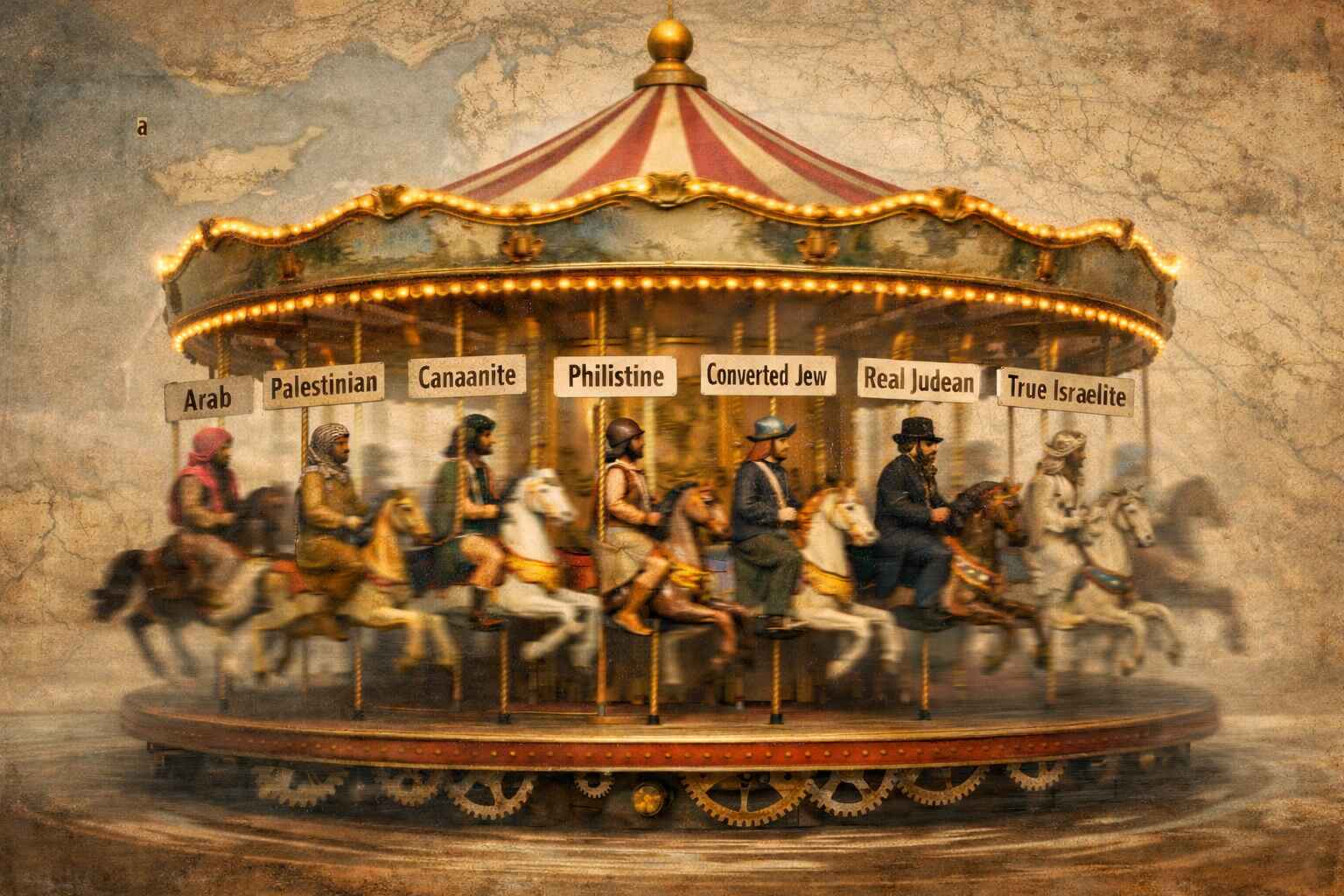
Spinning narratives: identities are reshuffled, appropriated, and redefined to suit changing political realities. Image © Ivan Bassov, 2026. Licensed under CC BY 4.0.
The Logic Behind the Identity Carousel
This article builds directly on my earlier essays, Arab Identity Laundering and The Narrative War of Attrition. It argues that the phenomenon under discussion is not merely rhetorical noise or an exhaustion tactic within what I previously called the Narrative War of Attrition. It follows a discernible logic. The constant reshuffling of identities—the Identity Carousel—exists to keep pace with changing political realities and collapsing narratives. It is adaptation, not improvisation.
There was a time when Arab was a plain, descriptive word—historical, geographic, uncontroversial. During the British Mandate, Jews were commonly called Palestinians, and Arabs identified as Arabs. The terminology was not confused; it reflected reality.
Today, that clarity has vanished. The word Arab has quietly become a liability. In its place, a rotating cast of identities appears: Canaanites, Philistines, Phoenicians, Israelites who converted to Christianity or Islam, and, most prominently, the ever-flexible label Palestinians. What we are witnessing is not organic historical discovery but Arab Identity Laundering—the systematic removal of an inconvenient modern identity and its replacement with something older, nobler, and, above all, non-Arab.
The term Arab Identity Laundering does not imply that Arab identity is inherently tainted. As with money laundering, the issue is not moral corruption but the concealment of origin: the transformation of something politically inconvenient into something socially usable. In this case, Arabness is treated by the narrative engineers themselves as the contaminant—not because it is false, but because it obstructs claims of exclusive indigeneity. Laundering, here, describes a deliberate process of masking origins to achieve legitimacy.
From Arabs to “Palestinians”: A Strategic Rebranding
Under the British Mandate, Palestinian was a territorial designation, not an ethnic one. Jewish newspapers, institutions, and sports teams used the term openly. Arabs, meanwhile, identified primarily as Arabs—culturally, linguistically, and politically.
This changed in the post-1967 period, when Yasser Arafat’s PLO, with decisive Soviet ideological guidance, embraced a deliberate rebranding strategy. Arabs were no longer simply Arabs living in Palestine; they were now a distinct Palestinian people. This was not the culmination of a long ethnogenesis process, but a political declaration designed to solve a specific problem.
That problem was legitimacy.
A nationalist Arab movement attacking a newly established UN member state had limited moral appeal. A “people” struggling for liberation against a colonial oppressor, however, fit perfectly into the dominant postwar ideological framework. From the 1980s onward, the PLO and its allied organizations began systematically professionalizing their media strategy—establishing press services and training spokespeople to shape global coverage around occupation, settlements, and human-rights themes—effectively exporting a coordinated narrative to international audiences. The result was not persuasion but inversion.
Why the Rebranding Worked
The success of the rebranded identity rested on several mutually reinforcing effects:
First, it reversed the moral picture. Israel—a small state fighting repeated wars of survival—was reframed as a powerful colonial aggressor, while its attackers were recast as victims.
Second, it transformed a political movement into a people. Nations can be declared; peoples cannot. Ethnogenesis normally unfolds over centuries. Yet once the label Palestinian people entered diplomatic and media usage, it became treated as an established fact rather than a recent construction.
Third, it unlocked international law. The UN Charter speaks of self-determination for peoples, not armed groups. By laundering Arab nationalism into peoplehood, the PLO could claim rights reserved for nations while retaining the tactics of a militant organization.
Fourth, it made the cause exportable. Marxist-Leninist, Maoist, and Third World revolutionary movements—otherwise indifferent or hostile to Arab nationalism—embraced the struggle because it mirrored their own liberation myths.
Fifth, the narrative outlived its original sponsors. The Soviet Union collapsed; the ideological template did not. It migrated into NGOs, academic frameworks, activist networks, and eventually into the moral vocabulary of Western campuses.
When Reality Changes, Identities Must Follow
Narratives survive only as long as they align with reality—or can plausibly deny it. The traditional Arabs versus Jews framing has become increasingly untenable in a world of normalization between Israel and Arab states. The Abraham Accords are not merely diplomatic agreements; they are narrative stress tests.
As Israel integrates economically and strategically into the region, the old binary begins to fracture. And when a narrative cracks, its identity core must be revised.
Thus the word Arab becomes toxic. It carries demographic facts, regional affiliations, and historical records that undermine claims of exclusive indigeneity. Palestinian, by contrast, remains elastic. And when even that elasticity proves insufficient, the carousel spins again.
Interestingly, Arab Israelis have no problem identifying as Arabs—before 1948, after, and today. They are happily part of Israeli society and face no identity crisis. They don’t need to be called Canaanites, Philistines, Palestinians, Judeans, or anything else. They proudly identify as Arab Israelis, even as external forces constantly try to redefine them and impose foreign identities for use in geopolitical games against Israel. All such attempts fail.
The Identity Carousel in Motion
We now encounter a proliferating array of substitute identities:
- Canaanites, to claim primordial antiquity.
- Philistines or Phoenicians, to invoke mystery and distance from Arab history.
- Israelites who converted, to appropriate Jewish continuity while denying Jewish survival.
- In its most radical form, claims to be the “real Jews”, paired with assertions that Zionists are merely European converts or impostors.
This last identity is part of a broader pattern: tens—probably hundreds—of millions of people worldwide claim to be the “genuine Jews” or “true Israelites.” There are Black Hebrew Israelites in the United States, entire movements in Africa, and now, increasingly, some Arabs asserting the same.
Despite their contradictions, these identities coexist without friction. Consistency is irrelevant; utility is everything. Each one addresses a particular challenge, deflects a specific critique, and buys time until the next adjustment is required.
Some narratives even erase the contradictions entirely, claiming that the same people are simultaneously “Arabs,” “Palestinians,” “converted genuine Jews,” “true Israelites,” “real Judeans,” “Canaanites,” “Philistines,” and more.
This is not confusion; it is narrative opportunism with internal coherence.
Anticipating the Objection: “But Identities Are Complex”
A common counter-argument insists that identity is fluid, layered, and historically complex—and therefore immune to accusations of laundering. This is a category error.
Complexity describes organic historical development. Laundering describes selective appropriation. What we see here is not the recovery of forgotten pasts but the strategic activation of whichever ancestry best serves the present political need—while suppressing all others.
Arab identity is not denied because it is inaccurate, but because it is inconvenient.
The Logic Behind the Laundering
Once this is understood, the logic becomes clear:
- If “Arab” identity weakens claims of singular indigeneity, discard it.
- If “Palestinian” identity strains under geopolitical normalization, supplement it.
- If antiquity confers moral authority, appropriate antiquity.
- If Jewish history grants legitimacy, appropriate it to claim continuity — but redefine who counts as “Jews.”
The Identity Carousel is not a side effect of narrative warfare. It is its engine.
The Brownian Motion of Narratives
These dynamics are not unique to this conflict. Narratives worldwide behave less like linear arguments and more like particles in suspension—colliding, drifting, and clustering in what might be called a Brownian motion of narratives.
Across the globe, competing identities are invented, revived, and rebranded to meet ideological demand: post-colonial mythmaking, indigenous reinventions, revisionist national histories. Patterns are difficult to trace in isolation, but at scale, the logic is unmistakable.
The Identity Carousel is simply one of the more visible manifestations of this broader phenomenon.
Conclusion: Adaptation Masquerading as History
Arab Identity Laundering is not an academic curiosity. It is a strategic response to a changing world—one in which old narratives no longer function as they once did. The constant reinvention of identity is not meant to clarify the past, but to control the present.
The carousel spins not because its operators are confused, but because reality keeps intruding. Each turn is an attempt to stay one step ahead of exposure, one step ahead of normalization, one step ahead of history itself.
What is presented as ancient truth is, in fact, modern adaptation—an identity in permanent motion, sustained not by continuity, but by perpetual reinvention.
Related Topics