
Why Does Israel Exist? What Does It Mean To Be Israeli?
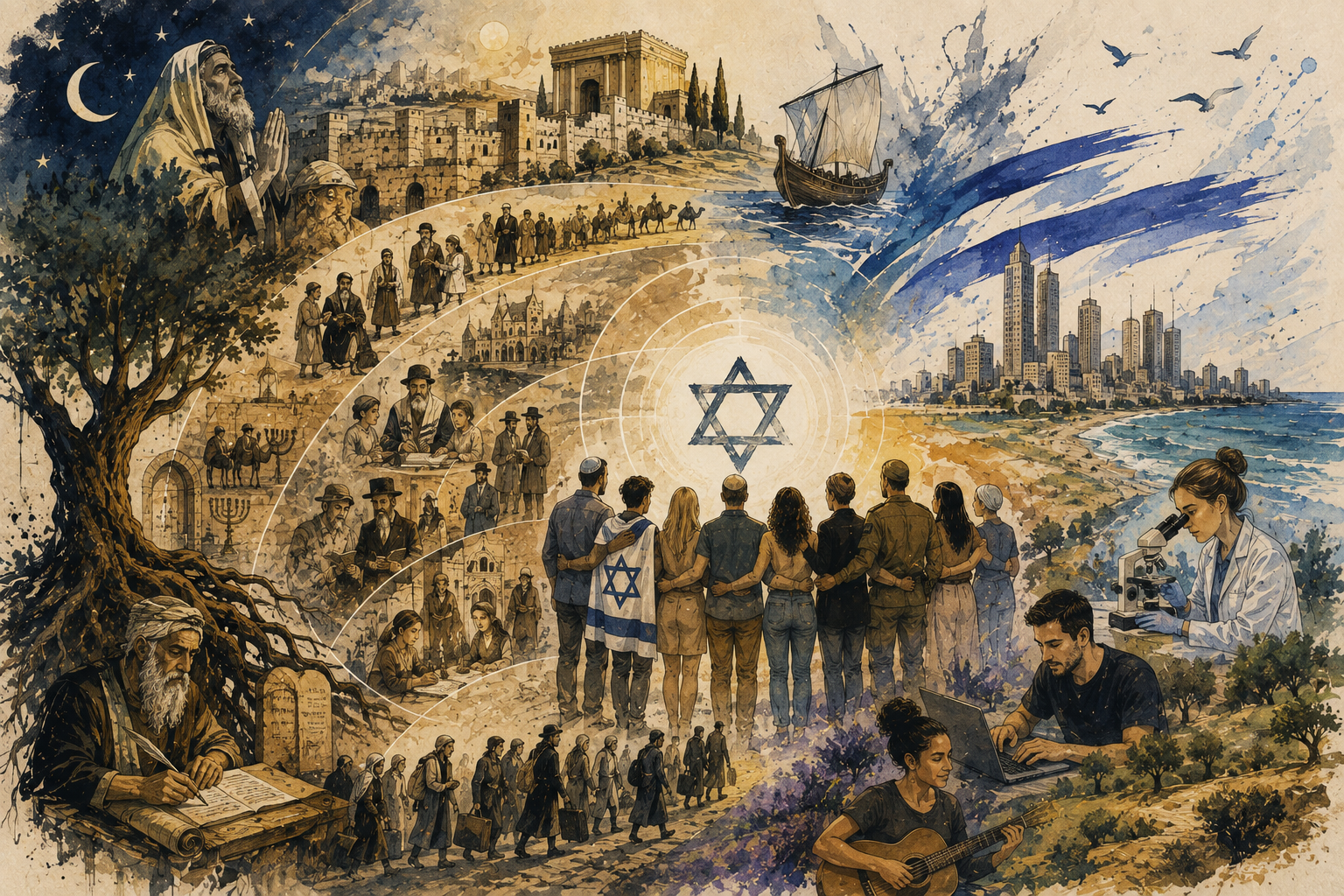
The room fell silent before anyone realised why.
My professor at Reichman University had asked what should have been one of the easiest questions of the semester.
“What does it mean to be Israeli?”
Around me sat students who had been born in Israel, educated in Israel, and shaped by Israeli society from childhood. Their answers were thoughtful. Some spoke about democracy. Others spoke about military service, Hebrew, innovation, resilience, or Israeli culture. Every answer captured something recognizably Israeli.
Yet as I listened, I became increasingly uneasy.
Every answer described Israel. None seemed to explain why Israel exists.
I left that classroom carrying an unexpected question.
I had grown up in Sydney. I had never attended an Israeli school, never served in the Israel Defense Forces, never spoken Hebrew with friends or lived inside the daily rhythms of Israeli life. My childhood was shaped by Shabbat dinners, Jewish schools, Hebrew prayers, Jewish history, and stories of Jerusalem.
I expected to spend months learning how to belong. Instead, I found myself experiencing the opposite. Israel felt strangely familiar, as though I had stepped into a place I already knew.
How could someone raised on the opposite side of the world feel so certain that she belonged here, while a room full of Israelis struggled to explain what being Israeli meant?
That question stayed with me for months. Gradually, I began to suspect that we had started with the wrong question.
Every nation tells a story about itself. Some tell the story of a revolution. Others remember an empire, a constitution, a language, or a struggle for independence. These stories do more than explain the past. They answer a deeper question that every political community must eventually confront.
Why do we exist together at all?
Modern democracies have become remarkably sophisticated at answering a different question. They debate constitutions, elections, courts, rights, and the separation of powers with extraordinary precision. These institutions determine how political power should be exercised. They are indispensable to a free society.
Yet they cannot answer the question that comes before all the others.
Why does this nation exist?
That question cannot be settled by an election or decided by a court. It belongs to history, memory, and identity. It belongs to the stories a people tells about itself and the inheritance it passes from one generation to the next.
Before asking what it means to be Israeli, perhaps we must first ask a much older one.
What does it mean to belong to the Jewish people?
The English language describes Judaism as a religion. The more I reflected on that word, the more convinced I became that it was too small. Judaism is certainly a religion. But it is also a civilization. It is a people. A language. A moral and legal tradition. A collective memory. An inheritance carried across generations.
Long before there was a State of Israel, there was the Jewish people. Long before there was an Israeli passport, there was Jerusalem, Hebrew, and Torah. There were festivals that synchronized Jewish life across continents. There was exile, and the hope of return. These were not merely religious practices. They were the architecture of a civilization that endured for centuries without political sovereignty.
For me, the Torah is far more than a religious text. It is the foundational narrative of Jewish civilization. Whether one understands it as divine revelation or as the founding document of a people, it tells the story through which generations of Jews understood who they were, where they came from, and why the Land of Israel occupied such a central place in their collective memory.
For thousands of years, Jews turned toward Jerusalem in prayer. They read the same biblical narratives. They celebrated festivals rooted in the seasons of the Land of Israel. At the end of every Passover Seder they declared, “Next year in Jerusalem.” Without that shared narrative, it is difficult to understand how a dispersed people maintained such a persistent attachment to the same homeland across centuries of exile.
The modern State of Israel did not create the Jewish people. Rather, the state emerged from a people whose historical, cultural, linguistic, and spiritual relationship with the Land of Israel long predated modern sovereignty.
That realization changed the way I understood my own sense of belonging. I did not feel at home in Israel because I recognized Israeli culture. I felt at home because I recognized the civilization from which the state emerged. Rabbi Jonathan Sacks argued that Jews are not merely adherents of a religion but members of a people. His words gave language to something I had experienced long before I could explain it.
Understanding Judaism this way changed how I understood Israel. The debate over whether Israel is Jewish or democratic often assumes these are competing values. I have come to think they answer different questions. Democracy explains how the State of Israel governs itself. Jewish peoplehood explains why it exists.
This is not the only way to read that debate, and it is worth sitting with the alternative before dismissing it. Many secular Israelis, and most Israeli Arab citizens, would reject the claim that Jewish peoplehood is the state’s foundation at all, for the latter, it is precisely what makes the state feel like someone else’s home rather than a shared one. A universalist critic would say that grounding a state’s legitimacy in the history of one people, however ancient, sits uneasily with the promise of equal citizenship for all who live under it. These are not objections that dissolve once we distinguish “why” from “how.” A state’s answer to why it exists shapes who it is understood to exist for, which is itself a live and unsettled question in Israeli life. I do not think this collapses the distinction I am drawing. But it means the distinction is a starting point for an argument, not a settlement of it.
With that caveat in place, I still think the distinction holds something true. When I say that Judaism comes before democracy, I do not mean that democratic rights are secondary or optional. Democratic institutions are indispensable. They protect liberty, restrain power, and safeguard the equal dignity of every citizen. I mean something more fundamental: purpose comes before procedure. Every state must first know why it exists before it can decide how it should govern itself.
Israel’s Declaration of Independence reflects this distinction. It begins with the history of the Jewish people and their enduring connection to the Land of Israel before committing the new state to equality of social and political rights for all its inhabitants, irrespective of religion, race, or sex. Whether one agrees with every implication of the Declaration or not, its structure is revealing. It addresses the question of purpose before turning to the question of governance.
More than a century ago, the essayist Ahad Ha’am made an argument that has stayed with me. Writing decades before the state existed, he broke with much of early Zionist thought by insisting that a Jewish state was not an end in itself. Political sovereignty, he warned, could restore Jewish power, but power was not the same as purpose. A state built only to solve the physical problem of Jewish survival, without a living Jewish civilization animating it, would eventually face a second crisis: a crisis of meaning. He wanted Israel to become not merely a state where Jews were safe, but a spiritual center, a place whose culture, language, and moral seriousness could nourish Jewish life everywhere. His warning was not against sovereignty but against mistaking sovereignty for the whole of the project. A century later, his distinction between the state as refuge and the state as civilization still describes the choice Israel keeps having to make.
One memory from that time has stayed with me longer than the others. As part of a cross-cultural dialogue program, our group gathered around a long table and was asked to bring a single photograph, one image that represented our identity, set face up, no explanation offered yet.
One by one, we laid them down.
A Palestinian student placed a photograph of an olive tree, its trunk knotted with age, roots exposed where the soil around it had worn away. Another set down a print of Al-Aqsa Mosque, its dome catching the light. A third added a faded picture of her grandmother’s village, a house that no longer stood.
Then the Jewish Israeli students added theirs. One placed an image of Arik Einstein mid-song, guitar in hand. Another set down a photograph from an army swearing-in ceremony, taken at night by torchlight. A third added a picture of a Tel Aviv rooftop at sunset.
I placed mine last: the Western Wall, its stones worn smooth by centuries of hands and prayer.
For a moment no one spoke. We simply looked at the table, at the small, private choices now lying next to one another, each photograph answering a question none of us had been asked directly. What makes you who you are?
What struck me was not that our symbols were different. Different communities naturally remember themselves through different stories. What stayed with me was something else. Many of the Arab students had instinctively reached for images stretching across generations, a tree, a mosque, a lost village. Many of the Jewish Israeli students had reached for images of a life being lived now, a song, a ceremony, a skyline. Neither choice was right or wrong. But looking at that table, I found myself wondering whether we had answered different questions without realizing it. One pile seemed to describe where its owners came from. The other seemed to describe what their lives looked like now.
I left wondering whether modern Israeli education has become exceptionally successful at cultivating Israeli citizenship while becoming less confident in articulating the older Jewish civilization from which the state emerged. If that is true, the challenge is not only political. It is educational. It is civilizational. A society can teach its children how institutions function. It must also teach them why those institutions exist.
This does not mean Israelis must all live the same way. The Jew studying Torah in Bnei Brak and the entrepreneur building a company in Tel Aviv may appear to inhabit different worlds. They may vote differently, dress differently, pray differently, or not pray at all. They may imagine very different futures for Israeli society.
I want to be honest about how far this claim can be pushed, because it is often asserted more easily than it is defended. The disputes between these two Israels are not cosmetic. They concern conscription, state funding, marriage law, and whose vision of Jewish life the state should embody, arguments serious enough that each side sometimes describes the other as having abandoned the shared project altogether. I do not think shared inheritance resolves any of those disputes, and I would not want to suggest that invoking a common civilization is a substitute for winning them.
What I do think is that those disputes are only legible as disputes within a shared inheritance, the same Jerusalem, the same language of return, the same story of exile and homecoming, the same people, rather than as encounters between strangers who happen to share a border. Families argue precisely because they are families; the argument does not disprove the kinship, even when it is bitter enough to make the kinship hard to feel. A healthy democracy depends on disagreement. But if we lose sight of the deeper story that binds us together, our political disagreements begin to feel like conflicts between strangers. If we recover that story, we may still disagree passionately, but we do so knowing we are arguing within a shared home and a shared history.
I still think about my professor’s question.
“What does it mean to be Israeli?”
Today I think the answer begins somewhere older.
Before the state.
Before politics.
Before sovereignty.
It begins with the story of a people.
A state can create citizens. Only a shared story can create a people.