
A Day in the Life
Why Game Theory Fails to Explain the Iran War
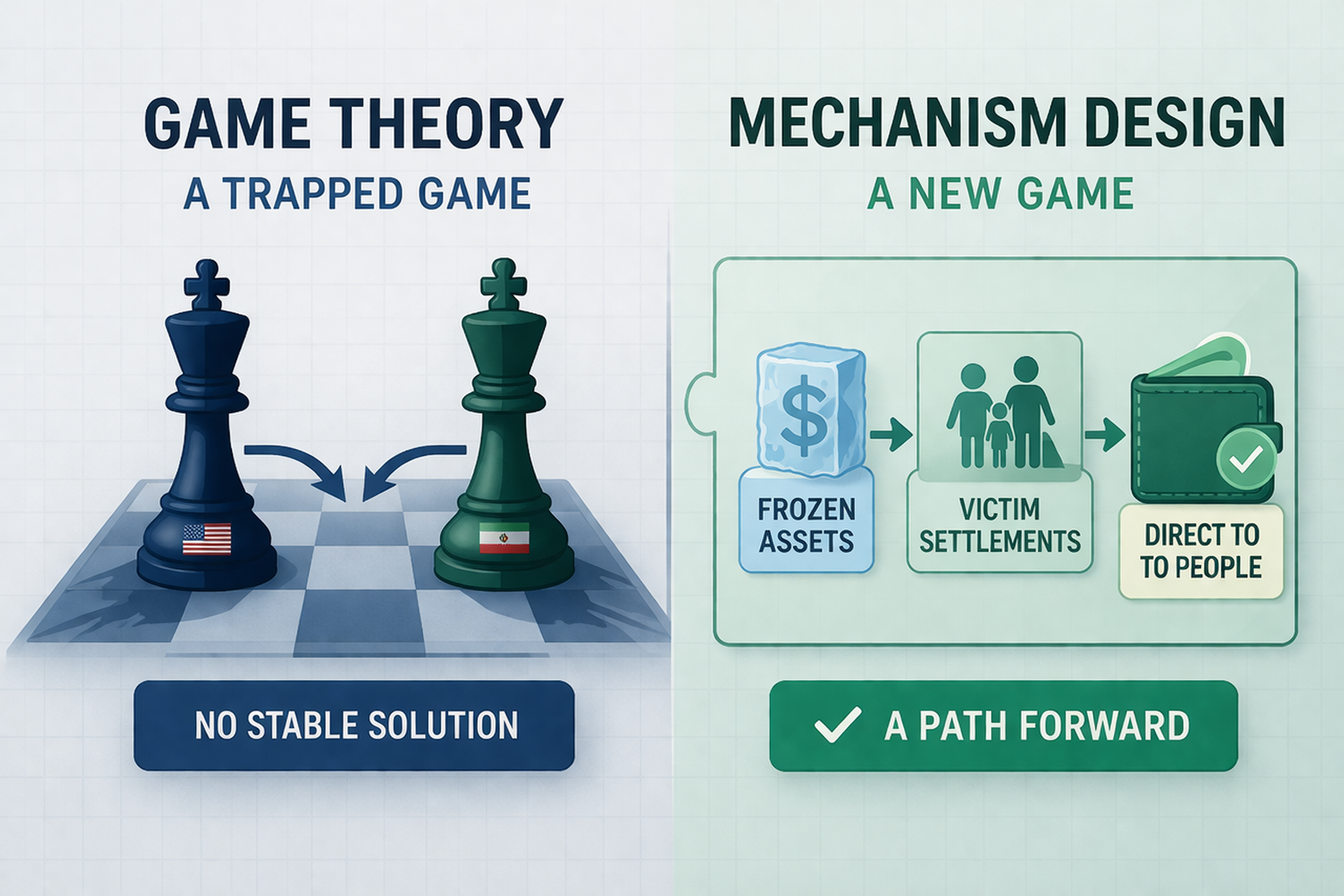
Game theory vs Mechanism design. Free and Fair Use. created by Miftan Labs
One month into the war with Iran, the game theorists have converged. They are right but only if the strategy space remains the same. If the game being analyzed is the only game that exists. They are fundamentally wrong, because there is no such thing as a static game that never changes and they have mistaken the boundaries of their model for the boundaries of the possible.
Bloomberg models it as an escalation spiral with no exit. The academic literature produces mutual entrapment. Multiple independent analyses arrive at a degraded stalemate — a Nash equilibrium where no player can improve their position, but all are worse off. Prisoner’s Dilemma. Chicken. Screening games. Commitment traps. War of attrition. Different frameworks, identical conclusion: no stable equilibrium produces a good outcome.
Every analysis I’ve read defines a fixed strategy space — escalate, negotiate, attrit, withdraw — computes equilibria over those moves, finds no stable solution, and concludes: there is no endgame. But this conclusion contains a hidden assumption that no one is stating explicitly: that the strategy space is closed. That the moves currently on the board are the only moves that can exist.
Mechanism design — the inverse problem of game theory, the discipline Leonid Hurwicz won the Nobel Prize for — exists precisely to address it.
Equilibrium analysis asks: given this game, what happens? Mechanism design asks: given the outcome we want, what game produces it? One computes over a fixed strategy space. The other expands it. Every game theorist writing about Iran is doing the first. None are doing the second.
I did the second. Here is what I found.
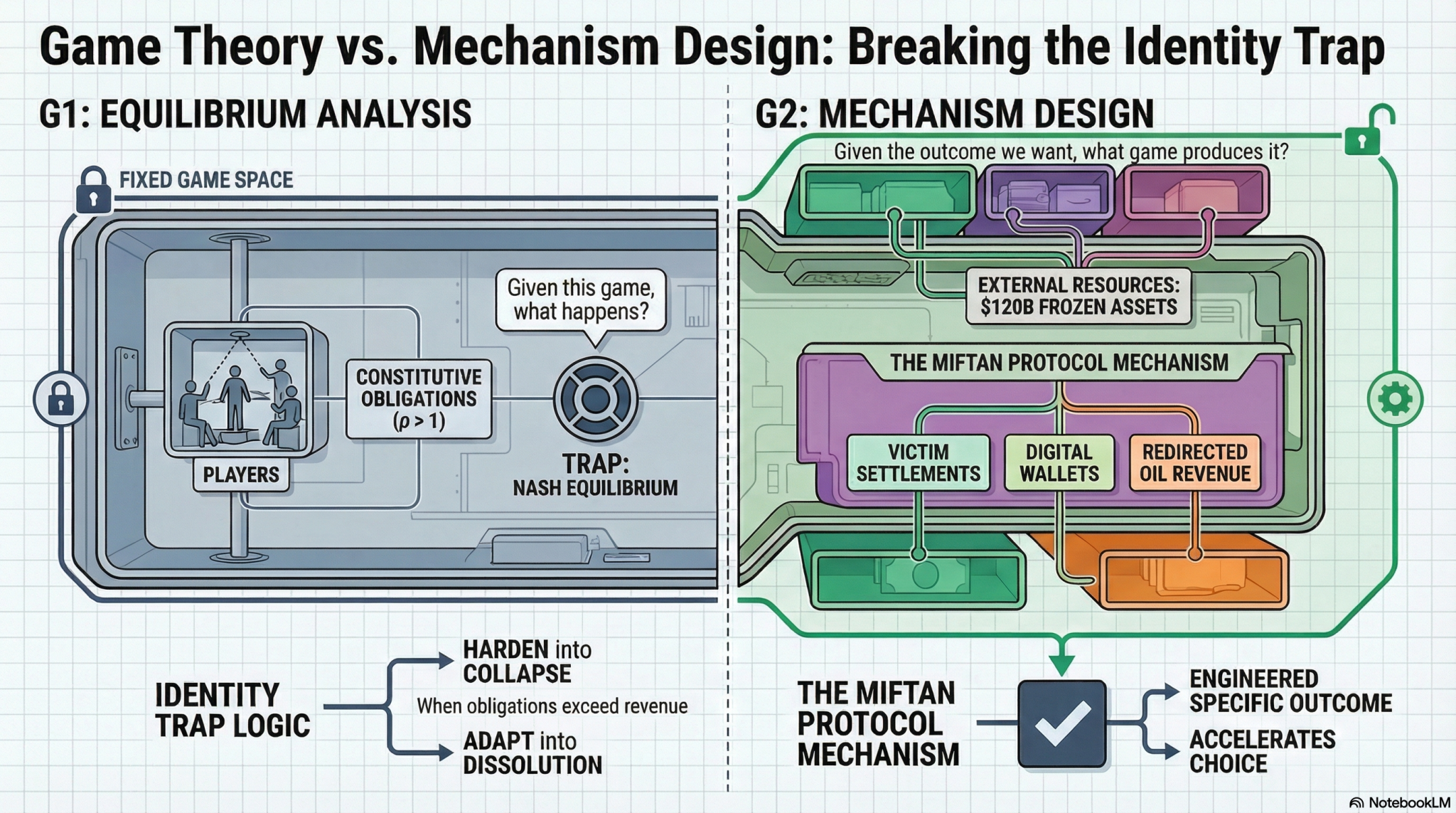
Why the Current Game Is Trapped
I’ll use the framework I developed in The Identity Trap (SSRN, February 2026) because it was built for precisely this class of problem — organizations that march into their own destruction not because they can’t see the threat, but because every path to survival requires them to stop being who they are.
An organization’s identity is its constitutive action set — the performed actions, internal and external, whose cessation dissolves the coalition from within. It is a formalization of identity as a correlated equilibrium (extending Aumann 1974, 1987): the self-enforcing coordination device that tells each member what to do, what to expect, and what rewards to anticipate. The constitutive actions are the organization’s identity.
The IRGC’s external constitutive actions include proxy network operation (Hezbollah, Houthis, Iraqi militias), nuclear program advancement, Strait of Hormuz operations, and anti-Western military posture. Its internal constitutive actions include Basij paramilitary stipends, military pensions for 190,000+ active personnel, bonyad patronage networks, martyrs’ family payments, and community funding programs. As with Kodak — the company that invented the digital camera and spent three decades defending film — the IRGC’s identity is more about what it owes its members than what it does in the world.
The critical variable is what I call organizational rigidity: ρ = total obligations / total value generated. When ρ is below 1, the organization has slack. When ρ crosses 1, no feasible allocation satisfies all members simultaneously.
In plain language: the IRGC is now close to owing more to its own people and proxies every month than it can supply.
According to my estimation Iran was pre-war: ρ ≈ 0.7–0.8. The system had slack. Now — their religious leadership assassinated, strike capacity degraded 80–90%, over fifty naval vessels destroyed, command structure decapitated, oil infrastructure targeted, and China halting refined oil exports on March 12 — estimated monthly revenue has collapsed to $1.5–2 billion against obligations of approximately $2.5 billion per month. ρ has crossed 1. The organization is functioning at a loss.
The Identity Trap theorem proves: when ρ crosses 1, no feasible action set preserves both the organization and its survival. Two paths exist. Both are terminal.
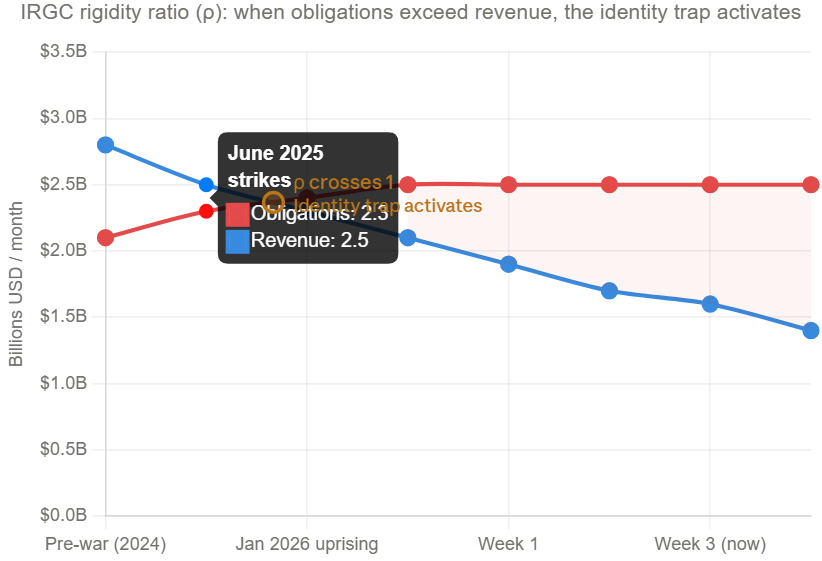 Let’s examine the options:
Path 1 — Hardening. Continue doing what you’ve always done. Double down, refuse to cut any obligations even as revenue falls. Refuse to negotiate or soften a stance even under pressure and pushback either internal or external. The triage between funding proxies and paying military pensions — both constitutive — is a mechanism of collapse. This was already visible before the war: the January 2026 crackdown killing thousands of protesters is the most extreme domestic enforcement in the Republic’s history. Escalating coercion with diminishing returns is the signature of identity performed at a loss.
Path 2 — Adaptation. Stop doing something constitutive. Abandon proxies — the Quds Force subcoalition defects. Reduce Basij stipends — domestic enforcement fractures. Become more liberal and soften the position, the die hards revolt. If they accept the US 15-point plan’s demands to dismantle nuclear capabilities and cease proxy support — the revolutionary identity is negated. Each adaptation path empties the coalition through obligation breach.
This is why the US 15-point proposal was rejected. This is why Iran’s 5-point counter is unacceptable to Washington. Both require the other side to cease constitutive actions. Neither side can accept without triggering its own dissolution.
The game theorists who model this as a commitment trap are correct. But they draw the wrong conclusion. They conclude: stalemate. The correct conclusion is: no solution exists within this game. The game must change.
What’s Not on the Board
Now consider what exists right now, in the real world, that appears in none of these models:
Finances
$100–120 billion in frozen Iranian assets across a dozen jurisdictions. Some frozen for 47 years. Generated by Iranian oil and gas. Frozen because of the regime’s actions — hostage-taking, nuclear proliferation, terrorism, proxy warfare. Never touched by the Iranian people. South Korea holds ~$7 billion. Japan ~$3 billion. Iraq ~$5 billion. China ~$20–30 billion. The US, EU, UK, and others hold the rest.
Legal Authority
These assets are accessible under existing US legal authority — IEEPA Section 1702(a)(1)(C), the confiscation provision added by the PATRIOT Act. President Bush used this exact provision in 2003 to confiscate $1.7 billion in Iraqi assets during armed hostilities. Courts upheld it. The factual predicate — armed hostilities with Iran — is met today. No new legislation required.
21,723 American families holding $102.2 billion in court judgments against the Islamic Republic of Iran. Beirut Marines families who have waited 43 years. Original hostage families — 47 years. 9/11 families. Iraq and Afghanistan veterans who won judgments in 2024–25. These are enforceable against the Islamic Republic’s frozen assets under the Terrorism Risk Insurance Act.
Here is an important part that should alarm everyone: if the Islamic Republic ceases to exist — through regime change, successor state, or collapse — the liable party ceases to exist and these claims become legally ambiguous. It is what happened with the Soviet dissolution. It is what happened with post-invasion Iraq. The war America is winning is actively destroying its own citizens’ legal claims. This legal window closes faster with every day of military success. This doesn’t affect the outcome, but it damages the US constitutive set and Trump’s commitments to veterans.
Momentum
88 million Iranians who were in open revolt weeks before the war started. Five million in the streets. The largest protests since 1979. Suppressed by massacre, not converted. They demonstrated the will. They lack the resources and the infrastructure.
These resources — capital, legal authority, popular will, structural vulnerability — exist in reality but not in any model. The strategy space looks closed because the models exclude the moves these resources enable because they haven’t been mapped, not because they don’t exist.
Building the Next Game: The Miftan Protocol
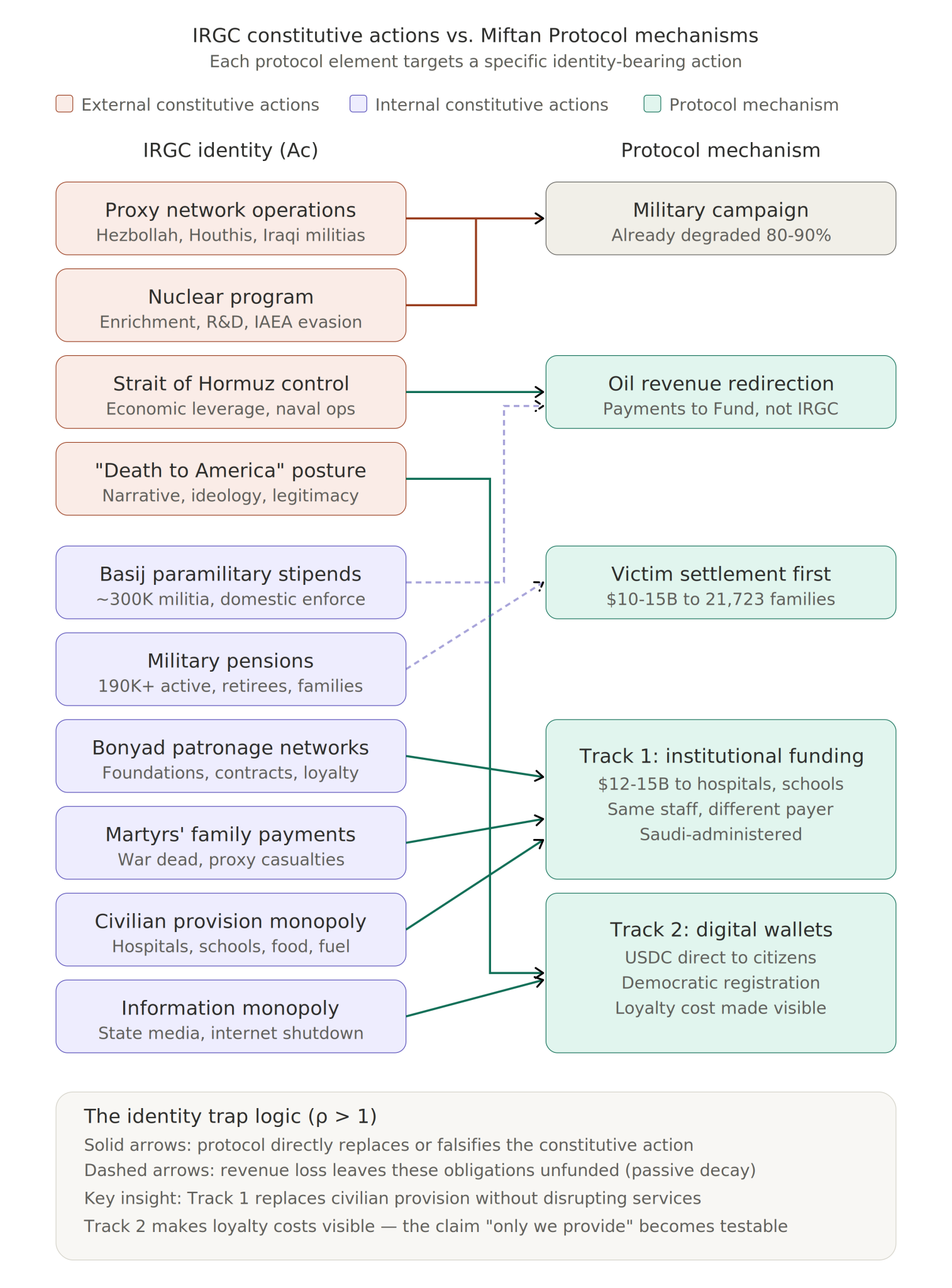
Mechanism design puts new moves on the board. Here is the mechanism I’ve published as the Miftan Protocol.
The IRGC’s power over the Iranian population rests on four claims that have never been tested — not because they are true, but because the regime controls the conditions that would produce the test:
“The West stole your money.” The population cannot access $100–120 billion in frozen assets to verify. “Only we provide.” No alternative provider exists. “The resistance is winning.” State media monopoly prevents independent verification. “Loyalty is strength.” No visible alternative to regime loyalty exists, so the cost of loyalty is hidden.
The Miftan Protocol is designed to produce the test each claim was preventing. Not counter-narrative. Not propaganda. Falsifiable signals — mechanisms where the claim either holds up or it doesn’t, and the evidence is visible.
The Mechanism — Step by Step
One executive order from President Trump, issued under existing IEEPA authority, releases frozen Iranian assets into an internationally administered trust: the Iranian People’s Fund.
Priority One: Pay American terrorism victims first. This is important to the US constitutive set, to the people who have lived and given their lives to make this moment possible. They are in the game space but have not been recognised.
21,723 families receive negotiated settlements from the asset pool — $10–15 billion — before any dollar flows to Iran. This must happen while the Islamic Republic still legally exists as the liable party. Mass tort settlements against sovereign defendants routinely resolve at 5–15% of judgment value. The 9/11 Victim Compensation Fund achieved 97% acceptance at comparable ratios. Paying the victims clears the legal lock on the assets and is the most politically powerful first move available. This is also the move that is most time-sensitive: the window closes whether America wins or loses.
Priority Two: Replace IRGC civilian provision. Fund payments flow to existing Iranian hospitals, schools, food systems, and pensions — same institutions, same staff, different payer. The Iranian population experiences continuity. The IRGC loses its monopoly as provider. “Only we provide” becomes falsifiable. Operational within 2–4 weeks of fund capitalization. Saudi Arabia is the proposed regional administrator — conditioned on full normalization with Israel, completing the Abraham Accords architecture.
Priority Three: Direct payments to Iranian citizens. USDC-based digital wallets distribute funds directly to individual Iranians. The wallet is also democratic infrastructure — identity verification, voter registration, constituent communication. The fund pool divides equally among all registered holders. If the IRGC tells loyalists not to register, the pool concentrates among those who do — loyalty becomes a measurable economic cost instead of a hidden one.
Oil revenue redirection. China purchases approximately 90% of Iran’s oil exports (~$3 billion/month). The Fund demands that all countries purchasing Iranian oil redirect payments to the Fund instead of the IRGC, stripping the regime of its primary remaining revenue source.
Zero cost to American taxpayers. The entire mechanism is capitalized by frozen Iranian assets — money that has been sitting in banks for up to 47 years. No appropriation required. No boots on the ground. The IRGC’s own seized assets fund its replacement.
Why the IRGC Cannot Respond
I tested this mechanism adversarially — AI systems playing the IRGC with full strategic optimization, human players with game theory expertise commanding the IRGC across multiple war game runs. The response matrix contains no cell that preserves the coalition:
Block the Fund → Population denied aid while an alternative exists. Confirms the narrative that the regime is the obstacle. Fund operates externally regardless.
Allow the Fund → IRGC monopoly on provision is broken. Subcoalition defection incentivized. The population can now compare.
Crack down on registration → Per-person wallet values increase for those who register despite the crackdown. Loyalty’s cost becomes more visible, not less. Crackdown consumes enforcement resources the organization can no longer afford at ρ > 1.
Accept the Fund → Requires accepting foreign-administered provision, Saudi-Israeli normalization, and democratic infrastructure. The IRGC that accepts the Fund is no longer the IRGC. In adversarial play, this move — attempted at high ρ with the framing “it was always our money” — destroyed the coalition faster than hardening did.
The predicted response, based on the Identity Trap framework, is hardening. More missiles. More crackdowns. More Hormuz escalation. This is individually rational — it is the only response that doesn’t require breaking internal promises. But hardening consumes non-replaceable resources while the Fund operates on an external, self-sustaining resource base.
The Fund does not need the IRGC’s cooperation. It does not need Iran’s agreement. It produces the tests the identity was blocking. The identity trap — already triggered by the military campaign — becomes irreversible.
What the War Games Show
I tested the mechanism against two controls.
Baseline — the war alone, no mechanism. The IRGC survived 10 turns. It is a stalemate that the analysts and game theorists accurately map. The military campaign crossed three of six sustainability thresholds: military capacity, proxy network, and revenue. It could not cross the fourth. Internal cohesion held because wartime justifies discipline. Population control held because no alternative to the regime existed. And here is the finding that should concern every policymaker: narrative credibility — the “Guardian of the Revolution” identity — rose from 0.600 to 0.660 after ten turns of sustained bombardment. The war fuels the identity it is trying to destroy. Every analyst predicting stalemate is seeing this dynamic correctly within the game as I built it.
Randomized game — both sides playing without strategy. The IRGC collapsed in five turns. But into a vacuum. No wallet. No victim settlement. No democratic infrastructure. No alternative provision. The regime fell and nothing replaced it. Blue won the war and lost the peace. This is Iraq. This is Libya. This is what happens when you destroy without building what comes after.
With the Miftan Protocol deployed. Collapse in six to seven turns. Victim settlement executing. Millions of wallet holders. Saudi-Israeli normalization advancing. Alternative provision reaching hospitals. The mechanism didn’t change whether the IRGC fell — the war’s passive dynamics guarantee that when ρ > 1. It changed what existed on the other side. In multiple game play, some elements worked and some didn’t. The is the stochastic nature of the game and the fog of war. But the Miftan Protocol does not need every move to work in order to create a win.
Three games. Same war. The variable is the mechanism. The question was not just “does the IRGC survive?” The question is also: what fills the vacuum?
In the last playtest, a human player commanding the IRGC hardened for six turns — narrative defense, patron operations, Hormuz escalation, counter-wallet, victory declarations. All rational. All constitutive. On Turn 7, with three thresholds crossed on passive decay alone, they accepted the Fund. “It was always our money.” The acceptance destroyed the coalition faster than the bombs did. The subcoalitions revolted. Five of six thresholds crossed in a single turn. The theorem predicted the sequence. The human player confirmed it.
The Window Is Closing in Both Directions
The window is the war. It closes two ways.
If the war ends without a new mechanism, the IRGC renegotiates obligations, reconstitutes what it can, pushes ρ back below 1. The structural conditions for collapse reverse. The frozen assets remain frozen. The current game resumes. The analysts are right. Stalemate.
If the regime falls without the victim settlement executed, 21,723 American families lose everything. The liable party ceases to exist. A successor state claims the frozen assets as national patrimony. The Beirut Marines families who waited 43 years get nothing. The 9/11 families get nothing. America wins the war and its own citizens pay the price.
The April 6 deadline on power plant strikes is days away. Iran’s response to the 15-point proposal is imminent. Both directions are closing.
One executive order. Existing legal authority. $100 billion in frozen assets. 21,723 families waiting. Zero taxpayer dollars. Zero boots on the ground. It seems simple. It is — it’s just not easy. The Miftan Protocol is a blueprint for what is possible.
The game theorists are right that the current game has no solution. They are wrong that there is no endgame. The endgame is in the “next game” which is G₂. All sides are still playing G₁, while the game state has definitely changed.
The war and the uprising built its preconditions. What doesn’t exist yet is the mechanism that makes them irreversible. The game can revert to G₁, Iran can stabilise and survive. The frozen assets are the capital. The legal authority is the instrument. The victim settlement is the first move. The identity trap is the strategic logic. The war is the window.
I built a war game engine that makes this testable. Play Red — command the IRGC. Try to survive ten turns against the mechanism. Find a strategy that preserves both the Guardian identity and the organization’s survival. If you can, the theorem is falsified. Nobody has found one yet. That doesn’t mean it doesn’t exist. There could be moves that I don’t see, or a strategy that I have missed. That’s the point of the game- to produce insight that is actionable.
Related Topics
Related Posts