
Professional Indian author and strategic affairs writer.
Why Haifa Is Now India’s Most Important Address
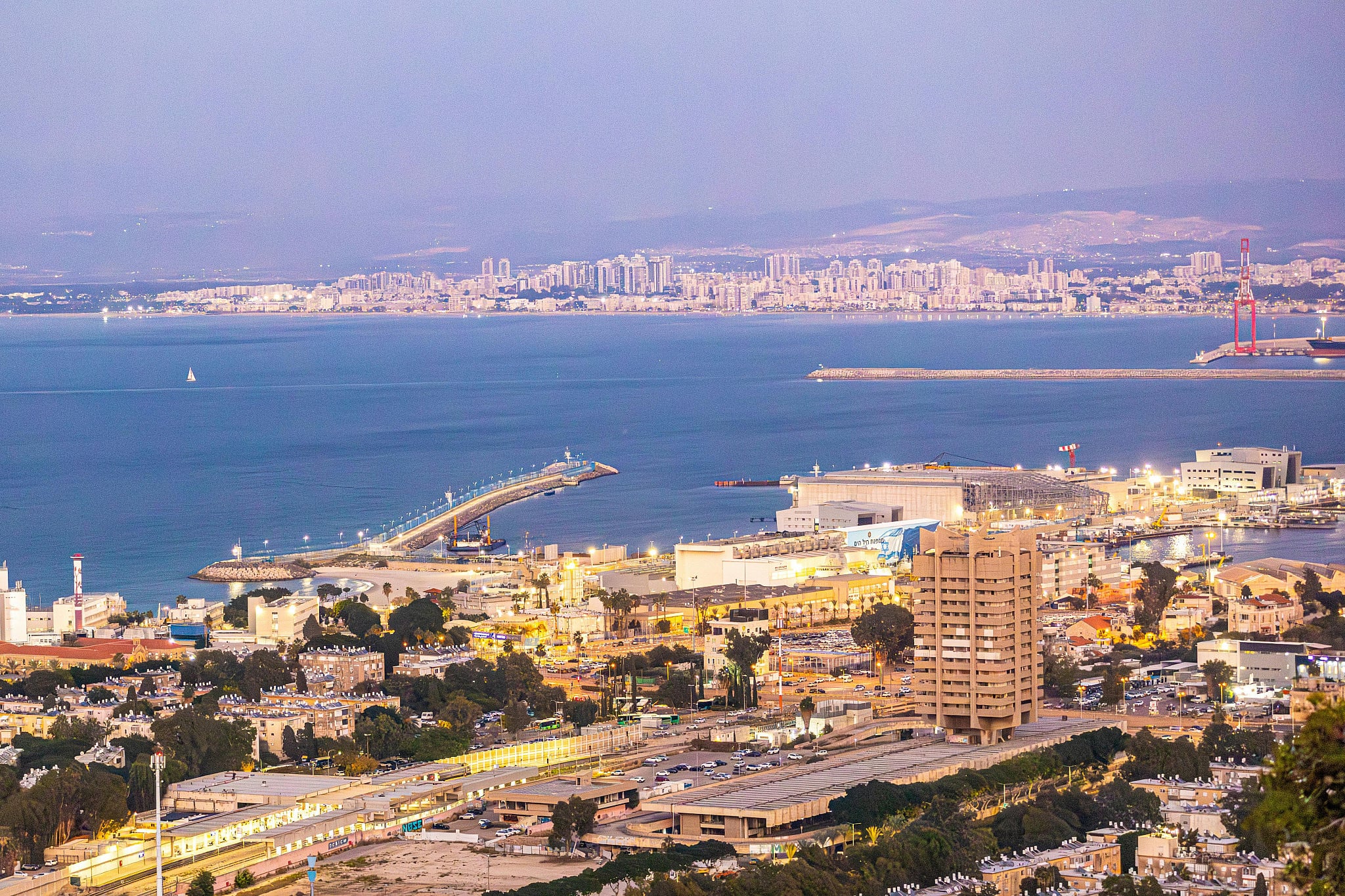
Haifa, Israel: An elevated perspective of the port and city infrastructure as dusk settles. (Pexels)
There is a cemetery in Haifa, Israel, within walking distance of the city’s port. It is small and quiet, shaded by trees, and contains 44 graves. The men buried there are Indian soldiers who died in World War I, fighting under a British flag in a land most of them had never heard of, against an Ottoman army they were ordered to break. They were cavalrymen from Jodhpur and Mysore, Rajput lancers who charged enemy machine guns on horseback. Most Indians have never visited this cemetery, and most have never learned that it exists.
I grew up knowing nothing about it. I suspect most of you reading this did not either.
What follows is the story of why that cemetery matters more in April 2026 than it did in 1918 and why a single city on the Mediterranean coast has appeared, with almost eerie consistency, at every defining moment in the India-Israel relationship across more than a century.
September 23, 1918: The Charge Nobody Taught Us About
The Battle of Haifa was fought in a single afternoon.
On September 23, 1918, the 15th Imperial Service Cavalry Brigade was ordered to capture the fortified Ottoman-held city of Haifa. The brigade was composed almost entirely of Indian soldiers from the princely states: the Jodhpur Lancers, the Mysore Lancers, and detachments from Hyderabad, Patiala, and others. Their commander for the critical assault was Major Dalpat Singh Shekhawat of the Jodhpur Lancers.
What they were asked to do was, by any conventional military assessment, nearly impossible. The approach to Haifa runs through a narrow defile between the steep slopes of Mount Carmel to the south and the swift, marshy Kishon River to the north. The Ottoman defenders, reinforced by German and Austrian troops, had positioned machine guns and artillery to cover every angle of this approach. The combined Ottoman, German, and Austrian garrison numbered approximately 1,500 men with 15 cannons and several heavy machine guns.
The Jodhpur Lancers numbered around 400. They were armed with lances and swords.
At around 2 in the afternoon, they charged. The Jodhpur Lancers came under machine gun and artillery fire almost immediately. The riverbanks were swampy and threatened to bog down the horses. Major Dalpat Singh wheeled his regiment to the left, up the lower slopes of Mount Carmel, trying to find a path through. He was shot by machine gun fire during that maneuver and mortally wounded. He died the following day and was laid to rest, as one account puts it, “in the shade of an olive grove at Mount Carmel.”
His men kept going.
They broke through the Ottoman defenses and galloped into the city, and by nightfall, Haifa had fallen. Together the two regiments captured over 1,300 prisoners, 17 artillery guns, and 11 machine guns. The Jodhpur and Mysore Lancers together had done what an army of professional soldiers with cavalry, artillery, and light armored cars had repeatedly failed to do.
Military historians call it one of the last successful cavalry charges in the history of modern warfare. The Indian Army marks September 23 every year as Haifa Day.
In New Delhi, a memorial was erected in 1922: three bronze figures of cavalrymen from Hyderabad, Mysore, and Jodhpur, standing around a white triangular obelisk. It was called Teen Murti, the Three Statues. For nearly a century, most Indians who passed it had no idea what it commemorated.
2017: The First Indian Prime Minister to Stand at Those Graves
When Narendra Modi landed in Tel Aviv on July 4, 2017, becoming the first Indian prime minister to visit Israel on a bilateral trip, his itinerary included something that received far less coverage than the defense deals and the agricultural agreements.
He went to Haifa.
At the Indian War Cemetery, Modi and Netanyahu stood together at the graves of those 44 soldiers and laid wreaths. Modi said in his remarks: “Around 150 kilometers from here, there is a slice of history in the city of Haifa that is very dear to my country. This is the final resting place for 44 of the Indian soldiers who sacrificed their lives during World War I to liberate the city.”
He was not reading from a diplomatic briefing note. He was invoking a connection that predated modern India, predated the state of Israel, and predated diplomacy between the two countries by several decades. The fact that Indian horsemen once liberated a Jewish city from Ottoman occupation was almost entirely unknown to both publics before that visit. By the time Modi left Israel, it was not.
Six months later, in January 2018, Netanyahu visited India. His first stop in New Delhi was the Teen Murti Memorial. Standing alongside Modi, he watched as the monument was formally renamed Teen Murti Haifa Chowk, its new name acknowledging the connection that had been embedded in stone since 1922 but had never quite been said out loud. The two leaders laid wreaths at the feet of the three cavalrymen.
I find something worth pausing on in that image: two sitting prime ministers, standing at a century-old memorial in the capital of one of the world’s most populous democracies, performing a ceremony of remembrance for a battle most of their citizens did not know had happened.
January 2023: An Indian Billionaire Buys the Port
In July 2022, the Israeli government held a tender for the privatization of Haifa Port, the second largest in Israel, a strategic Mediterranean hub that handles roughly 30 million tons of cargo annually. Among the bidders was the Adani Group, India’s largest port developer, operating through Adani Ports and Special Economic Zone Limited.
Adani won, in partnership with Israel’s Gadot Group. The deal, valued at approximately $1.2 billion, gave Adani a 70 percent stake in Haifa Port, with the lease running until 2054. It was completed in January 2023, and Netanyahu, standing alongside Gautam Adani at the signing ceremony, said something that I have not been able to stop thinking about since.
“Over 100 years ago, it was brave Indian soldiers who helped liberate the city of Haifa. And today, it is very robust Indian investors who are helping to liberate the port of Haifa.”
Adani, for his part, specifically invoked the 1918 battle in his own remarks, noting that the India-Israel friendship dated back to September 23, 1918, when soldiers from Mysore, Hyderabad, and Jodhpur had fought for this city.
The Haifa Indian Cemetery, where those soldiers lie buried, is within walking distance of the port that an Indian company now operates.
There is something almost fictional in the symmetry of that geography, except it is entirely real.
One More Detail Nobody Has Written About
Here is the part of the Haifa Port story that almost everyone missed in the January 2023 coverage and which now looks extraordinarily significant.
Haifa has two major port facilities sitting near each other. The older one, Haifa Port, is the one Adani acquired. The newer one, Haifa Bay Port, had its 25-year management contract awarded in 2018 to the Shanghai International Port Group, a Chinese state-owned enterprise. The Chinese port has been operational since 2021.
So in the most strategically significant Mediterranean port in the Eastern Mediterranean, an Indian company and a Chinese company are operating competing facilities, almost side by side, in an Israeli city.
This is not a metaphor. It is a physical fact. And it means that the competition between India and China for influence over the emerging trade corridors connecting Asia, the Middle East, and Europe is playing out, concretely and visibly, in the port that Indian soldiers liberated in 1918.
The United States had in fact pressured Israel for years to reduce Chinese involvement at Haifa, citing concerns about Chinese intelligence access to the port’s proximity to Israeli naval facilities and US Navy ships that dock there. The Adani acquisition was, among other things, Washington’s preferred answer to the Shanghai International Port Group’s presence.
India, in short, was brought in partly to push China out.
February 28, 2026: Iranian Gunboats Fire on Indian Ships
On February 28, 2026, the United States and Israel launched Operation Epic Fury, targeting Iranian military infrastructure, command centers, and ballistic missile sites. Iran’s supreme leader Ali Khamenei was killed in the strikes. Within hours, Iran’s Islamic Revolutionary Guard Corps began issuing warnings over VHF radio that passage through the Strait of Hormuz was not permitted.
The Strait of Hormuz, a narrow waterway between Iran and Oman, is the single most important maritime chokepoint on earth. Through it passes roughly 25 percent of the world’s seaborne oil trade and 20 percent of its liquefied natural gas. India imports approximately 50 percent of its crude oil through this strait. It imports 80 to 85 percent of its LPG through it. The dependency is not marginal. It is structural.
Within weeks, Iranian gunboats opened fire on Indian-flagged vessels attempting to transit. The VLCC Sanmar Herald was among those forced to turn back. Indian Navy warships deployed under Operation Sankalp escorted Indian carriers through the Gulf of Oman. On March 26, Iran’s foreign minister announced that ships from five nations, including India, would be permitted to transit: China, Russia, India, Iraq, and Pakistan. India had been granted a partial exemption, but one that depended entirely on Iranian goodwill, which has a historically short shelf life.
On April 18, Iran closed the strait again. Indian-flagged ships were once more targeted by gunfire.
The Corridor That Ends in Haifa
In September 2023, at the G20 summit in New Delhi, India signed a Memorandum of Understanding with the United States, the European Union, Saudi Arabia, the UAE, France, Germany, and Italy to establish the India-Middle East-Europe Economic Corridor, known as IMEC. The corridor is a multimodal infrastructure project: ships carrying Indian goods would sail from ports like Mundra or Mumbai to the UAE’s Jebel Ali or Fujairah, where cargo would transfer to a rail network running across Saudi Arabia and Jordan, terminating at a Mediterranean port from which ships would carry goods onward to Europe.
The Mediterranean port at the end of this corridor is Haifa.
The corridor, if built, would reduce shipping time from India to Europe by up to 40 percent and logistics costs by up to 30 percent, compared to the traditional Suez Canal route. It would bypass the Strait of Hormuz entirely. It would run through a port that an Indian company already owns and operates.
Trump, during his meeting with Modi in February 2025, called it “one of the greatest trade routes in all of history,” describing a route from India to Israel to Italy and onward to the United States.
Since the Hormuz crisis erupted in February 2026, the conversation around IMEC has accelerated dramatically. Gulf countries are now urgently studying alternatives to the strait. According to a Financial Times analysis from April 2026, officials and industry leaders have concluded that building alternative routes may be the only practical long-term guarantee against disruption. IMEC sits at the center of those discussions.
As RAND economist Rafiq Dossani put it in March 2026: “If Israel and the US win, IMEC will likely be Israel’s preference over the revival of Chabahar.” India’s other connectivity bet, a route through Iran’s Chabahar Port northward toward Russia and Central Asia, has effectively been closed off by the very conflict that is also closing the Hormuz.
The war that shut one route has, in the same motion, made the other route urgent.
The Thread That Connects It All
I want to step back for a moment and say plainly what the accumulation of these facts means.
In 1918, Indian soldiers died to take a city that mattered to an empire they served, on a coast they had never seen. They had no stake in the city’s future. They were ordered to charge, and they charged.
In 2017, the first Indian prime minister to visit Israel stood at their graves. In 2018, the central memorial in India’s capital was renamed after the city those soldiers had liberated. In 2023, an Indian company bought the port of that city for $1.2 billion, and Netanyahu invoked the 1918 cavalry charge at the signing ceremony. In 2026, as Iranian gunboats fire on Indian ships in the world’s most critical maritime chokepoint, the corridor being most urgently discussed as India’s alternative route to European markets runs through that same city’s port, which India now controls.
Haifa is not a coincidence in India’s strategic geography. It is a recurring destination.
What strikes me most, sitting in India and following these events in real time, is not the geopolitical logic of any individual decision. It is the fact that the city where Major Dalpat Singh Shekhawat died of his wounds in September 1918 has quietly accumulated, over 108 years, an almost implausible density of India’s most consequential relationships: military history, diplomatic symbolism, commercial investment, and now energy security.
The 44 men buried near that port did not know they were laying the foundation of anything. They were simply cavalrymen doing what cavalrymen did, charging into a city they were told to take.
But Haifa keeps finding India. Or perhaps India, without quite knowing it, keeps finding its way back to Haifa.
-Ankit
Related Topics
Related Posts