Leadership With Heart
Why I Came Back to Shul
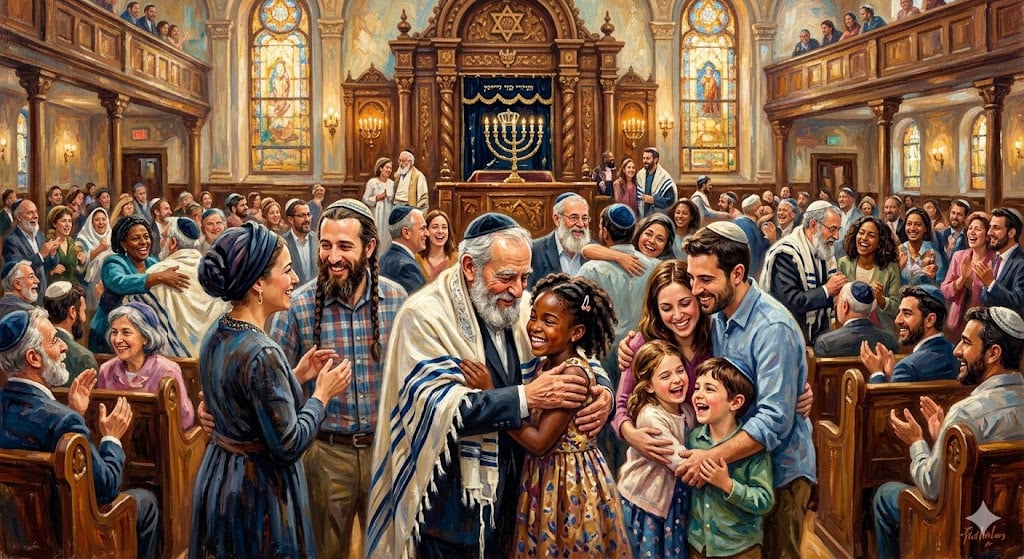
AI generated image
For years, one of the absolute best perks of returning regularly to synagogue has been rediscovering a very specific, distinctly Jewish superpower: our humor. It’s warm, deeply self-aware, and forged through millennia of practicing the art of the collective eye-roll.
Take, for instance, a Shabbat morning not long ago. Right before the Mourner’s Kaddish, the rabbi solemnly read the names of deceased congregants whose yahrzeit fell that week. Finishing the list, he looked out at us and asked, “Are there any other names that should be added?”
I leaned over to my neighbor and whispered, “I can think of a few… though they’re all still breathing.” We exchanged that perfectly restrained, knowing laugh we’ve spent centuries perfecting: dark humor wrapped in total affection.
Our clergy get in on it, too. During a long Presidents’ Day weekend, our rabbi dryly observed that latecomers to services generally split into two distinct political camps: the “FDR crowd,” who arrive just in time for the big speech—for da rabbi—and the “JFK crowd,” who aggressively slide in at the final buzzer—just for kiddush.
That humor isn’t just filler; it’s a survival mechanism. It proves that beneath the solemn rituals and lofty architecture lies an wonderfully imperfect, deeply human community.
The Buffet of Observance
Over time, I’ve come to accept a glaringly obvious truth: the synagogue is not populated by angels. It’s filled with ordinary humans struggling, striving, occasionally gossiping, and trying their best. A friend once bitterly complained to me about the “selective observance” running rampant in the pews—how people could be fiercely meticulous about certain kosher laws while casually ignoring other major commandments.
My response was simple: look, we all naturally embrace the traditions that feel like a warm blanket and conveniently wrestle with the ones that feel like a cold shower. Consistency is the goal, but the reality of spiritual life is a beautiful, messy buffet.
Ironically, it was precisely that human messiness that caused me to pack my bags in the first place.
During my younger, peak rebellious years, I gradually broke up with regular synagogue attendance. Like any good breakup, it didn’t happen overnight. It was fueled by a slow buildup of youthful disillusionment. I watched certain prominent congregants handle their wealth and social standing inside the sanctuary like they were flexing VIP credentials at a nightclub.
One cringe-worthy memory has stuck with me for decades. A newcomer unknowingly sat in a seat that “belonged” to a wealthy, long-time member. Instead of discreetly finding another spot for the hour, the regular publicly demanded the visitor move. Watching the embarrassment wash over that newcomer’s face in a building that literally has “House of Assembly” on the front door was brutal.
Combined with the standard-issue hypocrisies found in any neighborhood—people who put on a masterclass in piety on Saturday morning but practiced a completely different set of ethics in business on Monday—I decided I was done. I convinced myself I could find God just fine on my own. And for a long time, nature, meditation, and personal prayer outside institutional walls felt like a perfectly tailored, solo spiritual routine.
Hearing from G-d
Then the universe decided to start dropping some seriously unsubtle hints.
My wife and I started noticing the number 613 popping up everywhere. For the uninitiated, that is the exact number of mitzvot (commandments) in the Torah. Suddenly, it was stalking us. It was on license plates, digital clocks, grocery receipts, boarding gates, and random serial numbers. At first, we laughed it off. By the twentieth time, it felt like a very persistent celestial telemarketer.
Around the same time, an intrusive thought started echoing in my mind on loop: “Honor the Shabbat and keep it holy.” It wasn’t an angry, booming voice from a burning bush; it felt more like a patient, loving nudge from a parent reminding me it was time to come home.
Eventually, I threw up my hands and stopped resisting. I committed to going back to shul for Shabbat and holidays. And wouldn’t you know it? The moment I gave in, the 613 license plates magically vanished. Message received, loud and clear.
When I walked back through those doors, the community hadn’t undergone a magical transformation. The same quirks, the same social cliques, and the same imperfections were all right where I left them. But I had changed.
I finally stopped grading Judaism based on the flaws of individual Jews. I stopped looking at others and started listening to the advice my late father had given me for years: “You be the example.” Those four words changed everything. Faith wasn’t about the performance of the person in the next pew; it was about personal responsibility, humility, and simply showing up.
The Real Reason We Show Up
And then came the moment that stripped away any remaining cynicism.
A young boy in our community stood proudly before the Torah to celebrate his Bar Mitzvah—a beautiful, triumphant moment of continuity. Tragically, just two months later, he was diagnosed with a devastating brain tumor.
The news leveled us. But instead of fracturing, the community mobilized. Families prayed, Tehillim (psalms) circles formed instantly, and heartbreak was met with a wall of communal support. Through incredible medical intervention, fierce advocacy, and what many of us openly view as a flat-out miracle, his life was saved.
Moments like that completely shatter our illusions of independence. They remind us just how fragile we really are, and how much we actually need Hashem—and each other.
That is ultimately why the synagogue matters. It’s not a country club for saints or a showcase for the spiritually flawless. It’s a locker room for vulnerable human beings looking for meaning, connection, a little forgiveness, and a lot of hope. We don’t go because we’ve mastered holiness; we go because communal prayer forces us to look past our own egos and lift our eyes upward.
In a world that’s increasingly isolated, cynical, and online, the synagogue is one of the last places left where multiple generations still physically sit together, laugh at the same inside jokes, and stand before God as a family.
We don’t need dramatic signs on license plates to tell us where we belong. God is already sitting there in the sanctuary, waiting. The only question is whether we’re going to walk in and take a seat.
Related Topics