
Connecting Israel to the world through language, culture and technology
Why I Stopped Collecting Tools and Built a Professional Kitchen for Language Educators
Putting on the Apron: Why I Stopped Collecting Tools and Built a Professional Kitchen for Language Educators
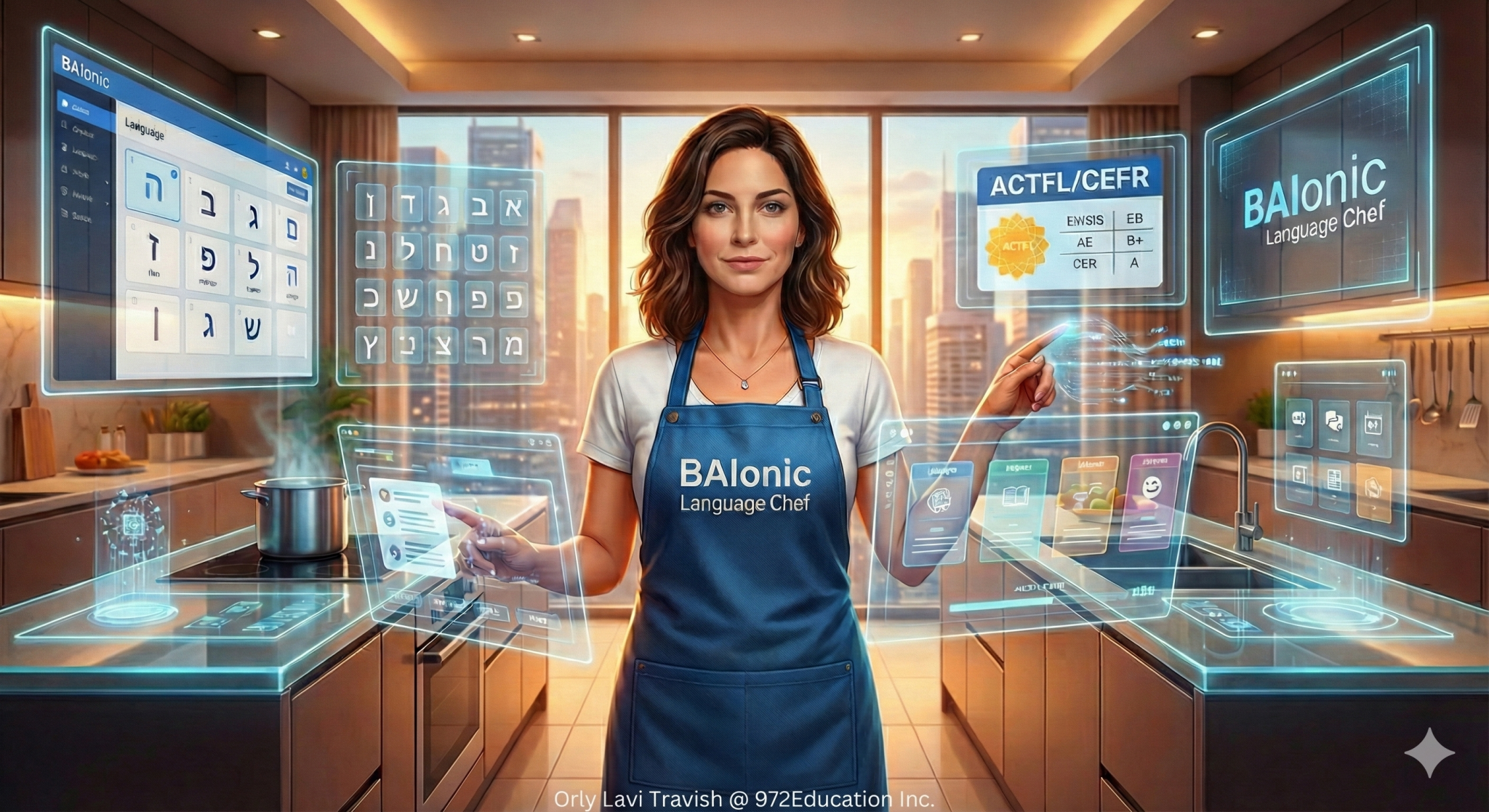 The ground beneath us is shifting. As an educational entrepreneur and Hebrew language instructor who has spent over three decades in classrooms, from Netanya to Los Angeles, I have witnessed countless technological waves that promise to revolutionize education. Yet, when the AI revolution arrived, I immediately felt that this time was fundamentally different. While many teachers were still standing outside, paralyzed by the fear that artificial intelligence might “spoil the broth,” making students lazy, hindering their writing, or killing deep thinking, I knew I could not afford to wait. I tied my apron strings and stepped up to the stove.
We must address this fear honestly. There is a heavy cloud hanging over our faculty rooms, a worry that AI threatens learning itself. However, when we look closer, we see that AI does not threaten learning; it threatens superficial learning. The educational system, largely used to measuring capabilities like memory, formatting, and adherence to templates, is now meeting a technology that refuses to accept that approach because it can already perform those tasks better than humans. If our assignments rely on regurgitating information or mechanically producing text, much like a cook simply chopping vegetables without understanding the dish, then AI will indeed surpass the learner without effort. It is not because the learner lacks ability, but because the assignment itself lacks true culinary thought.
Here is where the shift happens. If we continue to measure technical execution, AI will always win. But when we ask learners to interpret, compare, analyze, critique, and connect on a human level, then AI transforms from a threat into a powerful engine. We are facing an era where successful educators will not be those who try to ban the new appliances, but those who know how to use them to foster curiosity and deep, genuine connection, things a machine simply cannot do on its own. It is no longer about how to prevent “cheating,” but how to turn technology into a space for vital human learning.
To navigate this shift, disconnected apps are not enough. We cannot prepare this level of gourmet education with just a scattered collection of peelers and whisks. We need a Professional Workspace. I realized that language educators, whether they are novices just starting out or veterans with years of experience, need a comprehensive ecosystem that bridges the gaps in their knowledge. Many educators feel insecure about the pedagogy of second language acquisition or lack literacy in artificial intelligence, and they need a place that connects these worlds.
Because I could not find this workspace, I decided to build it. That is how The BAIonic Language Teacher was born. It is not just a tool; it is a fully equipped Master Kitchen designed for the specific needs of language educators. It is grounded in the highest professional standards, aligning with both the American ACTFL guidelines and the European CEFR framework. Within this workspace, the guides and methodologies I have developed serve as essential bridges. They act as a master cookbook that helps every teacher, regardless of their tech-savviness or pedagogical background, understand not just how to use the AI ingredients but why they matter for language acquisition.
In this kitchen, the AI handles the “menial work,” the tedious preparation and organization, such as instantaneously generating endless leveled grammar drills or aligning complex lesson plans to standards, so you are free to focus on the art of cooking. This art is the fostering of critical thinking and deep cultural connection. It is an invitation to move beyond the fear of the machine and embrace the potential of the human teacher who knows how to wield it.
So, I invite you to check your own equipment. Are you standing with your hands full of disconnected gadgets, worried that the machine will take your job? Or are you ready to put on your apron and enter a workspace designed for mastery? The menu is changing, and I am already cooking. Join me! Let us ensure that in this new era, we are not just cooking with better utensils, but serving meals filled with deeper meaning and greater humanity.
Related Topics
Related Posts