Learning The Lessons Of History
Why I Wrote “Taken. Numbered. Survived.”
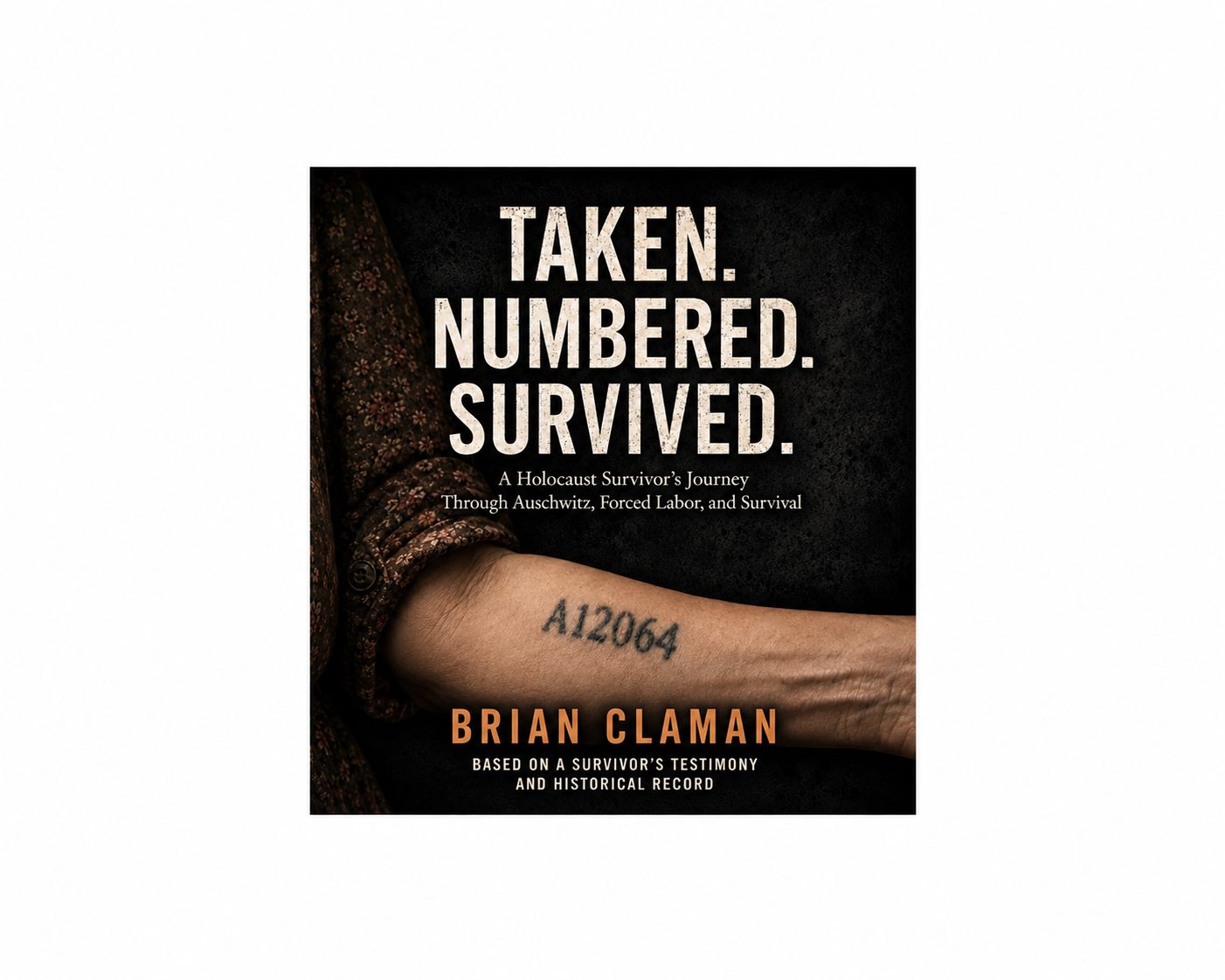
Book Cover
This is not a typical Holocaust memoir.
Taken. Numbered. Survived. tells my mother’s story, but it also does something more. It brings together her recorded testimony, surviving documents, archival records, and the historical evidence confirming what happened to her and her family.
I wrote the book not only to preserve her experience, but also to explain why that history continues to matter—to me, to my family, and to the generations that followed. This is why I felt compelled to write it.
A Son’s Reflection
I have tried to tell my mother’s story through her testimony, the historical record, and the documents that survived. The facts matter—for my mother, for the millions who were murdered, and for the families and communities that were destroyed.
They also matter because Holocaust denial, distortion, and indifference grow when memory weakens and truth is treated as optional. What follows, however, is not historical analysis. It is the reflection of a son who has spent much of his life trying to understand how his mother’s experiences affected the family that came after her.
As a child, I could not fully comprehend what my mother had survived. I did not see Auschwitz, forced labour, starvation, or a death march. I saw a woman raising a family and trying to create a normal life after everything that had once seemed normal had been destroyed.
Only later did I recognize that liberation did not end every consequence of what had happened. The camps had been left behind, but memory, fear, and loss entered the life she built afterward.
Intergenerational Trauma: The Legacy That Followed
I have come to believe that intergenerational trauma is real. I do not say this as a clinical conclusion or an abstract theory. I say it because of the ways my mother’s experiences have affected how I see the world, understand risk, worry about the future, and think about protecting my family.
Intergenerational trauma does not mean that children of survivors experienced what their parents endured. I was not deported, forced into a cattle car, starved, imprisoned, or separated from my parents on a selection ramp. Those experiences belonged to my mother.
Trauma can nevertheless move through a family. It can be carried through silence, caution, fear, protectiveness, and subjects that are avoided. Children observe what frightens their parents, what makes them watchful, and what memories they find difficult to express. We learn not only from what is said, but also from what remains unspoken.
My mother tried to protect us from the horrors of her past. She gave us a childhood that was not governed by what had happened to her, and that was an extraordinary gift. Yet even when the full history was not discussed, we understood that security could be lost and that ordinary life should never be taken entirely for granted.
My brother, sister, and I have each carried that history differently. I cannot define their experiences for them, but what happened to our mother and her family entered all of our lives.
Its effects may appear as anxiety, caution, protectiveness, anger, sensitivity to antisemitism, or the belief that stability is never guaranteed. It can influence how we understand belonging, how much trust we place in institutions, and how seriously we take the responsibility to protect those we love.
I also wonder how much of this has reached our own children. They have grown up knowing that their grandmother survived an attempt to destroy her family and that Jewish identity carries both pride and vulnerability.
They may inherit a heightened awareness of antisemitism or an instinct to notice warning signs that others might dismiss. The effects become less direct with each generation, but they do not necessarily disappear.
Jewish Identity, Fear, and Silence
For much of my life, I was quiet about being Jewish. I was not ashamed of my identity, but I did not always speak openly about it, particularly with non-Jewish friends and colleagues.
Beneath that caution was a fear I rarely expressed: that if events like the Holocaust ever occurred again, being publicly identified as Jewish could place my family and me in danger.
I knew that this fear did not reflect the ordinary circumstances of my life in Canada. Yet my mother’s history had shown that circumstances could change, rights could be removed, neighbours could turn away, and people could be identified for persecution because of who they were.
In her Shoah Foundation testimony, my mother said that she had felt “ashamed to be a Jew” as a child. I do not believe she meant that she rejected her identity. I believe she was describing the experience of being marked as different, exposed, and vulnerable in a society that increasingly treated Jews as undeserving of belonging and protection.
I was not ashamed to be Jewish, but I feared what being identified as Jewish could one day mean. That fear remained largely unspoken until October 7, 2023, changed something in me.
After October 7, I became more public about my Jewish identity. I did not do so because the fear had disappeared. I did so because silence no longer felt acceptable while Jews were again being threatened, hatred was being normalized, and Holocaust history was being minimized or distorted.
The Fear of Helplessness
One image has influenced me more deeply than any other. I imagine my grandfather on the ramp at Auschwitz, watching as his family was separated and realizing that he was powerless to protect them. He was a husband and father, yet every ordinary ability to defend those he loved had been taken from him.
As a husband and father, I have often feared being placed in a similar position of helplessness. The fear is not simply of personal harm. It is the fear of recognizing danger and being unable to prevent it from reaching the people who depend upon me.
That image may have contributed to my instinct to anticipate risk, remain vigilant, and think constantly about protection. It may also have influenced the professional path I chose, although no life or career can be explained by one experience alone.
The emotional consequences of the Holocaust did not end when my mother was liberated. They continued through memory, relationships, fears, choices, and the ways later generations learned to understand security and identity.
It is not the same wound my mother carried, but it is an echo of that wound.
Why This History Still Matters
This personal inheritance is one reason I wrote the book, but it is not the only one.
I am deeply concerned by the rise of antisemitism across Western democracies and by how easily hatred toward Jews is once again being expressed, rationalized, and tolerated.
I am also concerned by Holocaust denial and distortion. These do not always take the form of claiming that the Holocaust never happened. Distortion can involve minimizing the crime, disputing established facts without evidence, suggesting exaggeration, or treating documented history as a matter of opinion.
Holocaust denial attacks both Jewish memory and truth. It dishonours the victims while weakening society’s ability to recognize the conditions under which hatred can become organized and eventually transformed into policy.
What happened to my mother and millions of others showed what becomes possible when people are dehumanized, laws are used to exclude them, institutions cooperate in their persecution, and neighbours choose silence or indifference.
The Holocaust was a crime directed against the Jewish people, but its lessons concern humanity as a whole.
That is why accurate historical education matters. Young people cannot recognize distortion if they have not first been taught the facts. History must be grounded in evidence, testimony, and documented events before its meaning can be responsibly interpreted.
Critical thinking is essential, but it cannot substitute for knowledge. When facts are poorly understood, manipulation becomes easier and false equivalencies more persuasive. Evil is easy to recognize once its consequences are fully visible. It is much harder to identify while exclusion, prejudice, and dehumanization are becoming normalized.
Why I Needed to Write This Book
Writing Taken. Numbered. Survived. was one of the most difficult things I have ever done.
I began because I wanted to understand what happened to my mother, her family, and the world from which she came. The deeper I went into the testimony and records, the more painful that understanding became.
Some members of my family have found the book too difficult to read because they cannot bear to confront the full reality of what their mother, grandmother, sister, or aunt endured. I understand that reaction. There is pain in knowing, but there is also responsibility in refusing to turn away.
This book is intended to preserve a documented life and contribute to the historical record. It is not fiction, speculation, or exaggeration. It brings together testimony and evidence so that what happened cannot be dismissed simply because the witnesses are no longer here to speak.
That is what makes Taken. Numbered. Survived. different from a traditional memoir.
Part One tells the story. Part Two provides the proof.
The first part follows my mother through persecution, deportation, Auschwitz-Birkenau, forced labour, a death march, liberation, and the rebuilding of her life.
The second turns to the historical record—the surviving documents, archival evidence, and other records that corroborate her testimony and place it within its historical context.
Memory tells us what one human being experienced. Documentation helps ensure that experience cannot be dismissed when the survivor is no longer here to tell it.
The Responsibility to Remember
My mother once said that people should treat others as they would want to be treated and that no one should ever have to endure what she experienced. The words are simple, but they come from someone who witnessed what happens when human dignity is abandoned.
The responsibility now belongs to those who follow.
We must remember, speak openly, defend truth, and teach the history accurately. What happened to my mother, her family, the Jewish people, and millions of other victims must never be denied, minimized, or forgotten.
That is why I wrote Taken. Numbered. Survived.—not simply to tell my mother’s story, but to preserve it, document it, and make it harder to deny.
About Taken. Numbered. Survived.
Taken. Numbered. Survived. tells the true story of my mother’s Holocaust experience and brings her testimony together with the historical record that supports it.
The book is available on Amazon in hardcover, paperback, Kindle, and audiobook formats. Search “Taken. Numbered. Survived.” or the author’s name, “Brian Claman.”
The book can also be ordered through the author’s website:
Related Topics
Related Posts