
Geopolitical Analyst: Bridging Somaliland & Israel to the world
Why Israel broke the Somaliland taboo
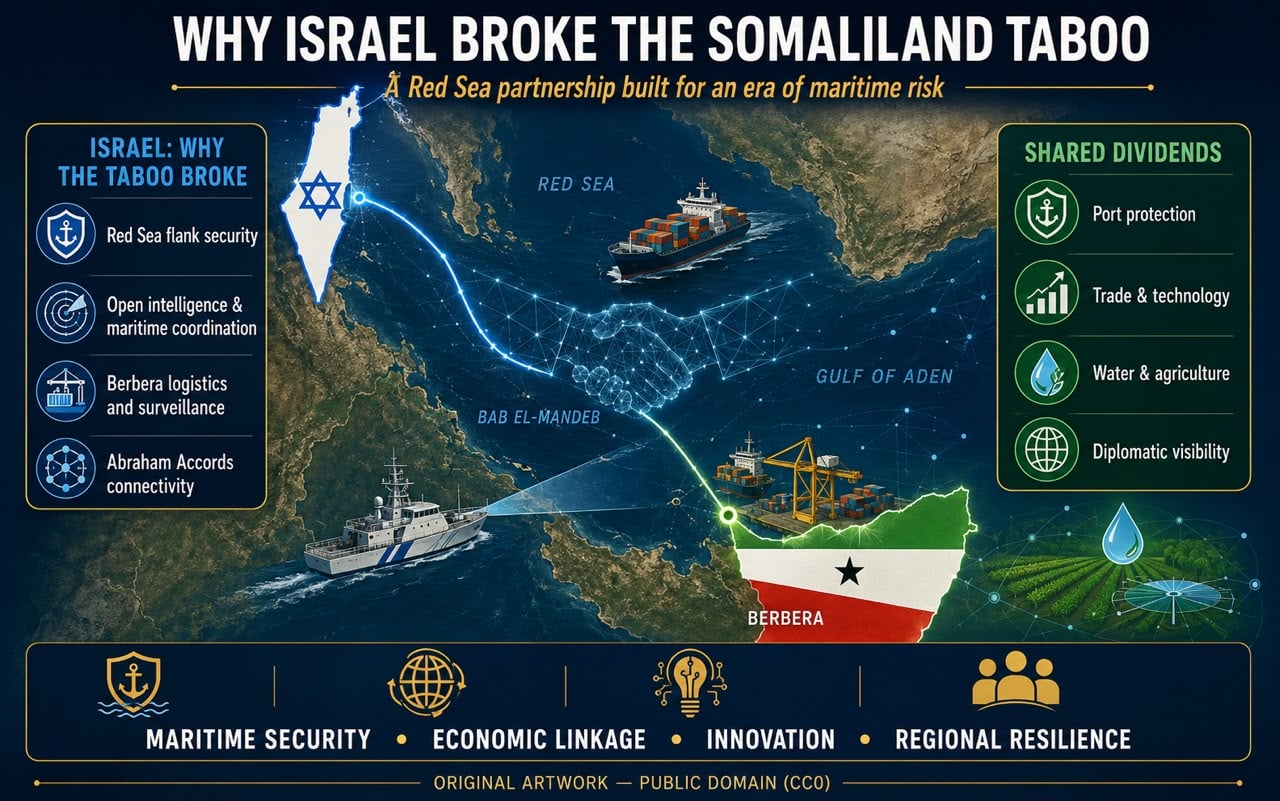
Why Israel Broke the Somaliland Taboo: The Mutual Strategic Benefits. Original infographic artwork-Public Domain (CCO); created for the author
Securing Its Red Sea Flank After October 7
Israel concluded that quiet cooperation with Somaliland could not deliver the open, binding state-to-state defense, intelligence, and economic infrastructure required to secure its Red Sea flank.
Quiet ties had become insufficient
Israel did not recognize Somaliland because quiet cooperation was impossible. It recognized Somaliland because quiet cooperation had become insufficient.
For years, Israel could have worked discreetly with Somaliland through commercial contacts, intelligence channels, development projects, and unofficial political engagement. Such an approach would have avoided the predictable backlash from Somalia, the African Union, Turkiye, Egypt, Qatar, Saudi Arabia, China, and others who regard Somaliland’s status through the framework of Somali territorial integrity.
Yet Israel accepted that diplomatic friction and, on December 26, 2025, became the first UN member state to recognize Somaliland formally. It then moved to institutionalize relations through official diplomacy and cooperation in areas including technology, health, agriculture, and the economy.
The reason is straightforward: informal cooperation cannot provide the open, durable, state-to-state defense, intelligence, economic, and diplomatic infrastructure that Israel now believes it needs to secure its Red Sea flank.
October 7 changed the strategic threshold
The events after October 7 did not create Israel’s interest in the Red Sea, but they raised its urgency.
Houthi attacks on commercial shipping, their demonstrated willingness to strike toward Israel, and the wider confrontation involving Iranian-backed armed networks transformed the Red Sea and Gulf of Aden from a distant maritime concern into an active threat environment. Bab el-Mandeb is not merely a regional passage. It is one of the world’s essential chokepoints, connecting the Indian Ocean and the Gulf of Aden to the Red Sea, the Suez Canal, and the Mediterranean.
Israel’s dilemma is clear. A hostile force on Yemen’s coast can threaten shipping, raise insurance and trade costs, disrupt supply chains, and endanger Israel’s maritime access to Asia and Africa. It can also turn the Red Sea into an arena in which Iran’s regional influence is projected far beyond the Gulf.
In that environment, strategic caution begins to look less prudent. Israel’s recognition of Somaliland signals a shift away from diplomatic risk avoidance and toward overt alliance-building. Somaliland’s geography—on the African side of the Gulf of Aden, near Bab el-Mandeb and across from Yemen—makes it highly relevant to Israel’s evolving security calculations.
Formal recognition enables enduring capabilities
Unofficial ties are useful when plausible deniability is the goal. They can facilitate dialogue, limited intelligence exchanges, commercial exploration, and humanitarian cooperation. But they remain fragile. They can be denied, curtailed, or abandoned under pressure. They do not create embassies, binding agreements, public accountability, or a stable legal foundation for major investment.
Formal recognition changes that. It permits the development of transparent state-to-state structures: diplomatic representation, official trade agreements, maritime-security coordination, investment protections, agricultural and water-technology partnerships, and long-term institutional cooperation.
It also creates the political conditions for more open coordination around critical infrastructure, including Berbera’s port and airport. That does not mean Somaliland should be presumed to have accepted, or be obliged to accept, foreign military bases or operational arrangements. Such claims require evidence, and Somaliland must retain full sovereign control over its territory.
But it does mean that formal relations make lawful and accountable cooperation—such as maritime domain awareness, port protection, coast-guard training, intelligence liaison, logistics planning, and emergency-response coordination—far easier to build than covert contacts ever could.
Somaliland offers a partner where geography and governance meet
Israel’s decision reflects the fact that Somaliland, not Mogadishu, administers the territory, institutions, coastline, port access, and security environment that are strategically relevant around Berbera and the Gulf of Aden.
This does not require hostility toward Somalia. Somalia’s sovereignty claim is supported by the African Union, IGAD, and many states, while Hargeisa maintains that it restored the sovereignty of the former British Somaliland protectorate after the failed union and devastating civil war. The dispute remains politically charged.
But security policies often follow practical control. Somaliland has maintained separate governing institutions, security forces, elections, and a comparatively stable political order for more than three decades. From Israel’s viewpoint, this makes Hargeisa a potentially more dependable partner for specific Red Sea and Gulf of Aden requirements.
This calculation recalls Israel’s historic periphery doctrine. In the 1950s and 1960s, Israel sought partnerships with states and communities beyond the immediate Arab Israeli confrontation—particularly Ethiopia, Iran under the Shah, and Turkiye. The aim was not simply friendship. It was to build political, economic, intelligence, and security relationships around a hostile strategic environment.
The Abraham Accords logic, extended to the Horn
Israeli officials presented recognition as being ‘in the spirit’ of the Abraham Accords. That language is important. It does not automatically establish Somaliland as a formal party to the accords, nor should it be used to claim a legal status that has not been publicly documented.
But strategically, the connection is evident. The Abraham Accords created a framework in which diplomatic normalization could be joined to trade, technology, security dialogue, investment, maritime cooperation, and a shared interest in containing destabilizing regional forces. Israel’s relationship with Somaliland could extend this logic toward the Horn of Africa.
In that broader architecture, Somaliland has potential links with partners whose interests partly converge around maritime security, logistics, technology, investment, and the containment of Iranian proxy influence. The UAE’s role in Berbera, Ethiopia’s interest in maritime access, and Israel’s concern about Yemen and the Houthis all make Somaliland more than an isolated diplomatic issue.
The danger, however, is equally clear. Somaliland must not be reduced to a chessboard square in other states’ competition with Iran, China, Turkiye, or the Gulf powers. Its leaders should insist that every partnership advance Somaliland’s own national objective: sovereignty, stability, jobs, infrastructure, export capacity, water resilience, education, and internationally accountable institutions.
Recognition de-risks economic and technological cooperation
A formal relationship also makes economic sense. Informal contacts leave investors and government agencies in legal and political limbo. They complicate contracts, financing, commercial dispute resolution, technology transfer, and long-term planning. Recognition provides a clearer foundation for official trade agreements, embassies, business delegations, and development partnerships.
Israel has internationally recognized expertise that could matter greatly to Somaliland: water conservation, irrigation, dryland agriculture, health innovation, digital systems, renewable energy, logistics, fisheries, and entrepreneurship. Somaliland, meanwhile, offers a strategically located market and a gateway to a wider Horn of Africa economy.
The value of this relationship will not be measured by announcements alone. It will be measured by whether projects produce visible public benefit: jobs for Somaliland youth, skills transfer, higher education, stronger local firms, transparent investment, better water systems, agricultural productivity, and infrastructure that serves the country rather than only outside interests.
Why accept the diplomatic costs?
Israel’s recognition inevitably antagonized important regional actors, but each has its own motives. Turkiye’s position is tied to its deep security, political, military, and economic investment in Somalia. Egypt sees the Horn through the lens of Red Sea security and its competition with Ethiopia. Qatar has longstanding ties with Mogadishu. China views the matter partly through Taiwan, its opposition to precedents involving contested political entities and its expanding strategic presence in Djibouti. Saudi Arabia must balance Red Sea concerns, Arab and Islamic diplomacy, and its relationship with Somalia.
Somalia, understandably, sees recognition as a direct challenge to its territorial claim. The African Union fears precedents that may encourage separatist demands elsewhere on the continent.
Israel nevertheless calculated that the cost of strategic absence was higher than the cost of diplomatic confrontation. Recognition itself does not violate a specific UN rule. States make sovereign decisions about recognition, even where those decisions are strongly opposed by other states and regional organizations. The dispute concerns law, precedent, political legitimacy, territorial integrity, self-determination, and regional stability—not a simple matter of Israel defying an enforceable UN ban.
Conclusion: recognition as strategic commitment
Israel’s recognition of Somaliland was not merely symbolic solidarity or an impulsive diplomatic gesture. It was a strategic commitment made under the pressure of a changing Red Sea environment.
Post-October 7 realities have convinced Israel that its security cannot be managed solely from the Mediterranean, the Gulf, or the skies above Yemen. The Horn of Africa has become part of Israel’s wider defense horizon. In that horizon, Somaliland offers something rare: proximity to a critical maritime theater combined with relative stability, functioning institutions, and willingness to cooperate openly.
Israel accepted diplomatic costs because recognition delivers what quiet ties cannot: durable state-to-state infrastructure for diplomacy, economic cooperation, intelligence liaison, maritime awareness, and long-term strategic planning.
For Somaliland, this is a historic opening, but not a reason for dependence. The wise course is to turn recognition into institutions, investment, skills, and sovereign capacity—while ensuring that Somaliland remains a partner with its own interests, not merely a forward position in someone else’s conflict.
Selected sources
Reuters, “Israel becomes first country to formally recognize Somaliland as independent state,” December 26, 2025. https://www.reuters.com/world/middle-east/israel-recognises-somaliland-somalias-breakway-region-independent-state-2025-12-26/
Associated Press, “More countries reject Israel’s recognition of Somaliland,” December 27, 2025. https://apnews.com/article/0643e819cc043163d7a81c91617232a9
https://hornofafricastrategicreview.com/why-israel-chose-somaliland-as-its-strategic-partner-in-the-horn-of-africa-and-the-red-sea/
Related Topics
Related Posts