
Consultant and writer exploring policy, society, and identity
Why Mike Huckabee Drew a Line in the West Bank
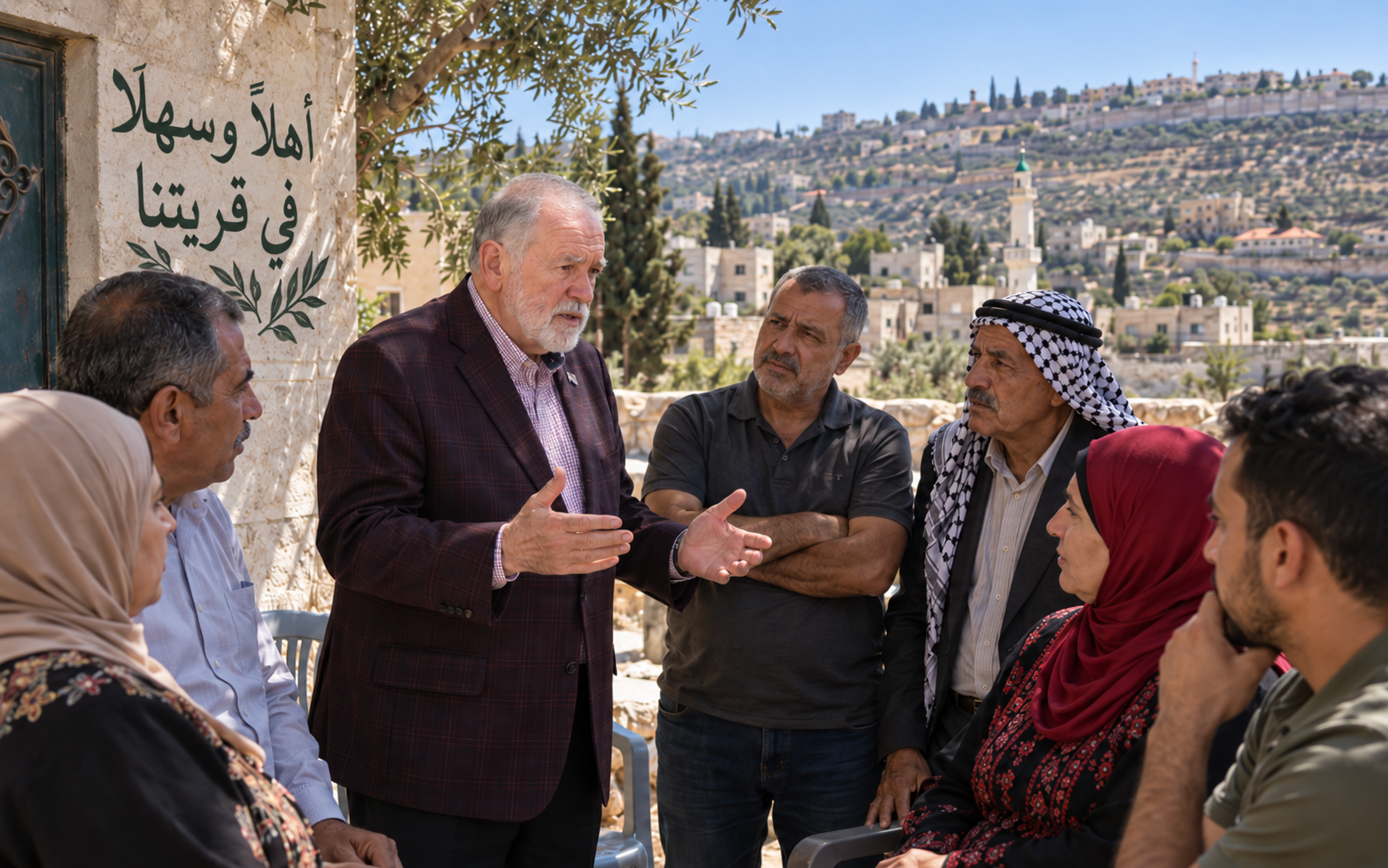
AI Composite Illustration (Bernard Markowicz)
His campaign against violent settlers may reveal how American politics is beginning to constrain unconditional support for Israeli policy. The first post used settler violence to test Omer Bartov’s diagnosis of unequal power. The second asked whether Jews could live under Palestinian sovereignty. This final post turns to the United States: why has a strongly pro-settlement ambassador become the official drawing a public line?
Mike Huckabee has not renounced Jewish settlement in Judea and Samaria. He remains an evangelical Christian Zionist, skeptical of conventional Palestinian statehood and closely identified with a strongly pro-Israel administration. What changed is his willingness to visit Palestinian communities, call violent Jewish settlers terrorists and press the Israeli government to act.
The immediate explanation is clear. The attacks affected Palestinian Americans, and an American ambassador is responsible for defending American citizens. But that does not completely explain why Huckabee used such strong language or why the State Department supported the substance of his intervention. The larger context is a changing American political environment around Israel.
An American government position
Huckabee’s campaign should not be treated merely as a personal religious initiative. The State Department said that the United States condemns criminal violence by any party and that a stable West Bank supports Israeli security and the administration’s objective of regional peace. That makes opposition to settler violence an American government position.
But precision matters: the United States has not formally designated the settlers involved as terrorists. There is no public evidence that the White House directed Huckabee to use that word. Nor has the administration adopted a general opposition to settlements. Huckabee’s language describes conduct. It does not announce a new legal designation or a comprehensive reversal of policy.
Why the administration needs the distinction
Uncontrolled settler violence creates several problems for Washington: it can provoke Palestinian retaliation, weaken the Palestinian Authority and create additional pressure on Jordan. It complicates relations with Arab governments whose cooperation is necessary for regional security and further normalization with Israel. When Palestinian Americans are attacked, it also tests whether Washington protects its citizens without regard to ethnicity. Finally, the violence damages the broader case for supporting Israel. An administration committed to law and order cannot easily defend arson, intimidation or the seizure of private property. Huckabee is therefore drawing a boundary that may protect the larger pro-Israel position:
“ Jewish attachment to the West Bank can be defended. Terrorism and theft cannot. ”
That boundary also has domestic political value.
AIPAC remains powerful—but more contested
It would be premature to describe the American Israel Public Affairs Committee (AIPAC) as powerless or displaced. AIPAC retains substantial financial resources, an extensive donor network and access to congressional leaders. It can still spend heavily in selected elections and affect how candidates discuss Israel. What is changing is its authority inside the Democratic coalition. AIPAC spending has itself become an issue in Democratic primaries. Some candidates now advertise their refusal of its support. Others have won despite major spending intended to defeat them. AIPAC therefore faces a distinction between power and legitimacy. It remains institutionally powerful, but its ability to define the acceptable Democratic position on Israel without resistance is weakening. This does not mean Democratic voters have rejected Israel. It means that support for Israel is increasingly separated from support for every policy of its government.
The space J Street is trying to occupy
J Street offers Democrats a position between AIPAC and movements seeking a fundamental break in the U.S.–Israel relationship. It supports Israel’s existence and security while opposing annexation, settlement expansion and unconditional support for Netanyahu’s government. It favors Palestinian statehood, diplomacy and conditions on some forms of American assistance. For the 2026 midterms, J Street announced a $3 million independent-expenditure fund, its largest effort of this kind, in cooperation with major Democratic congressional campaign organizations. That demonstrates institutional growth, but not dominance. A spring 2026 Jewish Electorate Institute survey found AIPAC viewed favorably by 39 percent of American Jewish adults and J Street by 18 percent. J Street’s access within the Democratic establishment may be increasing faster than its public recognition or popularity. Huckabee remains far from J Street on settlements and Palestinian sovereignty. Yet their opposition to settler violence now overlaps. That narrow intersection shows that the permissible boundary of criticism has moved.
The democratic-socialist pressure
The democratic-socialist movement exerts a different kind of influence. Candidates associated with democratic socialism or the wider progressive left challenge military aid without conditions, reject AIPAC funding and place Palestinian rights near the center of their foreign-policy positions. Their importance is not limited to the number who win office. Primary campaigns can move the range of positions that mainstream Democrats believe they must address. A proposal does not need majority support to change an election. It can force other candidates to state what they would condition, oppose or defend. J Street and democratic socialism should not be conflated. J Street is liberal Zionist and operates within mainstream Democratic institutions. Democratic socialists are more likely to be non-Zionist or anti-Zionist and to seek much larger changes in military support. But pressure from the left can create political room for J Street. Democrats who reject AIPAC’s approach but still support Israel need a credible alternative.
The U.S. midterm calculation
Israel has become a contested U.S. electoral issue rather than an automatic bipartisan advantage. Republicans can still use support for Israel to mobilize evangelical voters, highlight antisemitism and portray Democrats as divided. But complete identification with every Israeli policy now carries risks. Younger Americans have become more critical of Israel. Democratic voters increasingly favor reducing or conditioning support. Palestinian and Arab Americans are organized in important states and districts. Images of settlers burning property are difficult to reconcile with a law-and-order message. Huckabee is useful precisely because his pro-Israel credentials are difficult to question. He allows the administration to address several constituencies at once:
- To evangelical and pro-Israel voters, he confirms the legitimacy of Jewish connection to the land. To moderates, he demonstrates that support for Israel has limits.
- To Palestinian Americans, he says their citizenship entitles them to protection.
- To Israeli officials, he communicates that failure to control extremists carries costs.
There is no evidence that this midterm calculation caused his intervention. It is an inference from the political environment. The more firmly documented explanations remain the protection of Americans, Israeli security and regional stability. But a policy can arise for direct governmental reasons and still acquire electoral value.
Tactical correction or deeper change?
- Huckabee may simply be isolating a violent fringe to protect the settlement movement and the U.S.–Israel alliance. Under this interpretation, the underlying policy has not changed.
- A second interpretation is that even a strongly pro-settlement Republican administration now believes public support for Israel requires visible boundaries. Opposition to settler violence has moved from a liberal demand to a position expressed by an evangelical ambassador. Both interpretations may be correct.
A tactical intervention can reveal a deeper political change. Bartov argues that American backing has shielded Israel from consequences. Huckabee complicates that account. The United States can enable Israeli policy, but it can also impose limits. Which role it chooses depends partly on American politics. Huckabee may be confronting violent settlers not because he has abandoned the settlement movement, but because their conduct threatens the moral, strategic and political foundations of American support for Israel. When an evangelical ambassador decides that defending Israel requires confronting Jewish terrorism, the boundary of acceptable American criticism has already moved. The midterms may show how much further it will move.
Sources
***
Related Topics
Related Posts