A Moroccan Journalist
Why Morocco’s Israel policy outlasts its governments
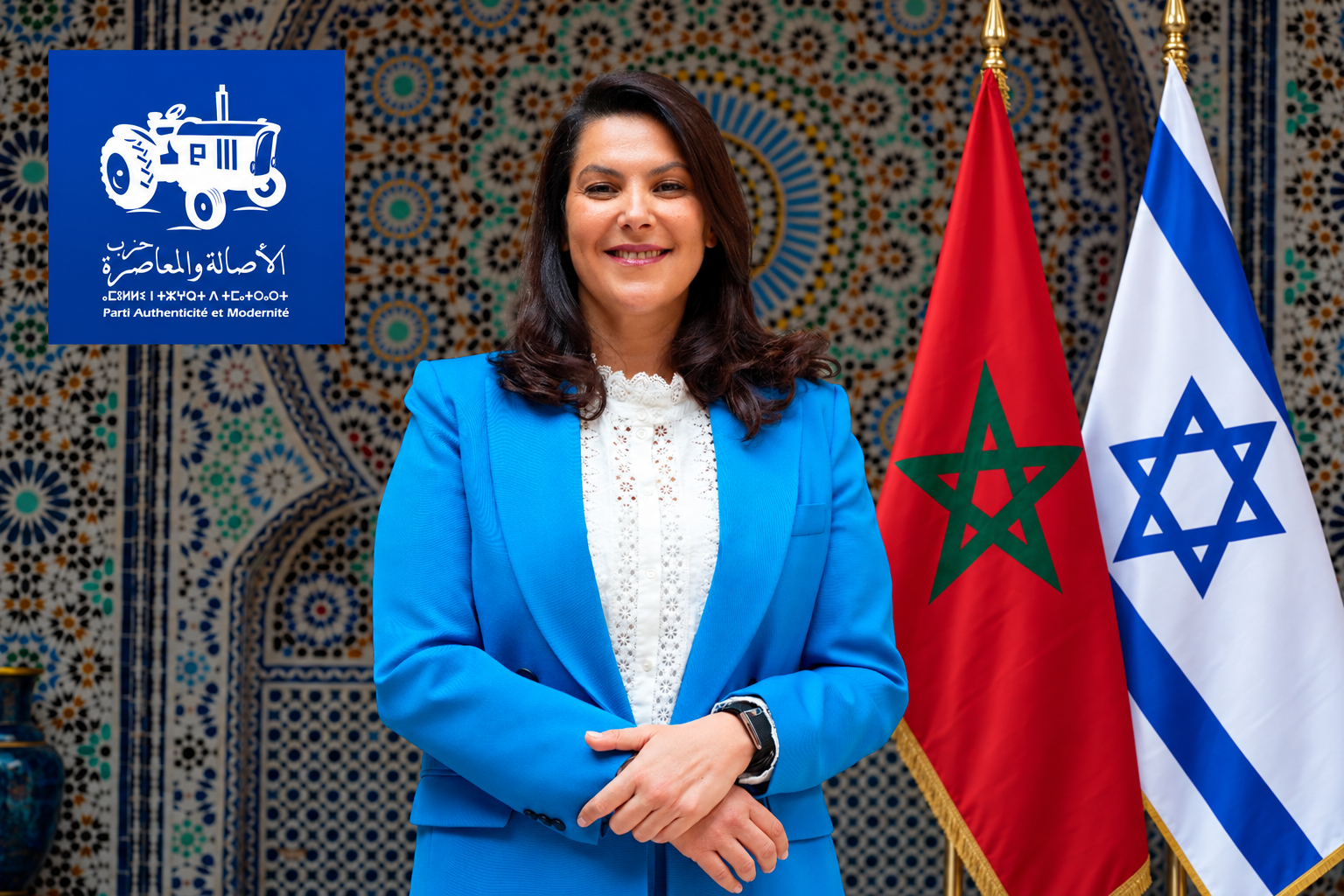
Head of government-designate Fatima Ezzahra El Mansouri pictured alongside the PAM logo and the Moroccan and Israeli flags.
Fatima Ezzahra El Mansouri’s appointment as Morocco’s first woman head of government marks a historic political breakthrough. King Mohammed VI appointed her on September 29 after the Authenticity and Modernity Party (PAM) finished first in the September 23 legislative elections. As she assembles a coalition, however, the significance of that breakthrough should be distinguished from the location of authority over Morocco’s international relations.
Some Israeli coverage has begun assessing the potential impact of the political transition on Morocco-Israel ties and asking whether PAM has particular ties to Jews and Israel, while other reports have emphasized the Islamist Justice and Development Party’s (PJD) electoral recovery and its opposition to closer relations with the Jewish state. These are relevant features of Morocco’s political landscape. They become misleading predictors when the attitudes of parties are treated as the decisive variable in the kingdom’s diplomacy. An assessment centered on whether the incoming government is friendly to Israel starts with the wrong institution.
Morocco has an elected government operating alongside an active monarchy. The King occupies a position of substantive authority in foreign affairs and security. The distinction between the state’s strategic direction and the government’s partisan composition is essential to understanding why diplomatic commitments can survive an election that changes the party leading the executive.
In political systems where the governing coalition directs foreign policy, party preferences can become state choices through control of the executive. Moroccan elections allocate governing responsibility within an enduring structure of royal strategic authority. Importing the expectations of the former system into the latter confuses a mandate to govern with a mandate to redefine the country’s diplomatic commitments.
Spain offers a revealing comparison precisely because it, too, is a monarchy. Its parliamentary democracy assigns foreign-policy direction to the elected government under Article 97, while the King represents the state without independently determining its diplomatic course. Pedro Sánchez’s left-wing coalition, led by the Spanish Socialist Workers’ Party (PSOE), has taken a confrontational stance toward Israel over Gaza, recognizing Palestinian statehood and imposing an arms embargo opposed by the conservative Popular Party (PP) and far-right Vox.
With a general election due by 2027, a PP-led government, potentially supported by Vox, could offer Israeli leaders an opening for a less adversarial relationship. From their perspective, a rightward change in government could therefore be advantageous. The institutional distinction is decisive: Spain’s diplomatic posture is more exposed to the ideological composition of its governing majority, whereas Morocco’s strategic direction remains anchored in the monarchy across changes of government.
The 2011 Constitution gives this arrangement concrete form. Article 42 identifies the King as guarantor of state continuity and respect for Morocco’s international commitments. Articles 48 and 49 place deliberation on the state’s strategic orientations in the Council of Ministers, chaired by the King. Article 55 assigns him treaty signature and ratification and the accreditation of ambassadors, while requiring legislative approval for specified categories of treaties.
The foreign minister’s appointment belongs within this framework. Under Article 47, the King appoints government members on the head of government’s proposal. This includes the minister responsible for diplomacy. The Constitution nevertheless gives the government a role: Article 88 includes foreign policy in its program, and Article 92 provides for government deliberation on treaties before their submission to the Council of Ministers.
The practical consequence is a hierarchy of authority within a system of participating institutions. Ministers conduct diplomacy, negotiate agreements, and administer cooperation. Parties can dispute the choices being made. But taking charge of the government does not confer an independent mandate to overturn the strategic framework directed by the monarchy. A new parliamentary balance changes the political setting in which diplomacy operates; it does not automatically change who determines its foundations.
The PJD supplies the clearest demonstration. On December 22, 2020, Saad Eddine El Othmani, then head of government and the party’s secretary-general, signed the Morocco-United States-Israel declaration in the King’s presence. The formalization of renewed relations with Israel therefore occurred under a government led by the very Islamist party whose opposition to normalization has since become a prominent feature of its political identity.
That signature exposes the weakness of reading Moroccan diplomacy directly from party ideology. An Islamist head of government participated in implementing a royal diplomatic decision. His party’s preferences and his institutional responsibilities were distinguishable. Governing within Morocco’s constitutional order required an accommodation that opposition rhetoric, considered in isolation, would never have predicted.
That distinction changes what diplomatic continuity means. It need not depend on successive governing parties sharing an ideology or enthusiasm for the same partner. It can rest on their acceptance of an institutional hierarchy. The PJD and PAM can disagree sharply about Israel and still govern under the same strategic framework. Continuity is produced by the system before it is reinforced by the preferences of the governing party.
The boundary was made explicit on March 13, 2023. Responding to PJD criticism of relations with Israel, the Royal Cabinet reaffirmed that foreign policy was a royal prerogative and rejected its use in a domestic partisan agenda. It also recalled the framework established by the December 2020 royal communications and tripartite declaration. This was a direct statement of where strategic authority lay, addressed to a party that had already exercised government power.
The subsequent record reinforces that distinction. The diplomatic framework survived the transition from El Othmani’s PJD-led government to Aziz Akhannouch’s National Rally of Independents (RNI)-led administration in 2021. PAM, already a partner in the outgoing coalition, is now tasked with leading the next government. Its accession changes the party holding the premiership within a system whose royal center of diplomatic authority remains in place.
PAM’s leadership has also participated visibly in cooperation with Israel. In fact, Israeli President Isaac Herzog was also among the first foreign leaders to congratulate El Mansouri on her appointment, calling it “groundbreaking” and wishing her success in the role. In July 2022, Abdellatif Ouahbi, then its secretary-general and Morocco’s justice minister, signed a judicial cooperation agreement with his Israeli counterpart, Gideon Sa’ar. PAM itself was founded in 2008 by Fouad Ali El Himma, a close royal confidant who later became an adviser to King Mohammed VI, and was often described by critics as part of Morocco’s tradition of “administrative parties.” More recently, publisher Ahmed Charaï – an outspoken advocate of Morocco-Israel ties and author of the 2023 essay “We Are All Israelis” – publicly backed PAM’s political project in a September 17 editorial. Senior PAM figures have also maintained contacts with Moroccan Jewish and Morocco-Israel friendship organizations; in 2021, Ouahbi and Mehdi Bensaid received Simon Skira, president of the Federation of Moroccan Jews in France and the Morocco-Israel Friendship Association.
That record suggests a more accommodating posture toward implementing the relationship than the PJD’s current oppositional stance. It can make the policy easier to defend politically, but it does not explain the source of the policy’s authority.
Indeed, the timing of the latest diplomatic development is instructive. On September 16, before Moroccans voted, a trilateral statement announced agreement to upgrade Morocco’s and Israel’s diplomatic missions to full embassies and exchange ambassadors. It also reaffirmed US and Israeli recognition of Moroccan sovereignty over Western Sahara and outlined further cooperation. The incoming administration is inheriting a diplomatic direction articulated before the election result was known.
That chronology matters. Relations with Israel form part of a broader assessment involving territorial interests, the American partnership, security, and economic cooperation. They cannot be adequately explained as an expression of a governing party’s affection for Israel. Party attitudes may affect the ease of implementation and the language of public advocacy. The strategic calculation extends beyond the fortunes of any one party.
If the PJD were to return to government while royal policy remained unchanged, its own record points toward renewed institutional accommodation. It would be expected to implement the existing framework, even while maintaining ideological objections. It could advocate reassessment, seek to influence decisions, or decline participation. But an electoral victory would not, by itself, transfer the King’s foreign-policy authority to the party. Predicting automatic rupture would ignore both the institutional structure and the precedent of 2020.
Foreign policy can nevertheless enter Moroccan election campaigns. The PJD’s campaign against normalization demonstrates precisely that. Palestine can mobilize voters, sharpen criticism of the governing coalition, and impose political costs. The distinction concerns what an electoral victory authorizes a party to do. A campaign position can become politically consequential without becoming a sovereign power to cancel diplomatic relations.
Nor should continuity be mistaken for unconditional alignment with Israel. In the same 2023 statement that rebuked the PJD, the Royal Cabinet reaffirmed Morocco’s enduring commitment to the Palestinian cause and the King’s responsibilities as chairman of the Al-Quds Committee. The monarchy’s framework accommodates relations with Israel alongside support for Palestinian rights. Treating these as mutually exclusive party identities obscures the state’s own declared approach.
Royal direction also allows policy to change. Morocco closed its liaison offices with Israel in 2000 following the outbreak of the second intifada and resumed official relations two decades later. The relevant continuity is therefore continuity of strategic authority. It gives the relationship insulation from ordinary government turnover, while leaving its future dependent on the monarchy’s assessment of circumstances and national interests.
El Mansouri’s appointment deserves recognition on its own historic terms. Its implications for relations with Israel require a different measure: how her administration will carry forward the kingdom’s diplomatic framework, and under what conditions that framework might be reassessed. A serious reading of Morocco must follow authority beyond the party label attached to the head of government. The institution directing the relationship is the one that remains after the election.
Related Topics
Related Posts