
An Iranian voice in exile
Why the Islamic Republic Must Be Removed
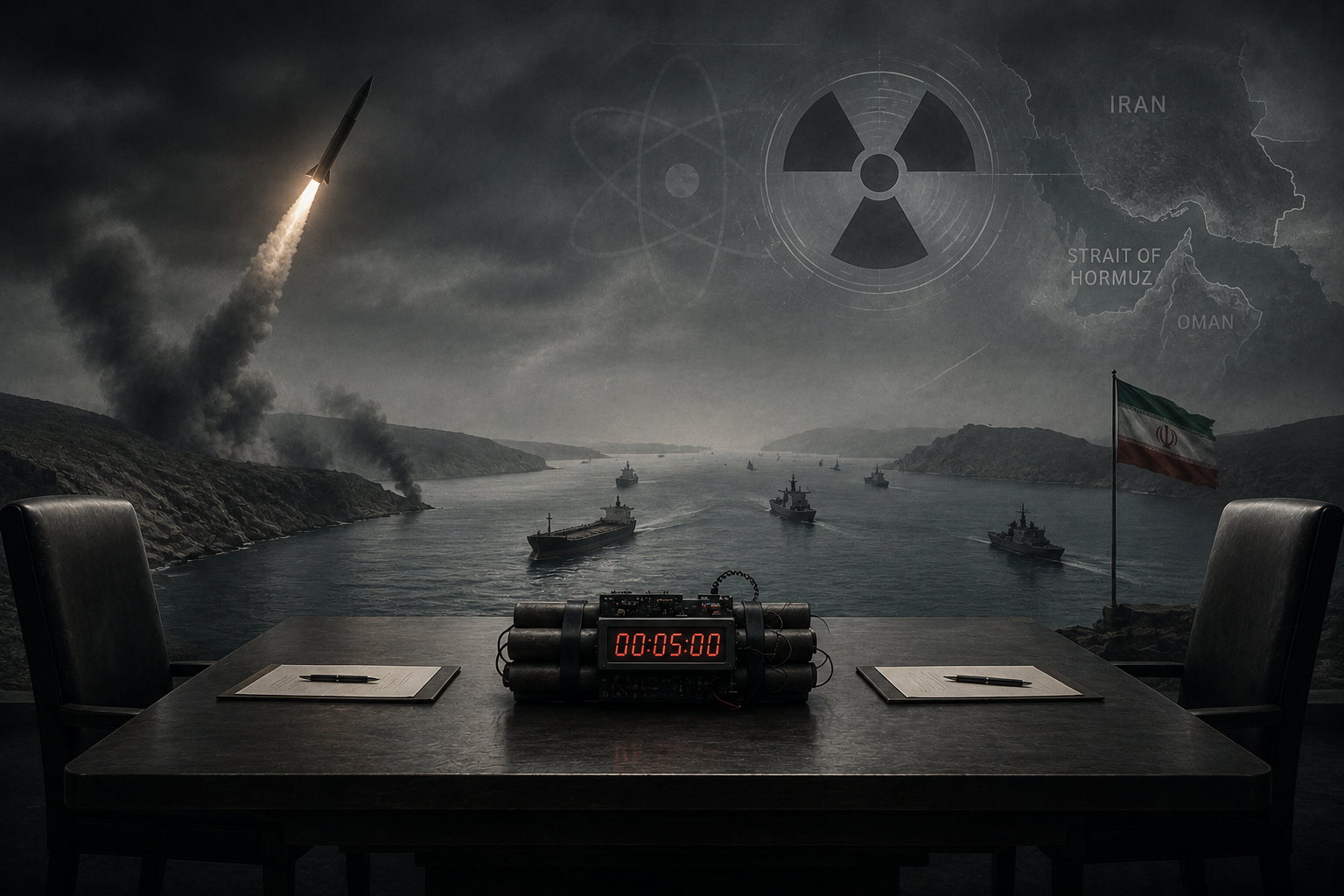
Negotiating with the Islamic Republic means sitting across from a ticking bomb — with the Strait of Hormuz, a nuclear program, and a missile arsenal still on the table. (AI-generated illustration)
You don’t give a ticking bomb more time — you defuse it
The ceasefire is five weeks old. The war, we are told, is pausing. Diplomats shuttle between Islamabad and Washington. A 14-point memorandum of understanding is reportedly “inches away.” And in the background, the Islamic Republic of Iran — its military degraded, its navy destroyed, its supreme leader dead — is being offered something it does not deserve: a seat at the negotiating table.
This is a mistake. Not a tactical miscalculation, but a strategic one — the kind that produces catastrophe ten years later, when the world has moved on and the regime has rebuilt.
You do not negotiate with the devil. You dismantle it.
The Illusion of a “Weakened” Regime
The numbers are impressive. According to CNN, over 8,000 military targets have been struck. Admiral Brad Cooper, commander of U.S. Central Command, reported that 130 Iranian naval vessels were destroyed — the largest elimination of a navy over a three-week period since World War II. Iran’s ballistic missile infrastructure has been severely degraded. Ali Khamenei is dead.
And yet.
The Islamic Republic still controls the Strait of Hormuz. It still launches drones at the UAE and Kuwait — even during the ceasefire. Its parliament speaker, Mohammad Bagher Ghalibaf, declared in May 2026 that Iran is “prepared for every option” and that its armed forces are ready to deliver “a lesson-giving response to any aggression.” Its foreign ministry spokesperson stated that enriched uranium is “as sacred as Iranian soil” and will not be transferred “under any circumstances.”
This is not the language of a defeated adversary negotiating terms of surrender. This is the language of an operation buying time.
What the Islamic Republic Actually Is
Western diplomacy treats the Islamic Republic as a state — irrational, perhaps, but ultimately governed by the logic of survival. This assumption is the root of every failed negotiation since 1979.
As I argued in my earlier analysis, the Islamic Republic does not function as a regime. It functions as an operation — a 45-year project of ideological expansion, regional destabilization, and covert warfare. Regimes seek survival. Operations seek completion of their mission. And the mission of the Islamic Republic has never been governance — it has been the export of revolution, the destruction of Israel, the establishment of regional hegemony, and the systematic plundering of Iran’s national resources to finance these objectives.
When Khamenei was killed and Mojtaba was named successor — chosen, as the Assembly of Experts stated, because he should “be hated by the enemy” — the message was unmistakable. The operation continues. The personnel change. The mission does not.
A weakened version of this entity is not a manageable partner. It is a ticking bomb.
The JCPOA Lesson: Every Dollar Becomes a Weapon
We have been here before. In 2015, the JCPOA granted Iran access to over $100 billion in frozen assets in exchange for temporary nuclear restrictions. The Washington Institute for Near East Policy documented what followed: Iran’s military budget surged by 40 percent. Hezbollah’s late secretary-general Hassan Nasrallah publicly declared that “as long as Iran has money, so does Hezbollah.” The Atlantic Council reported that despite sanctions, Tehran continued to provide more than $700 million annually to Hezbollah and up to $100 million annually to Hamas and other Palestinian terrorist groups.
The nuclear restrictions? Temporary. Iran began breaching JCPOA limits in 2019, enriched to 60 percent by 2021, and by 2024 possessed enough highly enriched uranium for multiple nuclear weapons — an estimated 440 kilograms that, as I detailed in my nuclear analysis, remains unaccounted for under the rubble of bombed facilities.
The lesson is unambiguous: every dollar released to the Islamic Republic is converted into weapons, proxy armies, and nuclear advancement. Sanctions relief is not diplomacy. It is oxygen for terrorism.
The Mirage of the Current Deal
The memorandum of understanding currently under negotiation reportedly includes Iran halting uranium enrichment for 12 to 15 years, transferring its enriched uranium stockpile, and reopening the Strait of Hormuz — in exchange for the lifting of sanctions and the release of billions in frozen assets.
This should sound familiar. It is, in essence, a second JCPOA — with the same structural flaw.
The Al Jazeera analysis of Iran’s counter-proposal reveals what Tehran actually wants: end the war first, settle the Strait of Hormuz, push nuclear negotiations to later stages. In other words: give us breathing room now, and we will discuss the existential issues when we are stronger.
President Trump rejected Iran’s latest proposal as “totally unacceptable.” He was right to do so. But the danger is not that this particular proposal is accepted — it is that the negotiating framework itself treats the Islamic Republic as a partner capable of honoring agreements.
It is not. It never has been. The JCPOA proved this. The current ceasefire — violated repeatedly by both sides, with Iran firing on U.S. ships and attacking Gulf states even during the truce — proves it again.
The China Factor: Loosening the Noose
As if the risk of a premature deal were not enough, the economic pressure on Iran is now being actively undermined.
During his visit to Beijing on May 13–15, President Trump told Bloomberg he is considering lifting sanctions on Chinese oil companies that purchase Iranian crude. CNBC reported that several Chinese “teapot” refineries — sanctioned earlier this year for importing Iranian oil — could see those restrictions eased. And PBS noted that days before Trump’s arrival, China’s foreign minister hosted Iran’s Abbas Araghchi in Beijing and publicly defended Iran’s right to civilian nuclear energy.
China purchases approximately 90 percent of Iran’s shipped oil. If sanctions on Chinese buyers are lifted — or simply not enforced — the Islamic Republic regains its primary revenue stream. And as the JCPOA era demonstrated, revenue does not fund hospitals and schools. It funds the IRGC, Hezbollah, Hamas, and the Houthis.
Loosening the economic noose while the regime still controls the Strait of Hormuz, still possesses unaccounted-for nuclear material, and still declares enrichment “non-negotiable” is not diplomacy. It is capitulation dressed as statecraft.
Why Dismantlement, Not Management
The temptation in Washington is always the same: manage the problem, contain the threat, move on to the next crisis. This approach produced a nuclear North Korea. It produced two wars in Iraq. And it will produce a resurgent Islamic Republic if applied to Iran.
A “controlled” Islamic Republic — weakened but intact, sanctioned but surviving — retains every capability that makes it dangerous. Its intelligence services remain operational. Its covert networks across the region remain in place. Its ideological infrastructure — the seminaries, the propaganda apparatus, the recruitment pipelines — continues to function. And its institutional memory of how to build nuclear weapons does not degrade with time.
As I have previously argued, the Islamic Republic’s threat is not located in any single leader, facility, or weapon system. It is located in the structure itself — a structure designed from its inception for covert warfare, ideological expansion, and the subversion of regional order.
You do not manage such a structure. You dismantle it. Completely. Its military apparatus, its intelligence networks, its ideological institutions, and its financial pipelines — all of it. Because a structure without leaders regenerates. Leaders without a structure are powerless.
The Principle of Simultaneity — Revisited
As I have argued previously, the Principle of Simultaneity holds that no authoritarian regime has ever been toppled by external force alone. The decisive factor is always the convergence of external pressure and internal action at the same moment.
The current ceasefire suspends external pressure without activating internal action. This is the worst possible configuration. The Iranian people — who took to the streets in their millions, who endured the massacre of over 30,000 of their own in January, who shouted not for reform but for the end of the regime — are watching. And what they see is their oppressor being offered a deal.
If the international community signals that the Islamic Republic can survive this war through negotiation, the strategic consequence is clear: the internal opposition is neutralized, the regime’s narrative of resilience is validated, and the window for structural change closes.
This outcome serves neither strategic interests nor long-term regional stability.
Conclusion
The Islamic Republic of Iran is not a government that has lost a war and is ready to negotiate peace. It is a terrorist operation that has been degraded but not destroyed — and that is now using diplomacy to achieve what its missiles could not: survival.
Every concession granted — sanctions relief, frozen assets, permission to exist — becomes fuel for the next phase. The JCPOA proved this. The current ceasefire, violated from its first week, confirms it. And the potential easing of Chinese oil sanctions threatens to restore the regime’s financial lifeline at precisely the moment it should be severed.
The question before the international community is not what kind of deal can be struck with the Islamic Republic. The question is whether the world is willing to finish what it started — or whether it will repeat the mistake of every previous negotiation and leave a wounded predator alive to hunt again.
You do not negotiate with the devil. You do not contain it. You do not manage it.
You dismantle it. Before it rebuilds.
Related Topics
Related Posts