
Middle East Analyst
Why the US Threatening Greenland Threatens Gaza Reconstruction
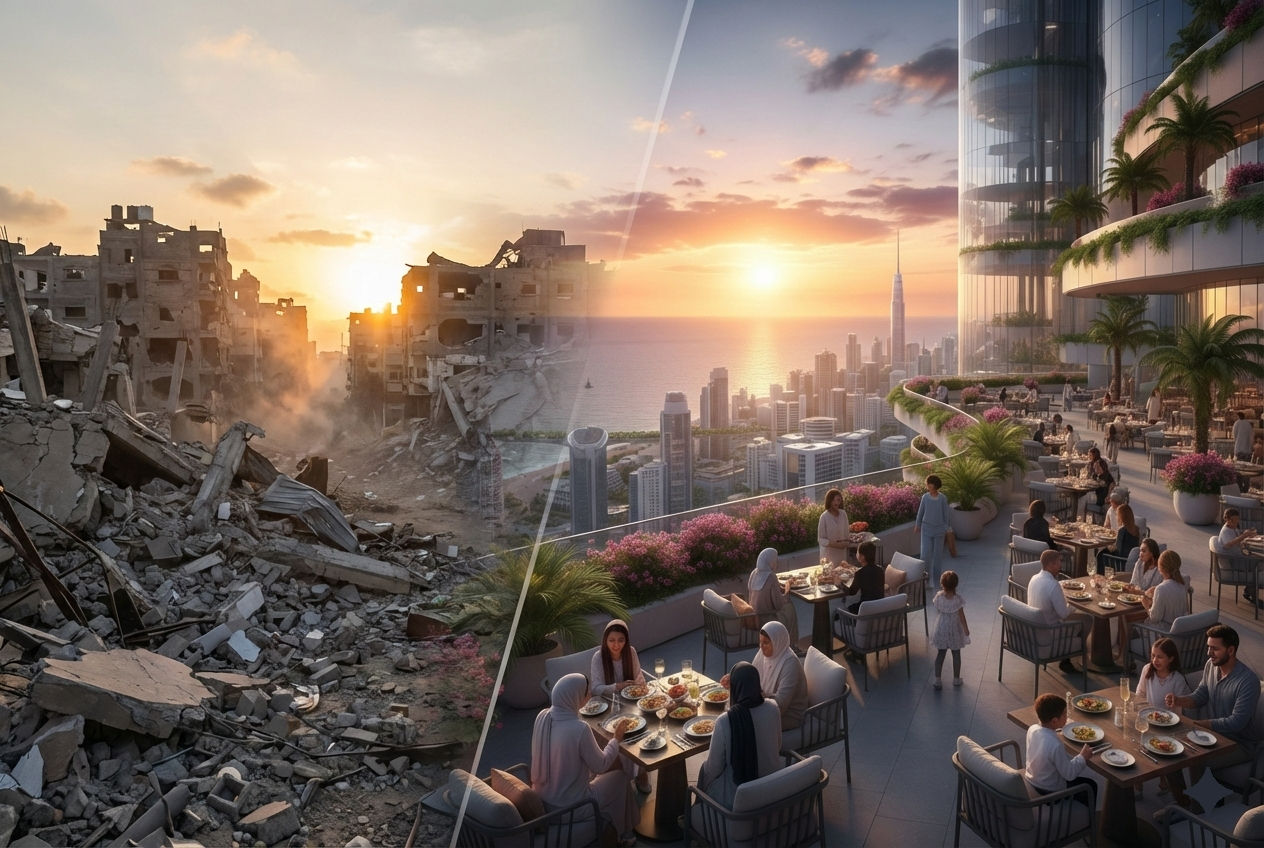
Graphic by author
Gaza’s reconstruction is not merely an engineering challenge; it is a test of international will, trust, and the predictability of global politics. The rubble of homes, hospitals, and schools can be cleared and rebuilt only if governments and private investors are confident that their money will be used as intended and protected from sudden geopolitical shocks. That confidence is fragile. When the President of the United States (and Chairman of the Board of Peace) signals an unprecedented willingness to disregard long‑standing diplomatic norms or to pursue unilateral territorial gambits — even in places as remote as Greenland — it sends a chill through the boardrooms and ministries that must finance Gaza’s recovery.
Rebuilding Gaza will require sustained, large‑scale commitments from European capitals, Gulf states, and international financial institutions. These actors do not write blank checks; they weigh political risk, legal guarantees, and the stability of the international order before committing billions. The moment a major security guarantor appears volatile — proposing unilateral actions that could strain alliances and unsettle markets — the calculus changes. Donors and investors begin to ask whether contracts will be enforceable, whether escrowed funds will remain insulated from political pressure, and whether the macroeconomic environment will remain stable enough to support long‑term projects.
Talk of militarily annexing Greenland may sound like a distant, even fanciful, geopolitical provocation. In practice, it is a signal with outsized consequences. Greenland sits at the crossroads of Arctic security, critical‑mineral access, and transatlantic cooperation. Any suggestion that a powerful state might ignore the sovereignty of an ally or press territorial claims unilaterally would not be contained to the Arctic. It would reverberate through NATO capitals, unsettle European energy planning, and inject fresh uncertainty into commodity and insurance markets. For Arab donors and private investors — many of whom already operate in a world of geopolitical risk — the question becomes practical: if a major power can upend alliance norms without consequence, what guarantee is there that reconstruction funds will not be politicized, frozen, or redirected when the strategic winds shift?
The problem is not merely rhetorical. Reconstruction projects require predictable supply chains, stable energy prices, and reliable insurance and banking services. If investors fear that global energy markets could be disrupted by sudden geopolitical moves, they will either demand much higher returns to compensate for that risk or withdraw entirely. That dynamic favors short‑term humanitarian aid over the long‑term infrastructure investments Gaza needs: housing, water and sanitation systems, power grids, ports, and airports. Humanitarian relief can be scaled up quickly; rebuilding a functioning economy and governance structure cannot.
Equally important is the signal such volatility sends about respect for sovereignty and international law. Arab states, many of which have themselves experienced foreign interventions and contested borders, are particularly sensitive to precedents that erode norms protecting small and medium‑sized states. When a leading power’s rhetoric or actions suggest that traditional protocols can be set aside, it undermines the moral and legal foundations that make multilateral cooperation possible. Donors who pride themselves on principled engagement will find it harder to justify large investments in a context where the rules of the game appear negotiable.
What, then, should be done to prevent US foreign‑policy turbulence from turning Gaza’s reconstruction into a stalled, politicized exercise?
First, reconstruction finance must be anchored in multilateral mechanisms that reduce single‑state political risk. Escrow arrangements, international trust funds managed by neutral institutions, and legally binding multilateral agreements can reassure contributors that their money will be used for reconstruction regardless of unrelated geopolitical disputes. These mechanisms cannot eliminate risk, but they can create a firewall between reconstruction finance and the unpredictability of American foreign policy.
Second, the international community should decouple humanitarian and reconstruction finance from high‑politics wherever possible. That means insulating construction governance from unrelated territorial or security disputes and ensuring that procurement, contracting, and oversight are transparent and internationally monitored. Independent audits, public reporting, and local stakeholder involvement will make it harder for funds to be diverted or weaponized for political ends.
Third, European and Arab donors should coordinate more closely on risk‑sharing and political signaling. A united front — one that ties reconstruction commitments to clear, enforceable standards of sovereignty and non‑interference — would reduce the leverage any single state might have to disrupt the process. Coordination also helps stabilize markets by presenting a predictable flow of funds and projects that underwrite long‑term demand for materials, services, and energy.
Finally, President Trump must recognize that rhetoric and unilateral posturing have real economic consequences. Threats to allies’ sovereignty or proposals for unilateral territorial expansion are not abstract exercises in brinkmanship; they are actions that can raise the cost of capital, spook insurers, and delay the very investments that save lives and rebuild societies.
Gaza’s reconstruction is a moral imperative and a strategic necessity for regional stability. It will succeed only if the international community can offer more than promises: predictable finance, enforceable safeguards, and a political environment in which donors and investors feel secure. If the world’s leading powers allow foreign‑policy volatility to become the new normal, Gaza’s recovery will be the first casualty. The choice is stark and immediate: restore predictability and respect for sovereign norms, or watch reconstruction stall under the weight of uncertainty.
Related Topics
Related Posts