
Advancing Public Good in Israel
Why this feels different from the inside
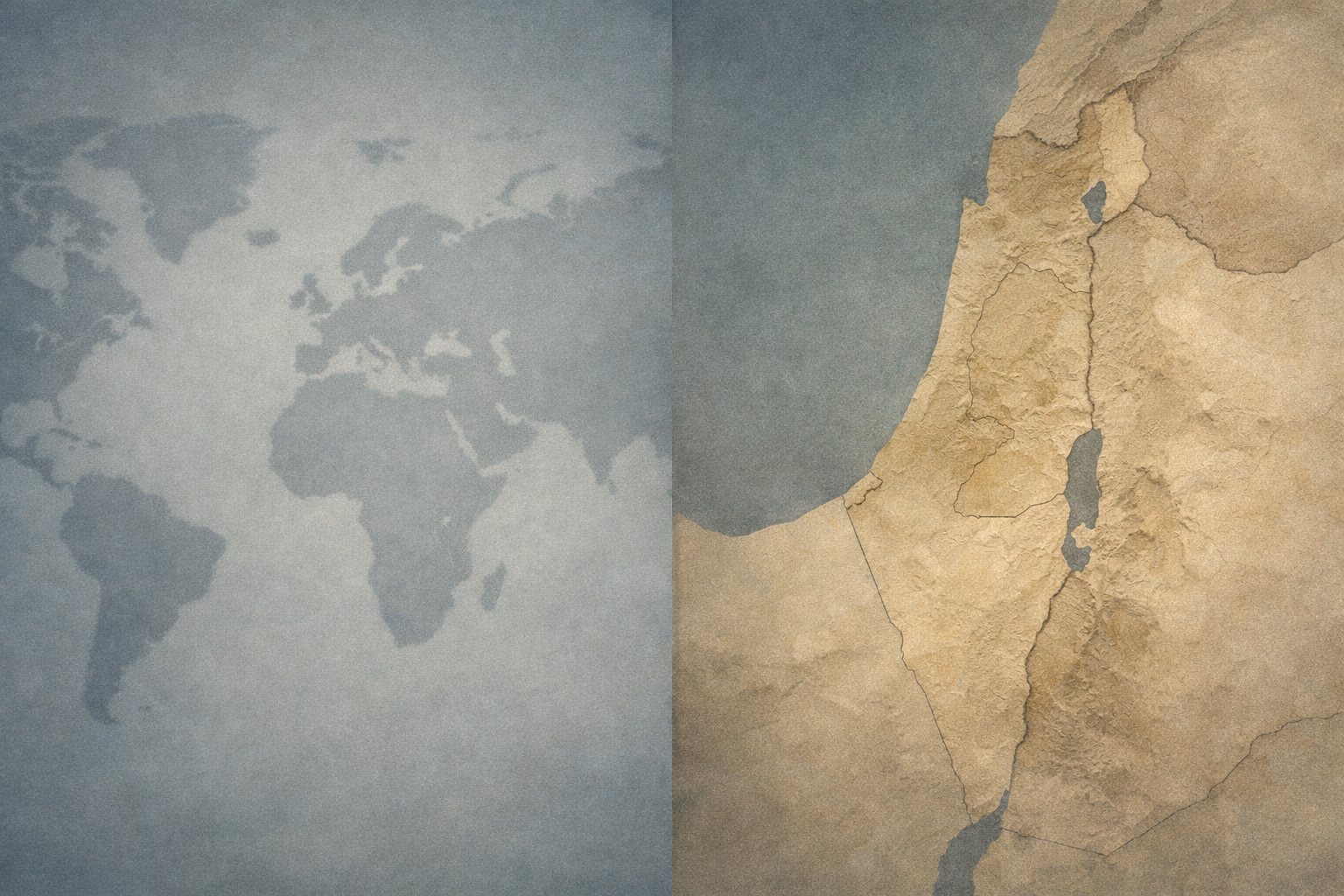
Generated by ChatGPT
A gap in perception
Lately, I’ve found myself in conversations that feel strangely misaligned.
People I know, people I respect, people I interact with regularly—we look at the same place, the same events, and seem to be seeing entirely different things. In some of these conversations, Israel is described in terms that suggest scale and power far beyond anything I recognize. In others, it is spoken about as though it is firmly secure, even unthreatened.
The descriptions sometimes feel so detached from what I know that it’s hard to tell whether we’re disagreeing—or simply not talking about the same thing.
Not because I think people are acting in bad faith, but because the starting assumptions feel so different that we end up talking past each other.
I’ve been trying to understand that gap.
Continuity and fragility
Part of the answer, I think, begins with something easy to overlook.
The Jewish people are small. But more than that, they are old—not in the sense of tradition alone, but in continuity. A people that has carried its identity across centuries, across continents, across repeated upheavals.
That continuity can create an assumption from the outside: that it will simply continue. That it always has, and therefore always will.
But that doesn’t hold from the inside.
Continuity, for a people like this, is not automatic. It has been interrupted before—reduced, nearly broken.
And if something has nearly ended once, the possibility that it could end again never disappears.
Scale and recovery
If we step back and look at scale, the picture becomes clearer.
In 1939, on the eve of the Holocaust, there were about 16.7 million Jews in the world. After the war, that number dropped to around 11 million. Today, it stands at roughly 15.8 million—still below where it was before the destruction of European Jewry.
Over the same period, Christianity grew from roughly 600 million to over 2 billion. Islam grew from around 250 million to nearly 2 billion. Christianity roughly quadrupled. Islam grew nearly eightfold.
Most major religions spent the last eighty years growing. The Jewish people spent much of that time recovering—and have not fully recovered.
Living as a small people
Scale like this has consequences.
For large groups, continuity is often taken for granted. Even significant losses—through conflict, migration, or cultural change—rarely put the group’s existence in question. It persists, almost by default.
Smaller groups do not have that luxury.
When a people is small, its future is less secure. Losses matter more, not only in absolute terms but proportionally. Over time, even gradual, natural processes—dispersion, assimilation, intermarriage—change the size and character of the group.
That doesn’t make those processes inherently negative. At the level of individual lives, they are often natural, even meaningful. But at the level of a people, they accumulate.
The result is a different kind of awareness. Continuity is not assumed; it must be maintained.
Because the threat of erosion is always present.
Memory and its weight
That awareness does not exist in a vacuum. It is shaped by memory.
Within the last century, the Jewish people came close to catastrophic destruction—not in some distant past, but in a way that still sits within living memory: through families, through stories, through what was lost and never rebuilt.
By 1942, credible reports of mass murder had reached the Allied world. Requests were made—among them, proposals to bomb the rail lines leading to Auschwitz. Those requests were not acted on.
The point is not to assign blame or extract a single lesson. But it leaves a mark on a people’s consciousness.
When that people has lived through a recent period in which declared intent became reality—and in which outside intervention came late or not at all—threats are not experienced as abstract.
They are heard differently.
A small country, a concentrated people
That sense of vulnerability is not only historical. It is also geographic.
Israel is a small country—roughly the size of New Jersey. It is also the only Jewish state in the world.
Today, close to half of the world’s Jews live there, making it the largest single concentration of Jews anywhere.
Since its founding, Israel has fought multiple wars with neighboring states under conditions in which its survival was not assured.
By contrast, there are about 50 Muslim-majority countries and 22 Arab states spread across a vast geographic area.
The difference is not just political. It is structural.
How things are heard
That difference shows up not only in facts, but in how things are heard.
Certain phrases, certain slogans, travel easily across contexts. They can sound abstract, even aspirational, depending on where one stands.
But from within a small, concentrated space, they land differently.
For many Israelis, phrases like “from the river to the sea” are not heard as distant or symbolic. They refer to the entire physical space of the country itself.
And when that is the entire country you live in—when there is no elsewhere within it—the meaning changes. What might be understood elsewhere as an aspirational political claim is experienced from within as something that leaves no room for your country itself.
A low margin for error
Taken together, these factors point in a consistent direction.
A small people, not fully recovered from recent catastrophic loss. A long continuity, violently interrupted before. A continuity not assumed, but maintained—always under threat of erosion. A people concentrated in large part within a single, small country. A country that holds much of that people, with no internal margin for retreat.
Within that structure, risk is experienced differently.
What can appear, from the outside, as overreaction or escalation often feels, from the inside, like a response to accumulated vulnerability—demographic, historical, and geographic.
This does not dictate a single course of action, and it does not eliminate disagreement about what should be done. But it does help explain why, for many Jews, the instinct to defend themselves and their people is not abstract.
It is immediate.
I am writing this today on Yom HaShoah—Holocaust Remembrance Day. That awareness feels closer to the surface.
Related Topics