Why We Protested in Tokyo for the Voiceless People of Bangladesh?
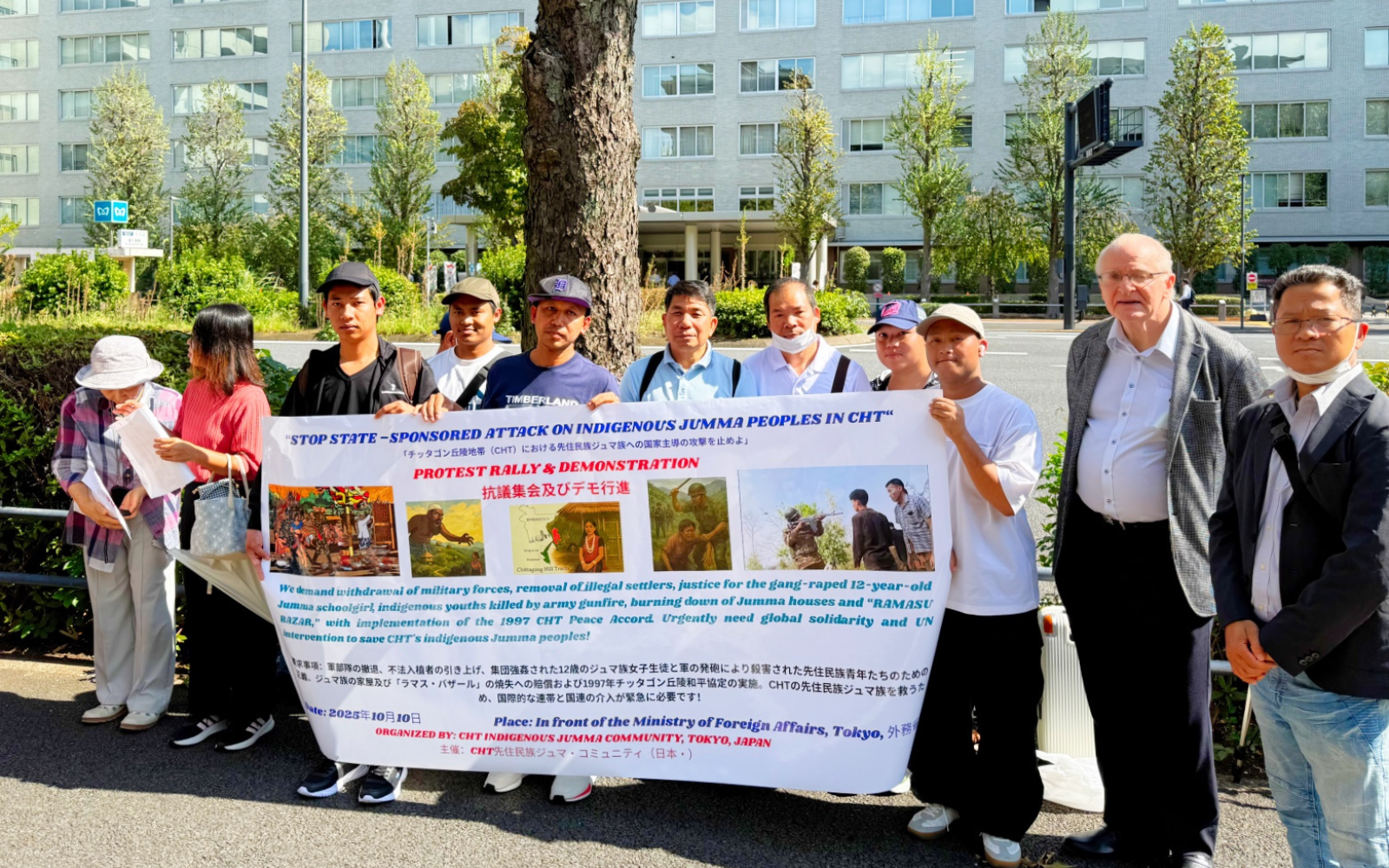
I never thought I would hold a protest banner several times a year in Tokyo. But here I am again, standing with the Indigenous people of the Chittagong Hill Tracts in Bangladesh. We stood in front of Japan’s Ministry of Foreign Affairs because the violence never ends, and the silence keeps repeating itself.
On October 10, 2025, a small group of us gathered there. We held one banner, but we carried a long history of pain. We came to say what the world has ignored for too long, “Stop the state-sponsored attacks on the Indigenous Jumma people of Bangladesh.”
Our protest was peaceful, but our message was clear. It was about what happened recently in Khagrachari’s Guimara area, a tragedy that exposed how broken “law and order” has become in Bangladesh. The violence began after three Bengali settlers raped a young Indigenous Marma schoolgirl. When her community went to the police to file a complaint, the police refused to accept the case.
As a result, frustrated and heartbroken people took to the streets, demanding justice. Instead of arresting the rapists, the army opened fire on the crowd. Three people were killed on the spot, many were injured, and several Indigenous homes and shops were burned to ashes. This was not an isolated incident, but part of a long-standing pattern that has continued since the 1997 Peace Accord, a promise of peace that has never been kept.
That is how “law and order” works in Bangladesh, where victims are treated as threats, and guns silence justice. The same government that protects Hamas supporters when they march in favor of Hamas terrorists uses its own soldiers to fire on unarmed Indigenous citizens. A government that defends extremists abroad but shoots its own peaceful people at home has no moral right to speak of peace.
Those of us living abroad had no choice but to raise our voices. So we stood there, far from the hills but close to our conscience.
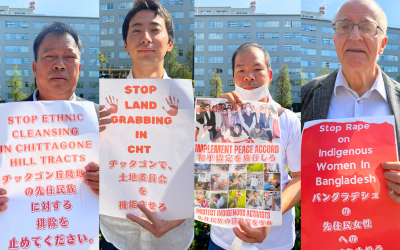
Among those who spoke that day were Dipti Shankor Chakma, Tom Eskildsen, Seka Chakma, Purna Lal Chakma (myself), Nozumi Inagawa, the general secretary of Jummonet, Uching Mong, Kyathuiching Akash, and Krazairhee Marma. Each spoke with the same fire inside — a call for the world to see, to listen, and to act. We stood together not as enemies of Bangladesh, but as friends of truth.
I have lived long enough to know that silence kills more than bullets. When the world is loud about some injustices but quiet about others, that is not peace; that is politics. The same people who cry for Hamas say nothing about the hills of Bangladesh, where Indigenous children disappear without a headline. Justice cannot be selective. Pain does not need a religion, a race, or a region to be real.
Japan is known for peace and discipline, and it is the right place for this protest. We wanted to remind the world that human rights are not only a national issue, but also a global duty. When people in power deny others their dignity, it concerns everyone.
For me, standing in Tokyo was both hope and heartbreak. It is a hope because, even far from home, our voices still matter, and it is a heartbreak because our people still live in fear. Every time I see Japan’s flag of peace waving in the wind, I wish the people of the Chittagong Hill Tracts could also feel that kind of peace, a peace that protects, not punishes.
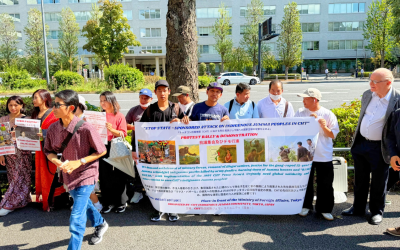
We were not thousands. We were not a big crowd. But sometimes, a few voices can echo farther than armies. Our protest was not against a country, but against the lawlessness of the Bangladeshi government toward the CHT. We wanted the world to hear us — even from Tokyo. Truth can travel across oceans, across walls, and through silence.
From Japan, we sent an appeal to the world, “Peace without justice is just decoration. The people of the Chittagong Hill Tracts deserve real peace, rights to live like human beings, and the kind that lets them sleep without fear.”
October 12, 2025
Tokyo, Japan