Journalist and Host of The Spiro Circle Podcast
Will 2,000 years of Jewish survival teach AI how to adapt?
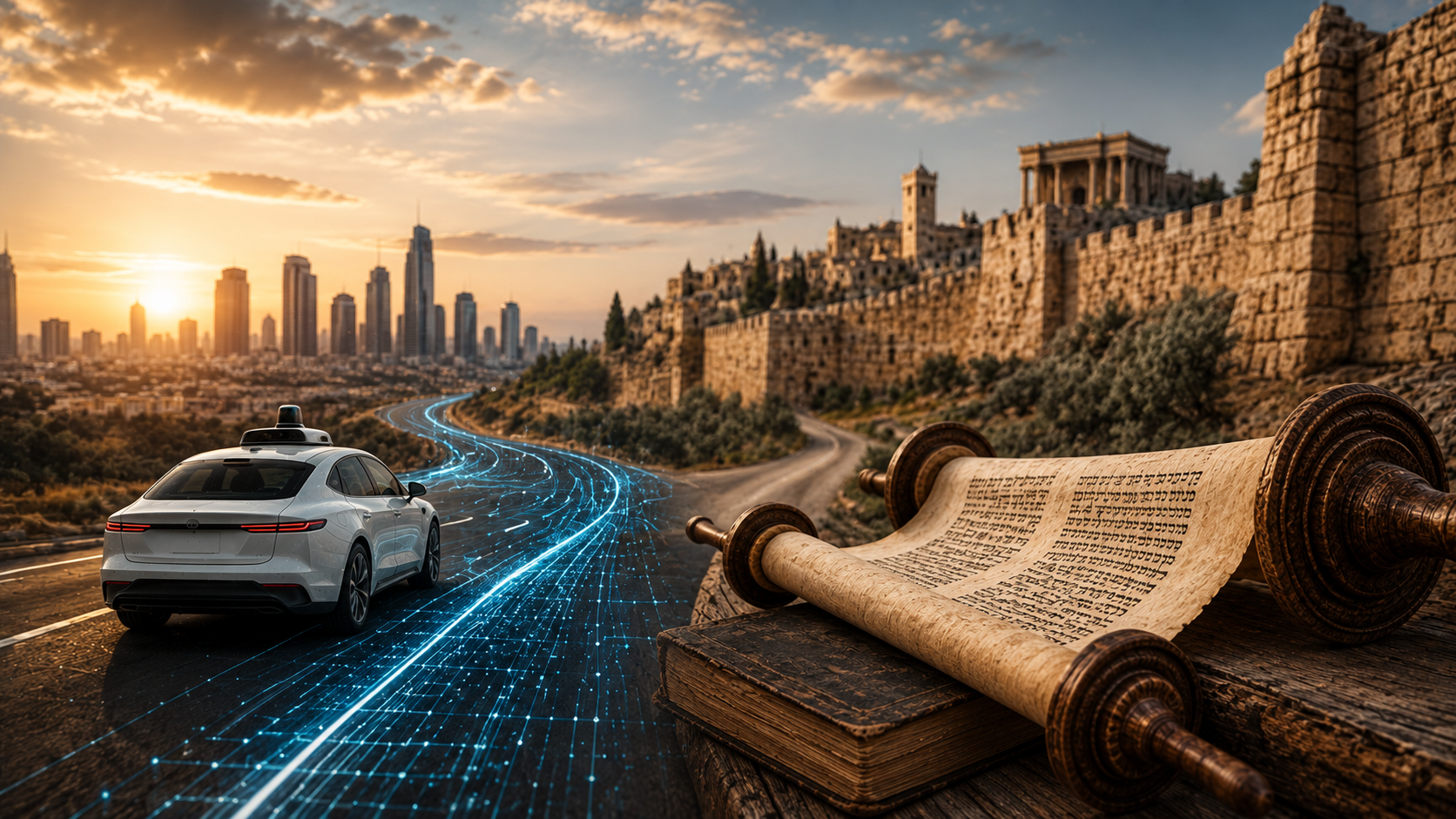
AI is asking Judaism something it hasn't had to answer before: what happens when the actor isn't exclusively human anymore? Photo credit: ChatGPT Image
Earlier this month, NVIDIA released the weights of Alpamayo 2 Super for commercial use, putting advanced driving intelligence within reach of more companies. The license permits use, modification, and commercial redistribution without a model-license fee.
I thought it might be a good time to reconnect with Tal Cohen, co-founder of Drive TLV, an innovation hub focused on smart mobility, and managing partner of Next Gear Ventures, whom I first spoke with for an episode of The Spiro Circle. We managed to speak briefly between our summer vacations (his had technically already started!), during which he called it “a big move that one huge gorilla is making.”
It comes back to a theory he has recently written about on his website: That once intelligence is abundant, it stops being anyone’s advantage.
When intelligence becomes abundant
NVIDIA’s model aims to advance the AV ecosystem on two fronts, namely open commercial licensing and leading multitask capabilities for autonomous driving. Alpamayo 2 Super is not a production-ready driver. The challenge lies in who has the authority to let systems built from it act.
Cohen has a thesis for this, one he’s repeated to me since our initial conversation where I first learnt about his concept of the Habitat: Everyone can now get access to the brain, but almost nobody has built the foundation around it that decides when the brain is allowed to act.
Deployment requires more than technology — it requires values and responsibility
Cohen was blunt with me about the gap between the technology (the ‘brain’) and the institutional framework (the ‘soul’) required for society to trust it: “The brain that they give us still doesn’t know what is right and wrong, ethically. It’s just a sensor to action.” Who decides whether an autonomous vehicle may act? Who is accountable when it does? What gets recorded, and who reviews it when something goes wrong? Leadership at these tech companies is coming to understand that these are becoming legal and moral questions that need answering.
This, to him, is what he calls the Habitat: “Ownership, accountability, responsibility, consequences, evidence. You don’t see it much coming from OpenAI, or Meta. You don’t see it much coming from NVIDIA.”
What the destruction of the Temple has to do with AI
This tied into a trend we’d touched on before where tech leaders are publicly turning to religious tradition for answers. In July, OpenAI’s Head of Strategic Futures, Dean Ball, sparked debate after saying he had begun studying the Talmud to better understand AI policy. In April, OpenAI and Anthropic representatives joined faith leaders, including the New York Board of Rabbis, at the first Faith-AI Covenant roundtable organized by the Interfaith Alliance for Safer Communities, to discuss how religious tradition might shape AI ethics.
No one is questioning the sheer ability of these companies and their models, but it is becoming publicly clear that they need a value system installed in them, and those in charge are increasingly turning to Judaism for their north stars. And at this particular technological moment, people building the future are looking to a civilization that has spent thousands of years wrestling with questions of power, responsibility, and adaptation.
Cohen brought up the Temple’s destruction, unprompted, as the clearest precedent he has for what he’s trying to build. “We managed to take the essence of Judaism and put it differently, and hold it to our heart,” he said, “and go around 2,000 years in the diaspora and managed to survive with our identity. It didn’t happen for no reason.”
A civilization that lost its physical center and kept its identity intact, for two millennia, across languages and continents, might be the actual engineering spec that goes far beyond the typical talk of “resilience” I hear across Startup Nation.
AI asks Judaism the same question back
But the river flows both ways. If Jewish tradition may guide AI on how to survive disruption without losing its values, AI is also asking Judaism something it hasn’t had to answer before: what happens when the actor isn’t exclusively human anymore? “Once autonomy is getting into the picture, it’s less about human action; it’s more about actions coming from AI and human authorization,” he explained. Judaism’s ethical instincts — don’t concentrate power, acknowledge the difference between us and God, and care for the vulnerable — were written for people making choices. Now, AI complicates that framework by introducing systems that can increasingly make decisions on our behalf.
Where technology and values meet
And this is ultimately where Cohen’s Habitat thesis comes back into the conversation. Not that Judaism solves AI, or that AI threatens Judaism, but that the Habitat (the record, the authority, the accountability he keeps circling back to) is the only place both problems actually live.
“If we can just take the wisdom of Maimonides right now, and combine the capability with the culture… that’s what drove me to write this particular paper,” he concluded. Maimonides wove reason and belief into one coherent system. Cohen sees the same need to join technological capability with responsibility.
But nobody has solved the challenge of how that abundance meets responsibility. For many, that may look a lot like the one Judaism has been building for 2,000 years.
I spend a lot of time speaking to founders and investors across Startup Nation. You can read my work on my independent platform and podcast, The Spiro Circle.
Throwback: Tal Cohen and I ask, “Can Judaism solve AI alignment?”
Related Topics
Related Posts