Hadassah Evolve Leadership Fellow, Hadassah Writers' Circle
Words that could flip your world: A medical odyssey
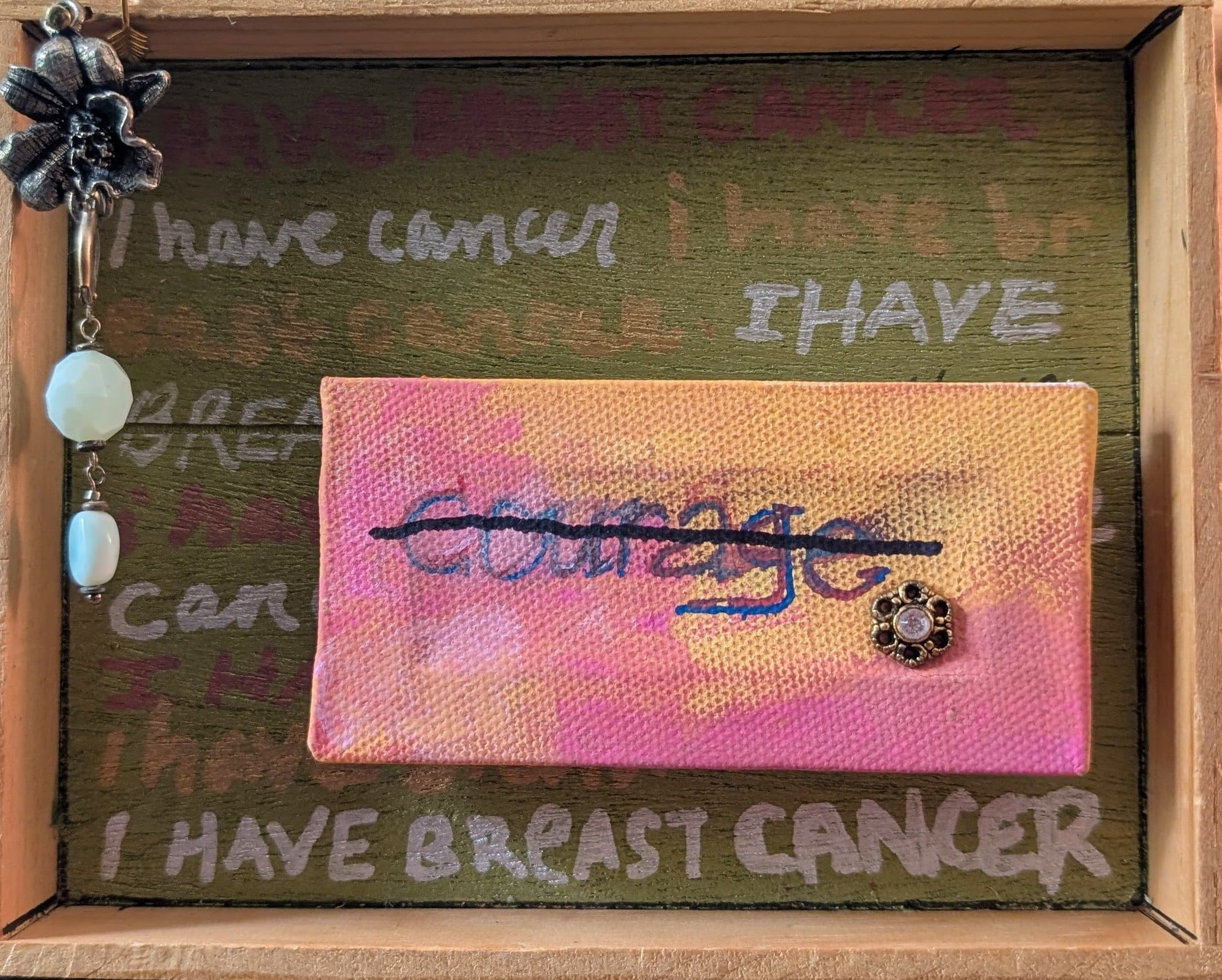
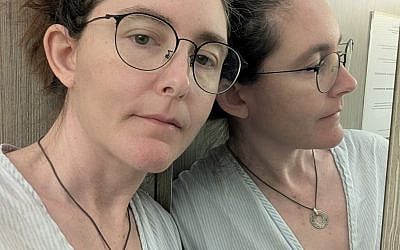
Image courtesy of the author.
This is the first column of a three-part series.
“She wants three more images.” Five words that have the power to tip my world on its head.
My breath catches, so I inhale more deeply, refusing to allow fear to take control. Tears sneak into my eyes, so I blink more rapidly, refusing to allow them to gain control either.
“It’s the right side now,” she says. Now the tears fall. My left breast has already endured two core biopsies, a fine needle aspiration and a lumpectomy. The scars from those procedures prove my determination to prevent any questionable cells from taking hold. My right breast has been free of such troubles. Until today. This news is enough to break through my well-built barrier. My mother, normally in the waiting room for every one of these appointments, was unable to join me today. The dual disappointment is strong, and I lose my composure. I’m not ashamed of this; it just is what it is. But it adds to the list of disappointments for the day.
The staff here are wonderful. Gentle, calm, reassuring. They do their jobs efficiently but kindly. They neither give unrealistic reassurances that everything will be fine nor recite platitudes like “Everything happens for a reason.” They do acknowledge my fears and stay nearby while I cry a little, releasing the sadness, fear and disappointment that come with each new finding of something that needs to be followed up.
My mother was diagnosed with breast cancer when she was 45 years and four months old. I am two months short of 46. Her cancer, comprised of multiple tumor types, was found just months after she had a clear mammogram. Within weeks, she underwent a mastectomy, followed by a year of intense chemotherapy and several years of hormone therapy. Fortunately, the cancer never returned.
With this family background, however, I had my first mammogram when I was 39 years old. My first biopsy took place in 2021, when I was just shy of 42 years old. That procedure was followed by a lumpectomy and my very own spot in the high-risk monitoring program at the University of California, San Francisco (UCSF).
My yearly mammograms are always more comprehensive and staggered with breast MRIs so that I receive imaging every six months. Thus far, everything has been benign, despite that first biopsy revealing some abnormal, but not malignant, cells. They were removed through a lumpectomy to avoid the risk of them becoming cancerous.
This extensive screening regime brings the issue of risk-benefit analysis to the forefront of my mind every six months. I studied public health education and communication as a graduate student, so disease screenings and risk-benefit analysis are topics I enjoy, at least in theory.
When considering a population of people, how much death or disability can we avoid by screening for a disease? On the other hand, how much emotional distress does that screening cause to those who either never develop the disease or would have died of something else prior to the disease itself causing death? We do studies to find answers to these questions, yet we still can only provide answers at a population level. In other words, statistics can only provide guidance, not answers, to individual concerns.
I have multiple strikes against me, statistically speaking: my mother’s pre-menopausal breast cancer diagnosis, my Ashkenazi Jewish genes, my extremely dense breast tissue and the abnormal cells found on my first biopsy. But truthfully, I’ve chosen the most comprehensive screening regimen because of my mother’s experience. There’s no way to separate that experience from my own thought process.
Thankfully, UCSF has a radiologist review my 3D mammograms before I’m even allowed to change out of my ever-flattering gown. On this Thursday, after my mammogram, I’m back to the waiting room once again, still in my gown. I give an emphatic congratulations to each woman who is released from the waiting room without any recall.
In just over four years, I’ve had five mammograms, only escaping once without any further images or testing.
There’s a woman in the waiting room who tries to reassure me, only to have me tell her that I’m already on the recall portion of my visit. I didn’t say it to be mean; I just didn’t feel up to pretending that everything was fine. She tries to find her way out of the faux pas by telling me of the women she knows who have been through breast cancer and are fine now. I don’t want to talk about it – I just want to sit quietly and not cry.
Routinely, my mammogram orders these days include a follow-up ultrasound, which ensures that I have a spot in the schedule should it be needed. If I have a lucky day, there is an opening for someone else.
At the door of the waiting room, an ultrasound technician calls my name. Clearly, it’s not my lucky day. When she finishes taking the pictures, I try asking her what size the finding is, but she’s trained better than that. She goes for the radiologist without suggesting that I make myself more comfortable, inadvertently telling me before she leaves that what she’s found is something the radiologist will want to see for herself.
Sometimes suspicious areas can be approached with “watchful waiting” – monitoring the mass rather than immediately testing. Of course, this presents another layer of emotional distress: If I get a biopsy now and it turns out to be benign, am I causing myself unnecessary pain? But if I don’t have a biopsy now and it turns out to be cancer, did I delay treatment enough that my chances of survival are decreased? So, in some ways, it’s easier when the radiologist simply states that we need to biopsy this lump. Her choice of a statement rather than starting a discussion indicates to me that the level of suspicion is high and I shouldn’t wait. There’s still a chance it will be benign, but these providers have seen enough masses that they have a good sense of what is and isn’t a problem.
Finally, I’m allowed to get dressed. Expecting to find myself talking to a scheduler next, I have forgotten that someone still needs to discuss the biopsy procedure with me. This all feels like such repetition by now that I haven’t given the procedure itself any thought. I try to rush the coordinator through the explanation, reassuring her that I know what to expect, but she sticks to the script. Another well-trained employee.
I used to be the person who explained protocols and got consent from people to join research studies. I know it’s important to stick to the script even when the patient encourages you to rush through it.
Reaching the very end of the script, she explains that my chest will be wrapped in a large elastic bandage to reduce excess bleeding and bruising. It is like a train has slammed into a wall of cars as my brain crashes to a halt. All further thoughts close in on one another like an accordion. I remember the elastic wrap. I remember the pain, both physical and emotional, of the previous biopsies. It’s nothing I can’t handle, but it’s also not nothing. I realize, all at once, that this is a real procedure that will provide concrete results, which could actually change the direction of my life.
I force my brain back into compliance because I’m still not finished with this day. I need to schedule the biopsy and to meet with a physician assistant (PA) for my manual exam and to discuss all of this. I’m hungry and I’m exhausted.
The manual exam is unremarkable — my PA cannot feel any lumps or any swelling in my lymph nodes, which she finds reassuring. If there is something problematic, she says, it’s good that she can’t feel it yet. Then she confirms that I’m not planning to travel in the next several weeks. With my tendency to travel for weeks or months at a time, I can understand her concern that I might be planning to leave town. Still, it’s another comment that feels foreboding.
I do have one bit of luck – there is an open biopsy slot for the next day. With my biopsy on a Friday afternoon, I can find solace in community, tradition and prayer during Shabbat services. Not only that, but I never expect results to be returned on a weekend, so I can actually relax for two full days.
On Monday morning, though, when labs and offices reopen, the idea of getting those results starts tickling my mind again. Still, I don’t expect the results until at least Thursday. But when, later that afternoon, the words “private number” light up my phone screen, I know my results — even before I answer the call. Good news doesn’t come this quickly, and my provider confirms this by sharing the pathology findings.
At 45-years-old, I have been diagnosed with breast cancer.
—
Danielle is a member of the Hadassah Writers’ Circle, a dynamic and diverse writing group for leaders and members to express their thoughts and feelings about all the things Hadassah does to make the world a better place. It’s where they celebrate their personal Hadassah journeys and share their Jewish values, family traditions and interpretations of Jewish texts. Since 2019, the Hadassah Writers’ Circle has published nearly 500 columns in The Times of Israel Blogs and other Jewish media outlets. Interested? Please contact hwc@hadassah.org.
Related Topics