Would you put your baby in a cage?
Of course, it’s natural for people to be focusing on the election results, right now. But I want to write about something else.
Normally, living in the holy land, I get so distraught and fired up I feel the need to write an angry, distressed or incredulous blog (or all three) around once a month. But now I’m in England on a long break, and my last blog was in fact on July 29th. https://blogs.timesofisrael.com/hands-up-if-you-think-youre-normal/
I felt very fortunate that it was featured. But one of my closest friends couldn’t understand the picture I’d created: the quiet, peaceful countryside. No war. Everything calm and beautiful.
Where is your heartache? She asked.
Yom Kippur has come and gone, but now I am atoning for the white lies I told, or the truth I did not tell, in that blog.
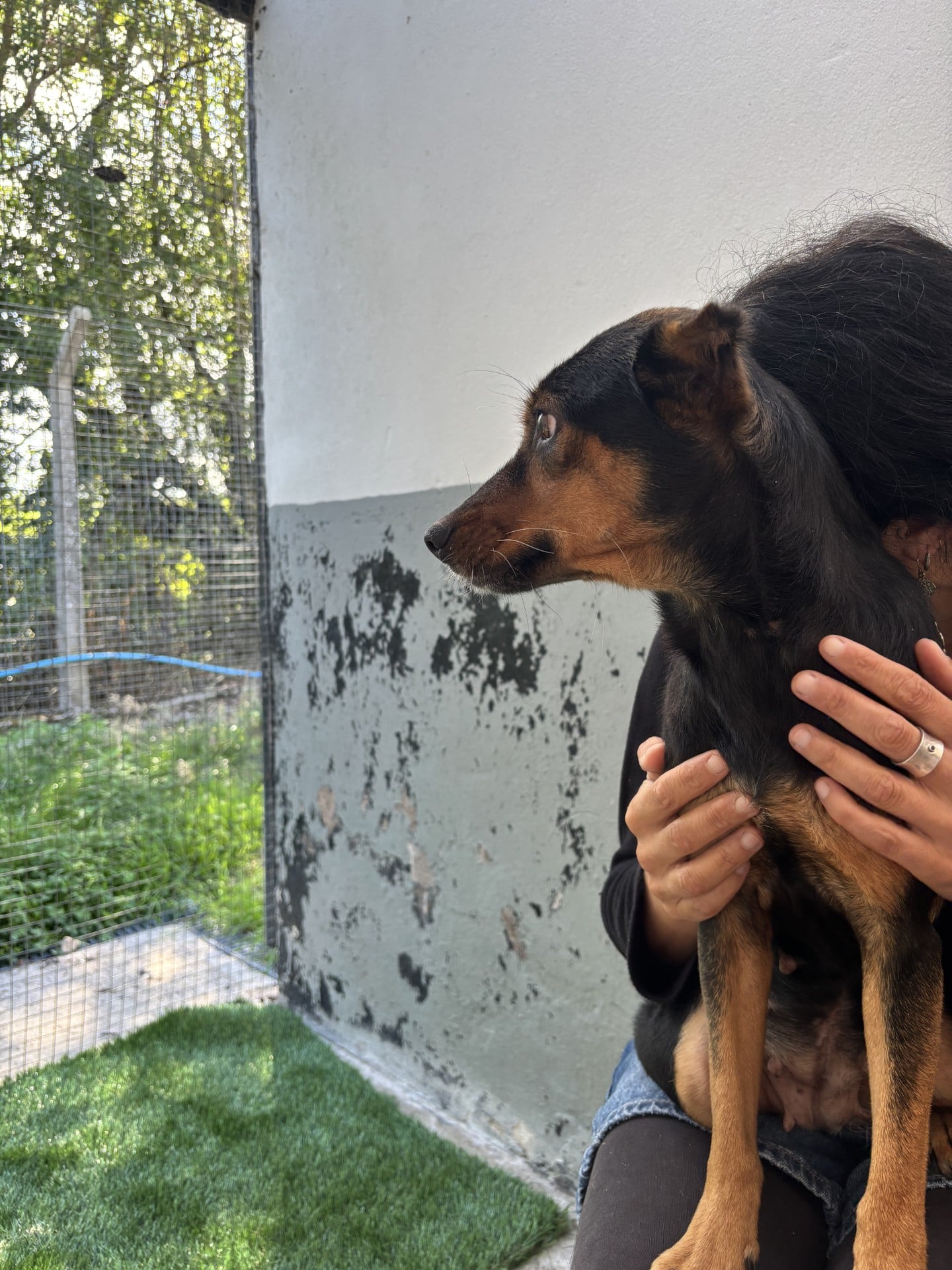
In March 2025, knowing we were going to have my sabbatical year on a canalboat and spend the time exploring the canals of England, we were ready to begin the process for our dog. Her name is Lucy, she is seven and a half and she was found on our kibbutz, abandoned and hungry. She had already given birth at the age of one and her tail and ears had been cut. (A Bedouin tradition). My three-year-old son and I found her at the entrance of his Kindergarten, and after giving her a whole lot of fuss, she decided to come home with me. She stayed by my side the whole way and came in through the front door as though it was her home. So, her home it became.
Since then, she has been with us on almost every one of our adventures: on countless demonstrations, as a coping-through-war therapy dog at school for my students and colleagues alike, on adventures all over Israel, and of course running with me every morning, or running by me while I’m offroad on my bike. She is an integral part of our family, even more so than the beautiful cats we’ve fostered and adopted and rescued over the years. When we decided to go to England, it was a no-brainer. Lucy was coming with us.
The documented rabies vaccinations had to be started in March. Only, you probably remember that in March there was – no surprises here – another war. My birthday was cancelled, Purim was cancelled, and we spent much ‘delightful’ time in our local shelter. And so, the paperwork started late. But come the beginning of July, our vet filled in the necessary documents, signed and stamped every page, and to make doubly and triply sure the dates would still be accepted, we paid extra to a head vet in another local authority. He informed us we must get our vet to sign by every dated vaccination. So, we did. We spent four hours with him until he was satisfied the paperwork was accurate.
We bought a large crate for Lucy, and at the airport we got her through customs four hours before the flight. Everyone there checked her paperwork, from the officials in the office to the people who sorted out her cage, to make sure everything was safe for the flight and acceptable for British customs. We had bought a sleeping tablet from our vet, who recommended it before the flight. At least that way I knew I did not have to worry about Lucy being awake and frightened in the cargo. But when we got to the loading area, they told us the tablet was forbidden. I left Lucy with my coat and a towel in her cage, familiar objects and scents around her. But she was shaking anyway. She was not allowed food or water in the cage. I took one more glance at her, still visibly trembling, as we left the cargo area.
I remember saying to one of our closest friends our adventure would not start until Lucy was safely in England with us…
We have been in England on our boat now for three and a half months, and Lucy only joined us on our adventure on the 15th October.
We went to pick her up from quarantine, where she travelled straight from the airport enclosure, because we were given no other choice. We received an email after waiting a few hours at the airport to inform us her documentation was incorrect, and she would not be released. We went to where she was being held as quickly as we could. It was late Friday evening. The pregnant lady behind the desk said Lucy’s documentation did not pass British standards. She would not even allow us to see Lucy. After the waiting in Israel, the flight and waiting in England, Lucy had been without her family around 12 hours. And now we were informed she would have to live without us for another four months. We had to find her a kennels, someone to take her there (we were not allowed to) and it would cost around five thousand pounds for the privilege (that’s 20, 000 shekels). I tried calling our vet in Israel. She didn’t answer, of course. We tried reasoning with the lady. Surely, she could understand we had been in a war zone, and if mistakes had been made, we would rectify them as soon as possible? That Lucy had had every rabies vaccination needed, it was just that the dates were wrong and we could sort it all out if only they would keep Lucy until we got hold of our vet. I tried to explain that Lucy had been a kind of therapy dog throughout falling missiles, that she helped people through depression, that we would do anything to get her released. But she would not budge. The woman had to keep to the British law. Not her fault, of course. She works for the government. But I could not help thinking that had it been her baby she’d had to put in a cell for four months, she might have behaved a little differently.
Totally exhausted and utterly distraught, but left with no power to argue and nothing else to use as reason, we left Lucy and made our way to the Air BnB where we were staying before getting on our boat. The next morning, during my first run without Lucy, I kept trying to work out what we could do – perhaps take her out and go through France, or even fly back to Israel and begin the process all over again? But to do anything where Lucy had to travel again by herself broke my heart even more.
That morning, we managed to make many fraught phone calls, find a highly recommended five-star kennels up north where we would be gradually heading on our boat, pay for someone to take her there, and also start arranging for the vet to fax the most recent rabies injection certificate which would at least take off a month of Lucy’s jail sentence. We also had to pay a large deposit to the kennels.
I chose that particular kennels primarily because it allowed owners to visit their pets up to three times a week, and promised walks two to three times and day.
So, a new routine was to begin. Our little boy and I would get on a train, or two, or three, or four, depending where we were, and go to visit Lucy in her temporary home. The place had received amazing reviews. But on arrival, I found out that the quarantine dogs are not allowed out of their kennels. Quarantine dogs have to eat and shit in the same room (Lucy had one room divided into two, partly outside and partly inside) which is basically a concrete cell. There are bars at one end, like in a prison cell, separating the dog from the trees outside. The ceiling is made of corrugated plastic. When the wind is strong, or it rains, the cell becomes cold and wet. Little to no sunshine can enter the small space. All you can hear is other dogs barking and whining all day long.
On my first visit to Lucy, when I went alone, I sat on the concrete ground where she came to sit on my lap, stared at the bars and felt a deep, black sadness.
Afterwards, I emailed the owner, asking if there was anything she could do to help Lucy through the months. And so, they put astro turf down to give her something other than concrete. When I saw her fur was greasy, I asked them to give her a bath. At least then, I thought, she would be getting human contact. They did the best they could in the circumstances, feeding her twice a day and giving her fuss too. And I am not blaming them at all, for the rules are not made by them. They all loved Lucy and did what they could to help.
Each time we came, Lucy would cry-bark when she saw us, jump all over us and lick our faces and display total joy. No resentment, of course. No blame. No, ‘Why am I here?’ or ‘What have you done to me?’ No judgment. Just love.
Oh, how much us humans could learn from dogs, who do not keep grudges.
It was hard to sleep at night, knowing Lucy was there on her own in the darkness, in a strange and new country with no understanding of what the future would bring.
I thought the time would never pass, but of course, it did.
Lucy is now sitting with me as I write this. She will barely let me out of her sight. Her fur is slowly recovering from its stress-induced dandruff, and she is fit enough again to run with me each morning, even in four degrees – a terrible shock to me, let alone her!
What an ordeal. For Lucy. For us. And what I truly don’t understand is how it can be legal. I mean, I know wars are legal, and having absolute tyrants as presidents or prime ministers is legal, but to leave a dog for three or four months, without their family, in a bare concrete room, with very little company, no walks, no freedom at all, without any understanding of what is happening and why… I don’t understand how such a thing can be legal in 2026.
Are you telling me there is no way the authorities could have contacted the Israeli authorities to get the right paperwork? And why weren’t the staff at the airport well enough informed to tell us the documentation would not pass British standards? Why can’t a rabies test be designed that doesn’t involve months of waiting? Or, if none of the above is possible, couldn’t there be a more humane kennels that looks after quarantined animals only, and therefore cares for them in a properly compassionate and caring way?
The reality is, people don’t care enough. And too many people are benefiting from this lucrative arrangement. And people have bigger battles to fight. The world is so messed up. After all, this only happened because Iran sent missiles to Israel, and the Iranians certainly never considered Lucy suffering as a consequence.
No one ever considers the animals. It seems hard enough to consider the people, these days. But you see, we could learn so much from the way our animals love us, if only we cared enough to notice.