
Yad Vashem Called Her a Hero. It Never Called Her a Soldier.
Eighty-two years ago last week, a Jewish girl hiding in plain sight became a soldier of the Polish Home Army. The record never said her name.
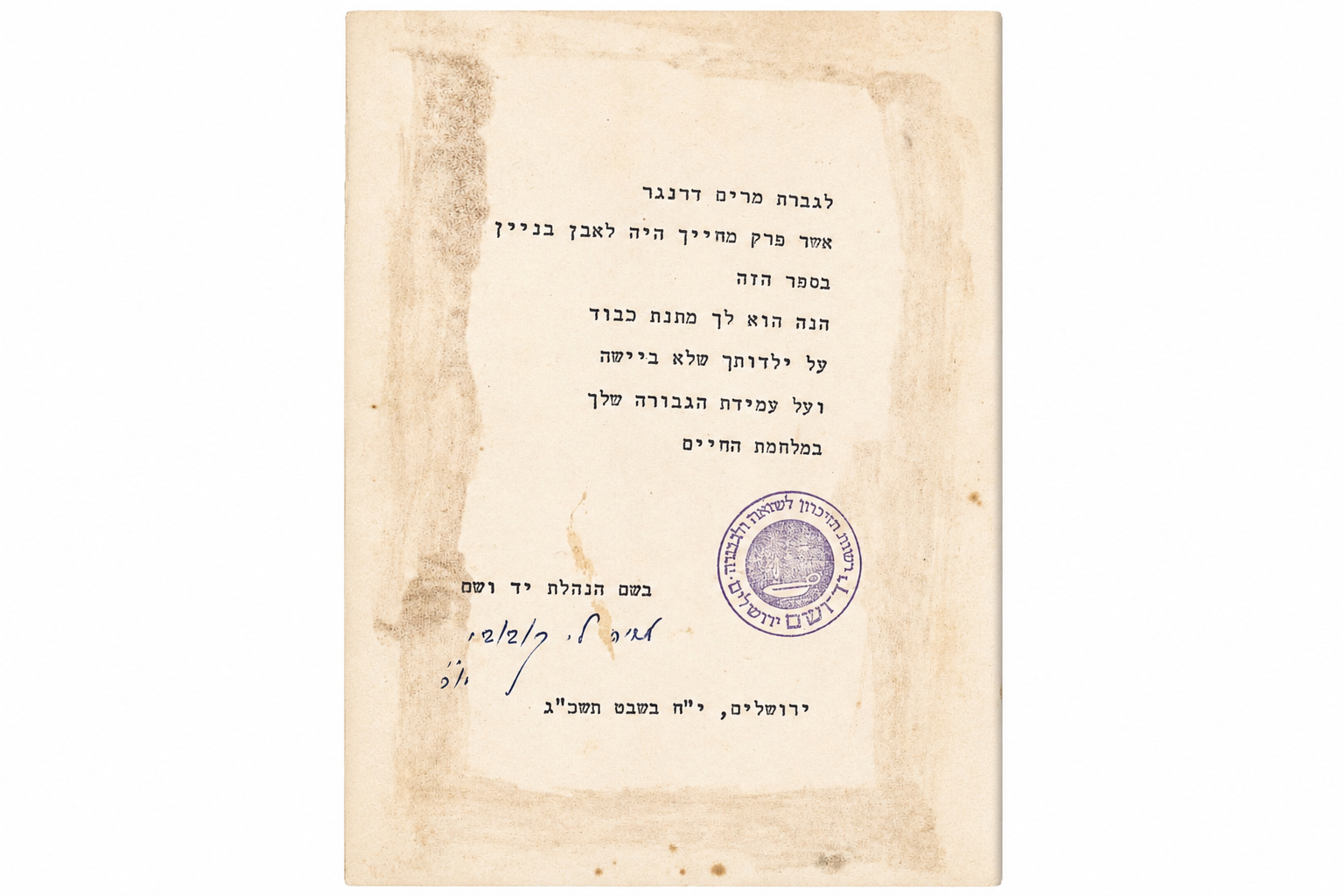
There is a page pasted into the front of a book my family keeps. It is typed in Hebrew, laid out like a poem, stamped with a purple seal, signed by hand on February 7, 1963, and formally dated Jerusalem, the 18th of Shvat, 5723, which is February 12. It reads:
To Mrs. Miriam Dranger,
whose chapter of life was a building-stone in this book,
here it is, given to you as a gift of honor:
for your childhood that was not shamed,
and for your heroic stand
in the war of life.
In the name of the Directorate of Yad Vashem
The book is the Hebrew first edition of Joseph Ziemian’s The Cigarette Sellers of Three Crosses Square, the foundational account of the Jewish children who escaped the Warsaw Ghetto and survived by hiding in the open, in the busiest, most German quarter of the city, selling cigarettes and newspapers to the soldiers who were hunting them. Miriam was one of those children, though her wares were different.
She sold the only thing she had carried out of the ghetto: a song.
She was also my husband’s aunt. She was Edna’s older sister. She is the reason any of us exist.
I have written about the family on Mila Street who sang after dinner, and about the two sisters who kept themselves alive on the Aryan side by singing on street corners for coins. It was Miriam, fourteen years old, who laid down the rule before they sang a note: Nothing in Yiddish. No Jewish folk songs, no matter how well we know them. Miriam who checked every Polish vowel, because a single flattened syllable could kill them both. Miriam who decided where they slept, whom they trusted, when they ran. Edna was a little girl with a beautiful voice. Miriam was the one who kept her breathing.
Think about what that survival asked of a child. The safest place in Warsaw to hide was in the open, where no Jew would dare stand: among the Germans themselves. So the children stood there. The boys sold cigarettes to the men who were hunting them, made change for them, smiled at them. Miriam and her little sister performed. They sang and danced on the street corners of occupied Warsaw, in flawless Polish, for crowds that would have turned them in over a single flattened vowel. Every song was a performance twice over, art on the surface and survival underneath, repeated day after day, for years. We give medals to adults for holding their nerve through a single afternoon of that. Miriam was doing it at fourteen.
Then, in August 1944, the performance became something the world has a formal word for. When the Warsaw Uprising began, the children of Three Crosses Square went into the Polish Home Army, and the Szurek sisters went with them. On August 15, 1944, the command office of the Plac Śródmieście sector registered both girls as łączniczki, couriers, under their cover names. Their identification cards were signed by Major Wołk of the Śródmieście Southern command. Those cards still exist. They have sat in the archive of the Ghetto Fighters’ House in Israel since the museum’s founding.
Read that again. Miriam Szurek was a documented, registered soldier of the Armia Krajowa. A Jewish girl who had escaped the ghetto her family died in, fighting for the city that was hiding her, under a name that was hiding her too.
When the Uprising capitulated, she was deported with the AK women as a prisoner of war: Stalag X-B Sandbostel, then Stalag VI-C Oberlangen, where the German transport list recording both sisters under their cover names still sits in a museum archive in Opole. She was there in April 1945 when the camp was liberated, and she did not finally get free of the machinery of the war until late 1946. She made her way through Italy, and eventually to Israel, where in 1963 the new state’s memorial authority pasted this page into a book and handed it to her.
Now look at the words they chose, and the word they didn’t.
For your childhood that was not shamed. Every survivor understood what that sentence was doing. Miriam’s entire childhood had been an exercise in treating her own existence as shameful: her language hidden, her name discarded, her face rearranged into a Polish girl’s face. Shame was the survival mechanism. And here was a state, twenty years later, putting a seal on the opposite claim: there was never anything to hide. Your childhood was not shamed.
Your heroic stand. The word is gevurah, and it is not a casual word. It is stamped twice on this one page, once in the dedication and once in the purple seal, because it is in Yad Vashem’s own name: the Memorial Authority for the Holocaust and Heroism. In 1963, when Israel was still deciding whether survival itself counted as resistance, someone at Yad Vashem looked at this woman and chose the word it reserved for the ghetto fighters and the partisans.
But notice what the page does not say. It honors her heroic stand in the war of life. Not in the war. Not in the Uprising. Not as what her own identification card, sitting in an Israeli archive, proved her to be: a soldier. The dedication praises her for surviving. It never once names what she did.
And it was the high-water mark. It was the most recognition Miriam Szurek would ever receive.
The boys she served beside at Three Crosses Square are remembered lavishly now. Peretz Hochman received the Knight’s Cross of the Order of Merit from the President of Poland; the City of Warsaw published his memoir. His brother Zalman is profiled at Yad Vashem. In 2021 a brass plaque in three languages went up on the wall at Plac Trzech Krzyży naming them both. Israeli schoolchildren are taught this cohort through the very Ziemian book that Yad Vashem inscribed to Miriam in 1963.
The Szurek sisters appear in none of it under their own names. The Warsaw memorial record still lists them only by their cover identities, the elder sister unnamed and the younger marked “Unknown Stefcia.” No Yad Vashem profile exists for either of them. The institution that formally honored Miriam in the language of heroism has, in the sixty-three years since, lost her name.
That name did not stay lost. I asked the Fundacja Życie Żydowskie, a Polish foundation researching the history of Warsaw’s Jews, to add it. A few months later, both sisters went up under their real names: Edna Szurek Brill, “Stefcia,” awarded the Cross of Valor on her tenth birthday in 1944 and dead in 2019, and Miriam Szurek Dranger, “Marysia,” her sister’s fellow courier, who died by suicide at forty-nine. No plaque required it, no state honor, no institutional imprimatur. Just a letter, a donation, and someone willing to build the page.
Yad Vashem knew who she was in 1963. The knowledge did not survive there. I made sure it survived somewhere else.
Miriam knew. The phrase on the page, the war of life, turned out to be the most precise thing anyone ever wrote about her, in ways its author could not have intended. Her 1975 German reparations file records what the war left in her body: tuberculosis scars in her lungs and her abdomen, and the pelvic tuberculosis from the camps that left her unable to bear children. The girl who saved a child could never have one. The file records psychiatric certificates going back to 1964, a diagnosis of permanent persecution-induced personality change, and the plain clinical fact that by the early 1970s she could not leave her house alone. She traveled to each medical examination on the arm of her second husband, himself a double amputee. Germany’s law demanded proof that the persecution had damaged her, and hera body supplied it on every page. One bureaucracy had hunted her. A second one graded the damage.
In June 1978, in Tel Aviv, Miriam took her own life. She was forty-eight, a month short of her birthday. The war of life was longer than anyone knew, and it was fought without rules, without an armistice, and mostly without witnesses.
I will not pretend to explain her death, and I distrust anyone who would. But I know that the words on the 1963 page were true, and her death did not un-true them. Her childhood was not shamed. Her stand was heroic. The failure was never hers. It belongs to a record that took her testimony, printed her story, honored her in its own highest vocabulary, and then could not hold on to her name for one lifetime.
The little sister Miriam kept alive grew up. She married, crossed an ocean, raised children, and told her story, and inside it, Miriam’s. I married into that family. Miriam’s rules, the perfect Polish and the borrowed names and the nerve, are the reason my husband exists, the reason my children exist. Yad Vashem called her chapter of life a building-stone in a book. They chose too small a building. Every one of us descended from the sister she saved is standing on that stone.
So let the record, in this small corner of it, finally say what it never said. Miriam Szurek Dranger. Born Warsaw, July 2, 1929. Street singer of occupied Warsaw. One of the children of Three Crosses Square. Łączniczka, Armia Krajowa, Plac Śródmieście sector, registered August 15, 1944. Prisoner of war. Sister. Soldier.
The men who hunted the children of Three Crosses Square are gone.
The plaque on the square does not name her. Yet.
Miriam’s building is still going up.