
Yitzchak: The Strength to Dig Again
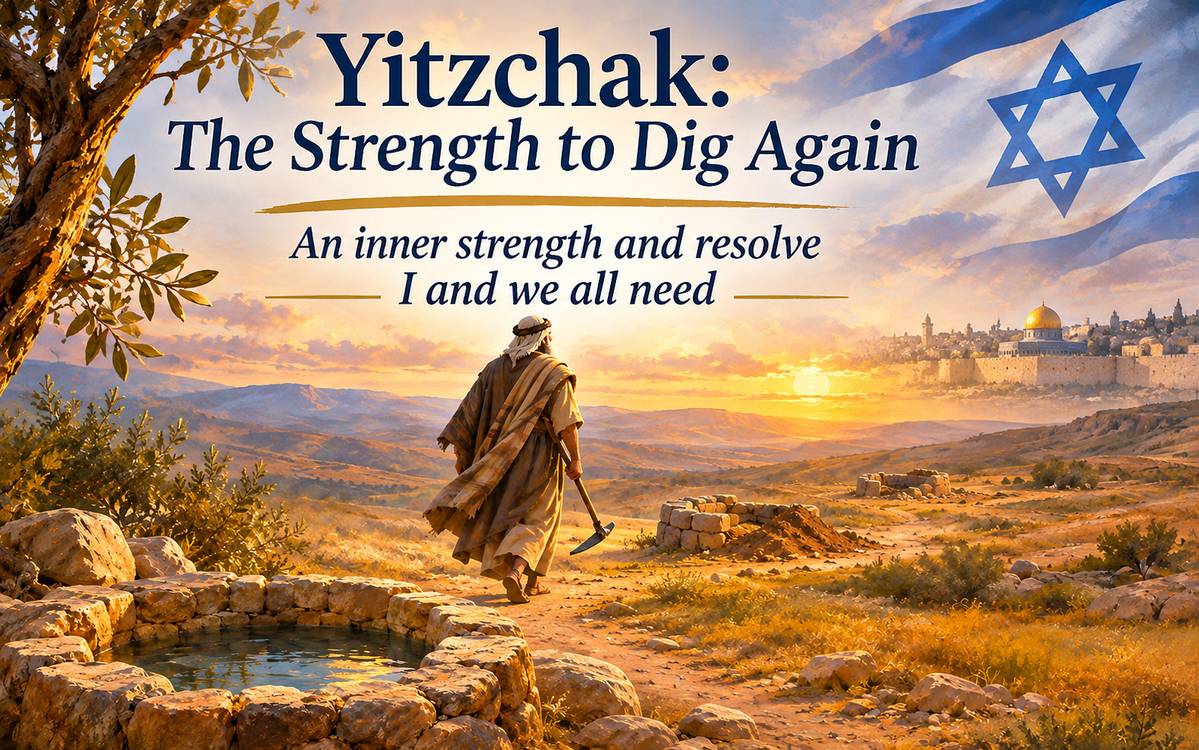
Yitzchak (Isaac) appeared quieter and less commanding than his father or son, yet tradition associates him with Gevurah – strength. He had a well of inner strength and resolve that we, as Jews and Israelis, need to draw from today more than ever. And so do I, in facing my own challenges.
Of the three Avot, Yitzchak is the one we tend to hurry past.
Avraham leaves home, argues with G-d over Sedom, goes to war for Lot and founds a faith. Yaakov wrestles with an angel and fathers twelve tribes. Yitzchak, sandwiched between them, has one chapter that is truly his own, and he spends most of it digging holes in the ground.
So often he is the one things happen to. His father takes him up the mountain. His father’s servant finds him a wife. His wife and younger son redirect the blessing he intended for Esav. He is not the initiator, the builder or the alpha male. For most of my life I would have described him, politely, as the quiet one in the middle.
And yet look at the attribute our tradition gives him. Avraham is Chesed, kindness. Yaakov is Emet, truth. Yitzchak, of all people, is Gevurah: strength. But not necessarily the kind of strength I had always imagined.
I have often wondered why. It took studying for this piece to find an answer, and it is one that speaks to me now, in my condition, and to all of us, in our position as Jews. Today we might call it resolve.
The wells
In this week’s parsha, Yitzchak reopens the wells his father dug, which the Philistines had filled with earth. His servants then dig a new one and find fresh water. The shepherds of Gerar claim it. He names it Esek, contention, and moves on. He digs a second. They quarrel over that one too. He names it Sitnah, enmity, and moves on again.
Then comes one of the least dramatic and most important verses in the Torah:
וַיַּעְתֵּק מִשָּׁם וַיַּחְפֹּר בְּאֵר אַחֶרֶת
“He moved on from there and dug another well.” (Bereishit 26:22)
No army. No speech. No insistence on his rights. He does not win the argument, and he does not stay behind to keep losing it either.
He gives up the ground. He never gives up the digging.
Ramban is disarmingly honest about all this. On the plain reading, he says, the story seems to serve little purpose and does Yitzchak no great honour. Read that way, it is pragmatism, not heroics: a man needs water, is pushed off, and digs somewhere else.
But Ramban insists the Torah dwells on it because it points to something far larger. The wells stand for the Temples. The first, Esek, fell to contention. The second, Sitnah, fell to enmity. The third, Rechovot, is the future Temple, built without quarrel. (Ramban, Bereishit 26:20)
So the most practical, unglamorous thing Yitzchak ever did turns out to carry the whole history of his people. We lost the well twice. We are still digging.
Nor should we mistake this for weakness. When Avimelech, the king who expelled him, later turns up asking for a treaty, Yitzchak makes him a feast and sends him on his way in peace. The Shelah HaKadosh sees in this a lesson for all of us: for the sake of peace, a person has to master the way he would naturally react. (Shenei Luchot HaBerit, Toldot)
My natural reaction, for the record, would not have been a feast.
Which is exactly how Ben Zoma defines Gevurah in the Mishnah:
אֵיזֶהוּ גִבּוֹר? הַכּוֹבֵשׁ אֶת יִצְרוֹ
“Who is strong? One who masters his own inclination.” (Pirkei Avot 4:1)
There is my answer. Yitzchak’s strength was never strength over other people. It was strength over himself.
Strength on the inside
Once you look for it, it runs through his whole life.
When Rivka first sees him, he has gone out alone into a field to pray. The Netziv says that to her he looked like an angel of G-d, and that she fell from her camel in sheer awe. He adds that the awe never quite left her, which is why, years later, she could not bring herself to tell her husband he was wrong about Esav. (Haamek Davar, Bereishit 24:64-65)
The quiet one, it turns out, was never the small one.
At the Akeidah, where rabbinic chronology places him at thirty-seven, he asks his father where the lamb is, receives an answer that answers very little, and the Torah tells us for the second time that the two of them walked on together.
In famine, when his father had gone down to Egypt, he is told to stay, and he stays. He is the only one of the Avot who never leaves the Land.
And he goes on loving Esav long after it has stopped being easy.
I am not going to pretend all of this was virtue. Rashi tells us that Esav knew exactly how to play his father, and Yitzchak’s trust left him wide open to it. Inner strength is not the same thing as being right. The Torah gives us a human being, not a statue.
But his resolve is beyond question. So is his trust.
Why I and we need him
I have PSP. It is progressive, and it does not negotiate.
I spent 27 years in a profession that admires Avraham’s. Lead, build, initiate, make things happen. That toolkit is of limited use to me now. I cannot beat this illness head-on, in a fight, in a war. Determination does not make it surrender. Every so often it takes another well: something I could do last month that I cannot do today.
So I retreat. I adapt. I look for another way of doing the thing, or another thing worth doing. And then I dig again.
There are a great many of us in this position. Not the leaders and the drivers, but the sufferers, usually out of sight. We need a different kind of strength, and someone to show us what it looks like.
And it is not only why I need Yitzchak. It is why I think we need him.
Jews in Israel and far beyond it are living through a test of resolve: of faith, of stamina, and of our ability to hold on to our love for the Land, the State, Zionism, our heritage and the Jewish people in the face of those who seek to wear that attachment down. There are arguments we must make and battles we cannot simply walk away from. But Yitzchak offers us something else as well: the strength not to let opposition define us or exhaust our attachment to who we are.
He did not answer Esek and Sitnah by giving up. He dug another well.
The Torah, it turns out, provided someone to show us what that looks like. It made him one of the three patriarchs.
No promises
Yitzchak eventually reaches Rechovot, the well nobody disputes. In Ramban’s reading, our people have a Rechovot still ahead of us. As a patient, I have no such promise. I would love to promise myself a Rechovot. I can’t, and I won’t promise you one either.
But look at what he does next. He goes up to Be’er Sheva, G-d tells him not to be afraid, and his servants dig yet another well. The digging was never only about winning. It was who he was.
And why did G-d need to tell him not to be afraid? Ramban answers plainly: because he was. Sent away by the king and harassed by the shepherds, he feared they would gather against him and his household. (Ramban, Bereishit 26:24)
I find that enormously comforting. The Father of Gevurah was frightened, and the next thing we read is another well.
Avraham teaches us the courage to begin. Yitzchak teaches us the courage to carry on.
Get up again. Get up again. Get up again.
Not always physically. Not always today. And not always without help.
I need that. I suspect we all do.
Dig another well.
Shabbat Shalom.