
Russian-American-Israeli Palestinian. Palestine is Israel.
You Can’t Have It Both Ways
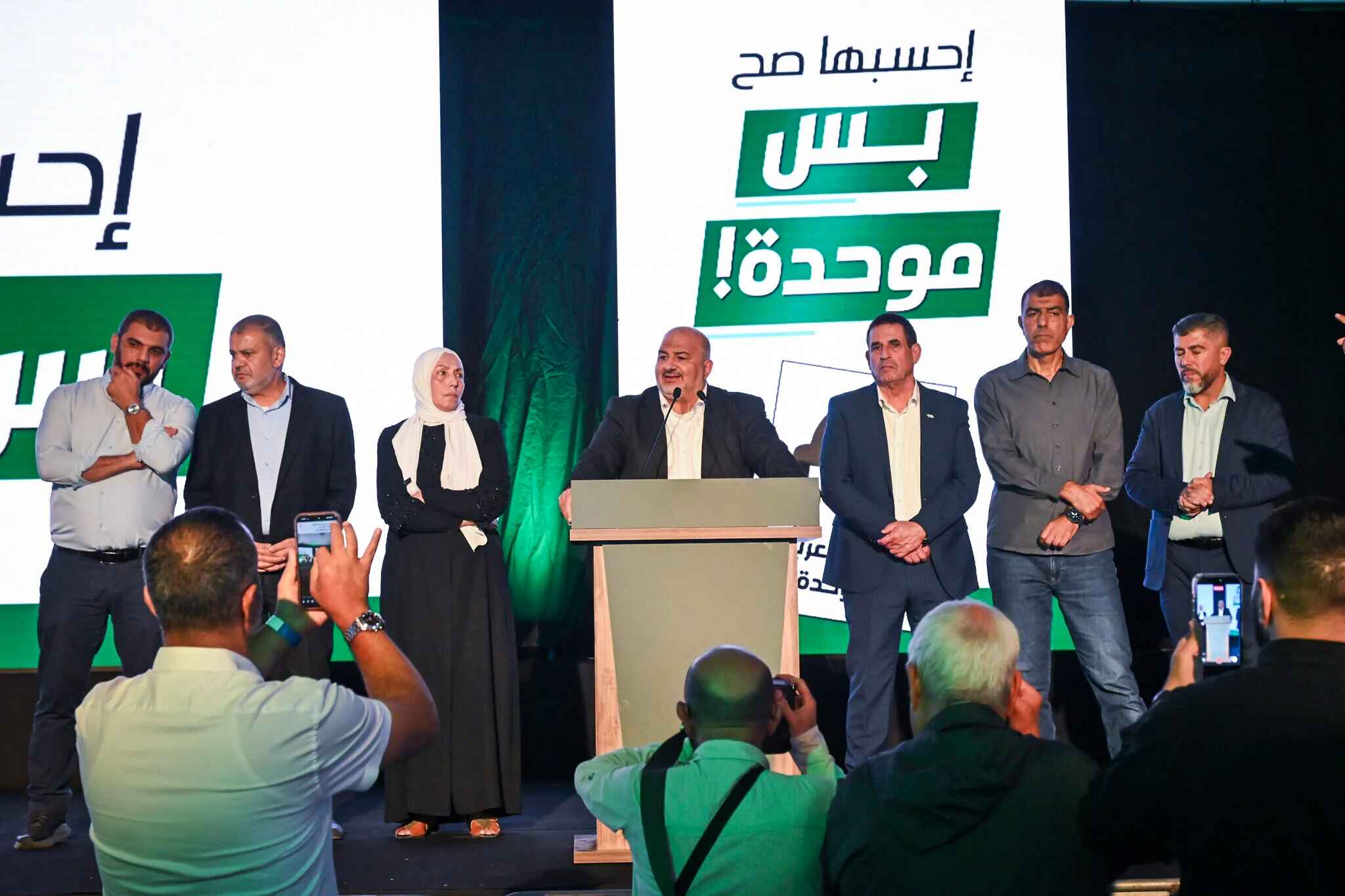
On October 27, Amnesty International UK declared that Israel’s election exposed “apartheid at the ballot box.” Image: Ra’am (Arab) party leader Mansour Abbas and other party members stand on stage following the release of exit poll results in Sakhnin, Israel, on October 27, 2026. (Michael Giladi/Flash90)
When “Palestine” Is a State, Except When Israel Holds Elections
Israel has just held another national election. Israelis voted for the 120 members of the Knesset who will decide who governs the State of Israel.
And, predictably, the international commentary has begun.
Once again, Israel is being accused of “apartheid” because UNRWA clientele who are not Israeli citizens did not vote in Israel’s election.
This time, the accusation flourished. On October 27, Amnesty International UK declared that Israel’s election exposed “apartheid at the ballot box.” Millions of UNRWA clientele it describes as “Palestinians,” the organization argued, have no vote in choosing the Israeli government.
There is only one small problem.
The same international community insists that these people belong to another state.
The “State of Palestine.”
More than 150 UN member states recognize “Palestinian” statehood. The United Nations accords “Palestine” the status of a non-member observer state. Amnesty International itself maintains a country page titled Palestine (State of) and consistently treats this purported state as a separate country.
The vocabulary of statehood is everywhere. The diplomatic recognition is real. The official designations are unmistakable.
And yet, when Israelis go to the polls, the existence of that supposedly recognized state seems to become an inconvenient detail.
If the “State of Palestine” exists, why should its people who are not Israeli citizens vote in Israel’s national elections?
This is not a trick question.
Apparently, it is a politically incorrect one.
The State That “Exists” When Convenient
Let us take the international community at its word.
Suppose the “State of Palestine” exists. It has a name, diplomatic recognition, representatives, and political institutions that claim to represent its population.
Israel has its own citizens, its own government, and its own electorate.
Now comes the revolutionary proposition: a state has its own national elections, and people who are not its citizens do not automatically vote in them.
Americans do not vote in Canadian federal elections. Canadians do not vote in American presidential elections. French citizens do not vote in German parliamentary elections.
No one calls this apartheid.
Apparently, this elementary principle of citizenship becomes incomprehensible when the country in question is Israel.
The international community recognizes the “State of Palestine.” Governments celebrate additional recognitions as diplomatic milestones. In 2024 and 2025, recognition expanded substantially, including through a new wave of decisions by Western governments.
Then Israel holds an election.
Suddenly, the fact that non-Israeli citizens do not vote in it becomes an international scandal.
The more firmly the “State of Palestine” is affirmed in diplomatic declarations, the more readily its supposed citizens are presented as an electorate Israel is obligated to include.
What an extraordinary achievement of political logic.
Perhaps the next step is to recognize the “State of Palestine” at the United Nations in the morning and declare Israel an apartheid state for treating it as a separate state in the afternoon.
Diplomacy has never looked so flexible.
A State Without Elections?
The last “Palestinian” legislative election took place in 2006. The last presidential election took place in 2005.
Two decades have passed without another legislative election.
One might imagine that anyone deeply concerned about the political representation of UNRWA clientele would be particularly interested in the electoral accountability of the institutions supposedly representing them.
Where is the equivalent international drama over the absence of regular elections for those institutions?
Where are the urgent declarations about the democratic rights of UNRWA clientele who have not had an opportunity to elect a new legislature in twenty years?
Where is the daily outrage over the gap between the “State of Palestine” as a diplomatic designation and the political reality of the institutions operating in its name?
Instead, the international spotlight returns to Israel.
Israel’s democracy is on trial for not including an electorate that the international community simultaneously assigns to another state. The democratic accountability of that other state is apparently a separate matter.
How convenient.
Consistency Was Never the Point
The international community is free to recognize the “State of Palestine.” It is free to debate the rights of UNRWA clientele it considers its citizens. It is free to criticize Israel, including over questions of political representation.
But it cannot have it both ways.
You cannot celebrate the existence of the “State of Palestine” and then treat the exclusion of its citizens from Israel’s national elections as self-evident proof of apartheid.
At some point, the recognition of a state must mean something beyond a diplomatic announcement.
Otherwise, perhaps we should stop calling it recognition and start calling it what it has become in this debate: a rhetorical instrument, invoked when convenient and ignored when inconvenient.
You can’t have it both ways.
Unless, of course, consistency was never the point.
The next time—if ever—the fictitious “State of Palestine” holds its own elections, should the international community demand that Israeli citizens vote there, too?
—
See Also
Related Topics
Related Posts