
You Do Not Get to Redefine Zionism for the People Who Lived It!
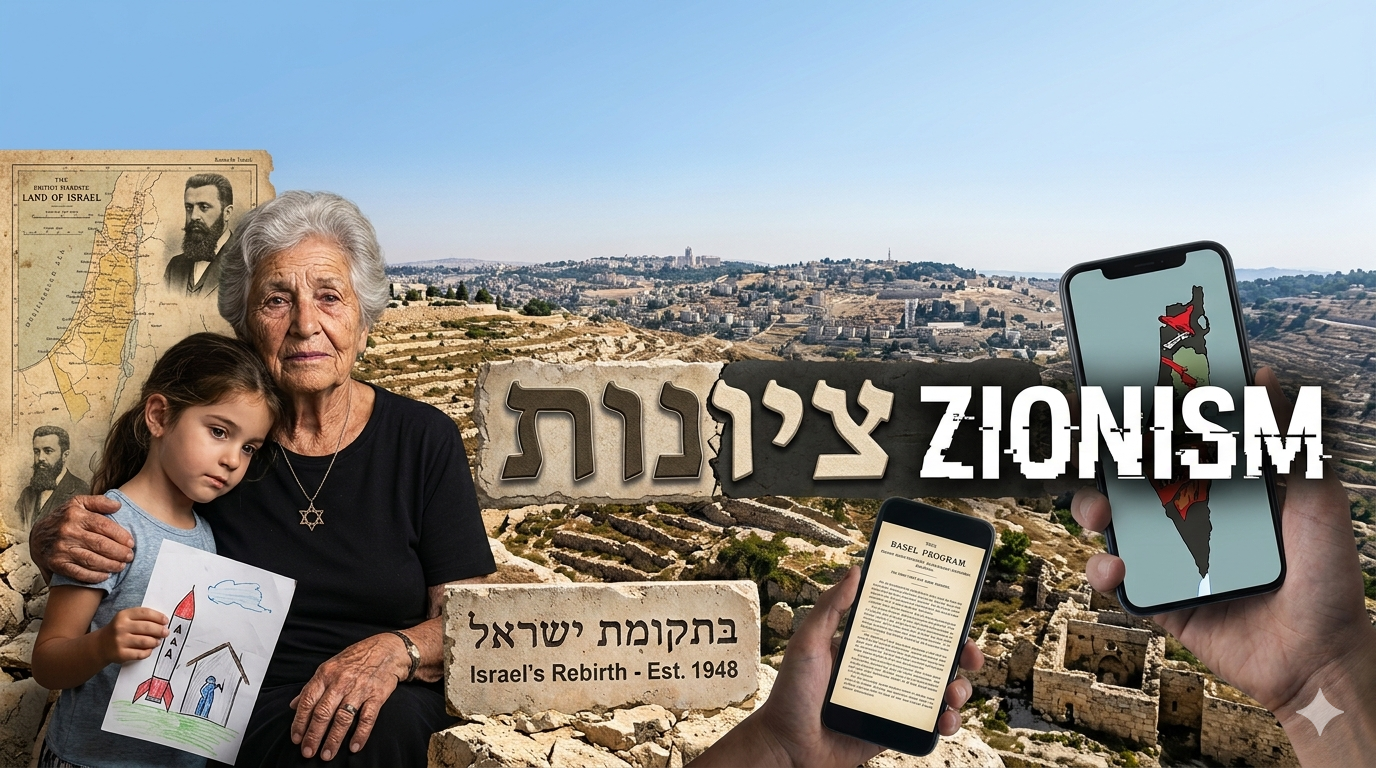 There is something deeply arrogant about people who have never lived a day of Jewish history, never buried a friend after a terror attack, never run to a shelter with their children, never stood on this land and felt what it means, and yet still believe they have the right to redefine the word Zionism for the Jews who carried it, built it, and defended it.
Zionism is not a fashionable insult. It is not a code word invented on social media. It is not a slur for Jews you dislike. Historically, Zionism is the Jewish national movement: the belief that the Jewish people, like every other people, have the right to self-determination in their ancestral homeland. Britannica defines it as the Jewish nationalist movement aimed at the creation and support of a Jewish national state in the ancient homeland of the Jews, and the World Zionist Organization’s official Jerusalem Program defines Zionism as the national liberation movement of the Jewish people.
That is the real meaning. Not the fantasy version screamed on campuses, not the distorted version posted online by people who could not tell Herzl from Hamas, and not the lazy propaganda that tries to separate Jew from Zionist as though the second word describes some alien species. The Knesset’s own publication of Israel’s Declaration of Independence begins with the simple truth that the Land of Israel was the birthplace of the Jewish people, where its spiritual, religious, and political identity was shaped. Zionism did not invent Jewish attachment to this land. It gave political form to an attachment that long predated the modern era.
That is why so much of the modern rhetoric around Zionists is intellectually dishonest. Of course not every individual Jew describes himself the same way politically, and of course debate exists inside the Jewish world. But when crowds across the West spit out the word Zionist with hatred, what they are usually targeting is not some abstract policy school. They are targeting the Jewish claim to collective dignity, Jewish self-defense, and Jewish nationhood. They have simply found a more fashionable vocabulary for an old obsession. The same people who insist every other person may define themselves, defend themselves, and seek sovereignty somehow discover a unique philosophical problem only when the people in question are Jews. That is not moral sophistication. It is a double standard dressed up as activism.
The ignorance becomes even more embarrassing when people pretend Zionism is some colonial import disconnected from Jewish history. The historical record says the opposite. Britannica notes that while political Zionism emerged in late-19th-century Europe, it was also a continuation of the ancient attachment of the Jewish people and Jewish religion to the Land of Israel. The Jewish Diaspora itself was the result of long dispersions and exiles, especially after Roman destruction and expulsion; Zionism was the political answer to a historical condition of statelessness, vulnerability, and dependence on the mercy of others.
And then there is the basic historical illiteracy of people who speak about Zionism as though it were born in sin rather than in necessity. The First Zionist Congress in Basel in 1897, convened by Theodor Herzl, endorsed the Basel Program, which called for a publicly recognized, legally secured home for the Jewish people in the Land of Israel. This was not some secret conspiracy. It was a national movement acting openly, politically, and historically, just as other national movements did. The US Holocaust Memorial Museum notes that the congress pledged to secure for the Jewish people a publicly recognized, legally assured homeland in the Land of Israel.
That matters, because people who hate Zionism often speak as though Jews arrived out of nowhere, with no history, no memory, no trauma, and no right to act like a people. But Zionism did not emerge because Jews were bored. It emerged because Jews learned, over centuries and in blood, what it means to live at the mercy of other societies. It emerged because exile was never just poetry. It was dependence, humiliation, massacres, expulsions, and finally the modern lesson that even in enlightened Europe, a Jew could still be reduced to a problem. The Dreyfus Affair helped crystallize that lesson for Herzl, and the Holocaust made the consequences of Jewish powerlessness impossible to deny.
And yet here we are, in 2026, listening to people in other countries tell Israelis and Jews what Zionism really means. People who have never walked through Jerusalem. Never been to Sderot. Never stood at a cemetery on Memorial Day. Never heard a siren and calculated whether they had ten seconds or forty-five. Never had to explain to a child why there are shelters in schools. Never had to live the burden of Jewish sovereignty in a hostile region. And still they speak with absurd confidence, as though reading a slogan on TikTok gave them more authority than the lived experience of the people who actually carry this history on their shoulders.
That arrogance is not only offensive. It is revealing.
Because if these people truly cared about definitions, they would start with the definition the movement gave itself. If they truly cared about history, they would begin with the Jewish historical bond to the land. If they truly cared about justice, they would ask why the Jewish people alone are expected to surrender the right every other nation claims as obvious. But too many of them do not care about any of that. They want the word Zionist because it lets them attack Jewish national existence while pretending they are saying something more sophisticated than Jew. It is a linguistic laundering operation: take an old hatred, update the vocabulary, and call it moral progress.
That is why so many Jews hear the word Zionist today and recognize what is really happening. Not always, not in every case, but very often, it is being used not as a serious historical term but as a socially acceptable replacement target. And that is exactly why the attempt to split Jews from Zionists is so dishonest. Pew found that eight-in-ten US Jews say caring about Israel is an essential or important part of what being Jewish means to them. That does not mean every Jew thinks identically. It does mean that people who casually pretend Zionism is some fringe distortion of Jewish life are speaking against a reality they have not bothered to learn.
So let us say it clearly: Zionism means that the Jewish people are not required to apologize for surviving history and refusing to disappear. It means Jews are not guests in their own story. It means the Jewish people are a people, not just a religion, not just a trauma, and not just a museum exhibit for others to pity. It means that after exile, persecution, statelessness, and mass murder, Jews reclaimed political responsibility for their own future in the one land tied to their identity from the beginning. Israel’s own Declaration presents the modern state as the restoration of Jewish independence after two thousand years. That is not extremism. That is history.
And if people who have never set foot here, never studied this history seriously, and never endured what Israelis endure still want to lecture Jews about what Zionism is, then they should at least have the honesty to admit what they are doing. They are not correcting a definition. They are trying to seize it. They are not clarifying Jewish history. They are trying to overwrite it.
They do not get that right.
Zionism was not defined by the mob, by campus fashion, or by foreign activists hunting for a new slogan. It was defined by Jewish history, Jewish memory, Jewish peoplehood, and the Jewish return to sovereignty in the ancestral homeland.
And no one who neither lived that history nor bothered to learn it gets to take that meaning away.