
From Kibbutz to the global stage
2026: Trump Pushes Global Stability as Saudi Arabia Shapes the Region
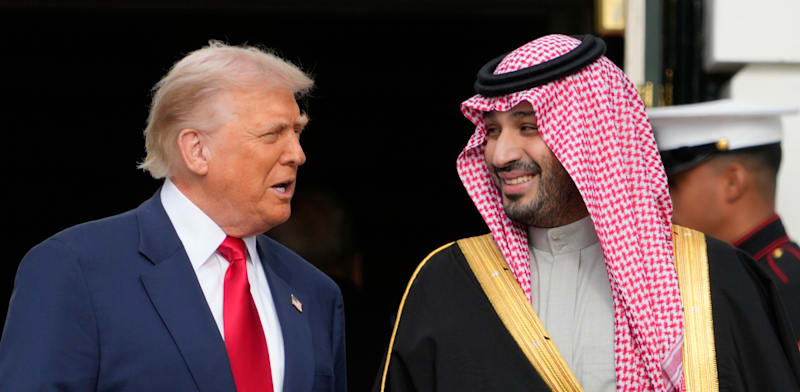
Saudi Crown Prince Mohammed bin Salman and U.S. President Donald Trump speak during their meeting at the White House, November 2025 — a moment reflecting the deepening Washington–Riyadh axis and Saudi Arabia’s growing role in shaping the regional and global order toward 2026. (AP / Mark Schiefelbein)
The Washington-Riyadh axis, trade corridors, and a shifting world order.
Signs of Growing Stability in the New World Order – Toward 2026
Over the past two weeks, something has shifted.
Kings, presidents, prime ministers, and foreign ministers are constantly on the move, signaling a broad systemic realignment. A simple yet effective geopolitical indicator applies: those who remain in their capitals are strong; those who travel to their neighbors are seeking balance or a change in position.
The Doha, Dubai, and Turkmenistan conferences—scheduled long in advance—have become arenas for addressing the most urgent and current global issues. Content, not timing, tells the real story. At the same time, a multinational force is taking shape, and the world appears to be transitioning from localized conflicts to the management of a complex global system.
Gaza and the Multinational Force: A Test of Stability.
Last week, Israel’s Consul in New York issued a statement clarifying that no Turkish force would enter Gaza. On the same day, a meeting took place in Riyadh between the Turkish and Saudi chiefs of staff. In parallel, the United States invited approximately 70 countries to join an international peace force in Gaza; around 40 responded and convened this week at the U.S. Central Command (CENTCOM) base in Qatar.
On Saturday, a senior Hamas figure—deputy head of its military wing in Gaza—was eliminated. It took Washington two days to issue a condemnation of Israel. Axios journalist Barak Ravid reported a sharp response from a senior U.S. official, including a review of whether the strike violated the ceasefire—sending a clear message that Israel may be expected to pay a diplomatic price.
In Israel, many assume that key decisions will be addressed during the Trump–Netanyahu meeting at the end of December. In reality, however, developments are advancing simultaneously across multiple arenas, without waiting for a single moment of resolution.
India as a Balancing Power: Westward Without Cutting the East.
India is leaning toward the West—without severing longstanding ties. India’s president is visiting Jordan, Ethiopia, and Oman this week, days after a warm and dramatic phone call with President Trump. Each destination carries strategic significance: Jordan for trade routes, Ethiopia for the Horn of Africa, and Oman as the first Gulf gateway after Mumbai.
The Trump–Modi call followed the conclusion of a U.S. technological and commercial delegation visit led by Deputy Secretary of State Alison Hooker, together with representatives from the U.S. Department of Commerce. The visit resulted in the announcement of a $17.5 billion Microsoft deal.
The IMEC trade corridor (India–Middle East–Europe) is no longer a theoretical concept—it is real and evolving. India is repairing ties with Washington without cutting links with Moscow, positioning itself as a central balancing actor in the emerging world order.
Turkey: A Shift in the Rules of the Game.
President Erdoğan met President Putin at the Turkmenistan conference, one day after Putin’s return from India and following his conversation with Iran’s president. Putin was invited to Ankara and promised a reciprocal visit, signaling unresolved issues. At the same conference, Putin also met with Pakistan’s prime minister.
Turkey could benefit from multi-billion-dollar projects in Gaza’s reconstruction, but doing so would require a shift in its posture toward Israel. The United States understands that Turkey is important for disarming Hamas and will therefore need to mediate between Jerusalem and Ankara.
At the same time, Turkey recognizes that Europe is no longer dependent on it as the exclusive trade corridor between East and West. If Turkey wishes to integrate into the new reality, it must adapt. For now, Ankara and Warsaw are signing agreements on drone supplies—an important deal for both Turkey and Europe.
Toward a New Balance in the Caucasus:
Sources in Armenia point to a strategic Azerbaijan–Israel–Turkey triangle, representing one of the most significant geopolitical shifts of the post-Soviet era. This partnership goes far beyond Nagorno-Karabakh, reshaping alignments, power balances, and regional dynamics.
The pan-Turkic dimension adds a deep layer of complexity, particularly for Iran, which views this development as a threat to its territorial integrity and national cohesion. The future stability of the Caucasus will depend on whether a new balance emerges that accommodates the legitimate security interests of all parties—or whether the region slides into prolonged confrontation.
The old order has disappeared. The new strategic reality demands new security approaches, new diplomatic architectures, and a renewed regional consensus.
The United Arab Emirates: Strategic Autonomy.
The UAE is demonstrating growing strategic independence: launching a spacecraft from a Chinese facility, deepening space cooperation with Beijing, hosting China’s foreign minister, and discussing joint projects.
In Yemen, the UAE supports local southern forces and the containment of the Houthis—contrasting with Saudi Arabia’s preference for a pause. In Sudan and other arenas, the UAE is acting decisively to curb Iranian influence.
At the same time, Egypt’s foreign minister met with the EU’s deputy prime minister during the UAE conference to discuss Gaza’s reconstruction and broader regional peace arrangements.
Russia, China, and Iran: From Confrontation to Commerce
President Zelensky has signaled willingness to forgo NATO membership in exchange for security guarantees, while the United States is pushing toward an end to the war—now seemingly closer than ever. In this context, Russia is seeking a bloc of cooperating states after China opted for a freeze in rivalries following its trade agreement with Washington.
Turkey, India, the UAE, Pakistan, Azerbaijan, Armenia, and Kazakhstan are all maintaining a careful balance between East and West. President Putin appears to understand that moderation is necessary if Russia wishes to benefit from emerging global processes.
Iran now stands at a critical crossroads:
- No markets
- No customers
- Limited resources
- A shift from strategic asset to geopolitical liability
Three paths lie ahead:
- Genuine integration (with painful concessions)
- Slow economic decline
- A disruptive and dangerous course
There are signs Iran may opt for partial integration through China’s Belt and Road Initiative (BRI) and avoid harming Indian investments in the port of Chabahar. Iranians are a pragmatic people; while risks remain, the odds of restraint appear stronger. The China–Russia–Iran axis could evolve from a “confrontation axis” into a “trade axis.”
The Saudi–Qatar–Syria Axis:
Following the Doha conference, The Observer wrote that “tiny Qatar is playing its diplomatic cards to prevent a new regional upheaval.” During the conference, Qatar’s emir traveled to Riyadh and signed historic agreements, including plans for a high-speed electric rail line between Doha and Riyadh—a critical component of trade routes linking to India.
Qatar is being compelled to adapt to a new era of responsible state conduct, media discipline, and distancing from extremist actors, in line with its defense agreements with the United States. It is no coincidence that Qatar, Saudi Arabia, and the UAE have recently expressed interest in acquiring media assets in the United States.
Conclusion: Indicators of Greater Stability in 2026.
- The China–Russia–Iran axis may transition into a commercial framework under the BRI.
- The U.S., Europe, India, and the Gulf states are advancing IMEC from concept to reality
- The Trump administration is pushing decisively toward Gaza’s reconstruction, the creation of a multinational force, and the establishment of a Peace Council
- Turkey is no longer the sole bridge between East and West and must adapt to the new environment
- Attempts to fracture the European Union are unlikely to succeed; the EU is moving toward greater autonomy in Economics, defense, aviation, and space
- Ukraine’s reconstruction may, within a few years, transform it into a more unified, stable, and economically significant state
The new world order owes much to the determination of President Trump and his administration. At the same time, it is impossible to ignore the erosion of core democratic values in the West. How the world chooses to confront this tension remains an open question.
Related Topics
Related Posts