7 questions to Haredi leaders on not drafting to the Israeli army
Question 1:
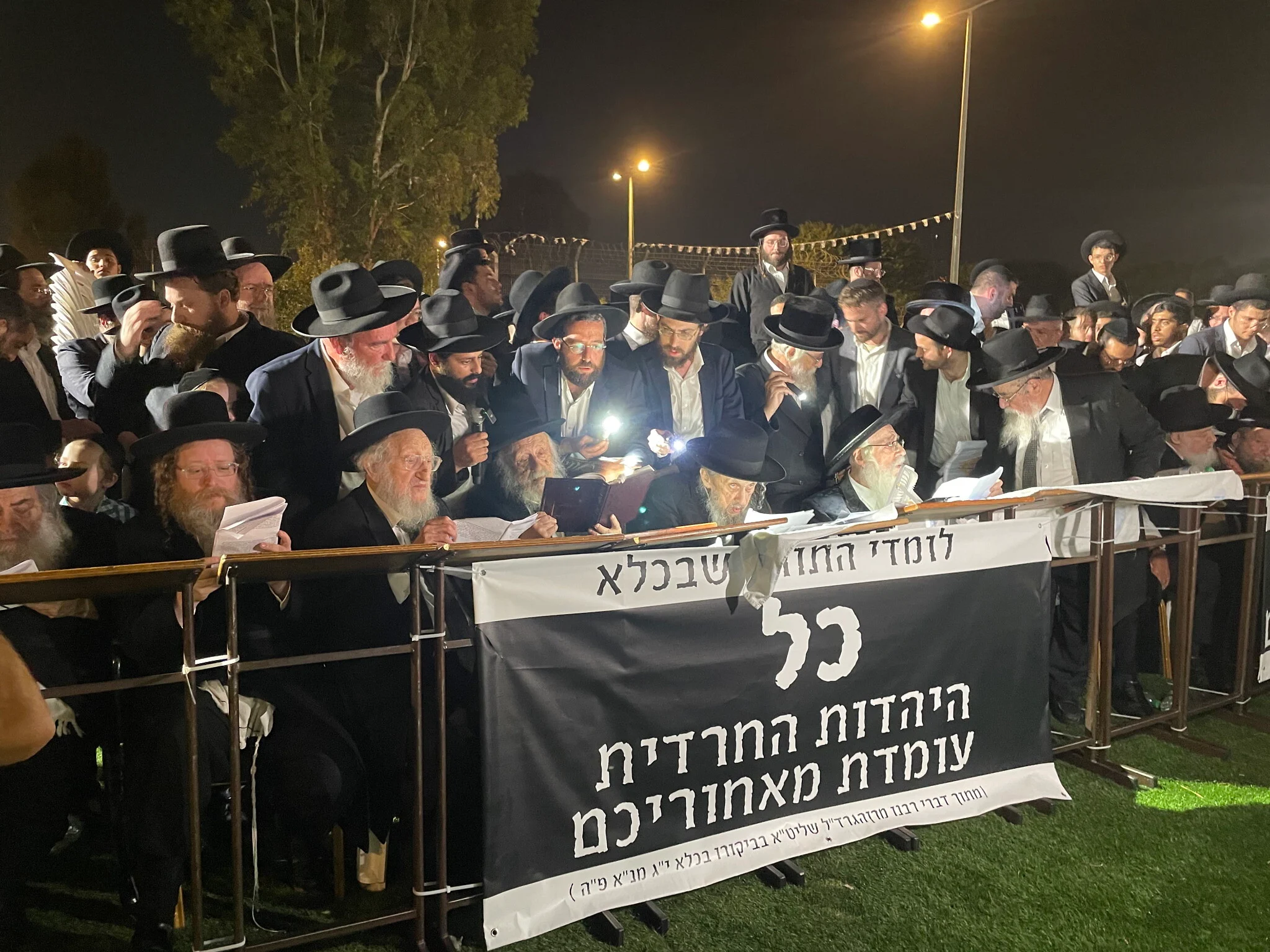
Why do Haredi rabbis tell their people that the goal of a draft law is “to destroy the world of Torah,” or that a kollel scholar was arrested “for the sin of studying Torah?” I hear things like this all the time (as if the entire “world of Torah” is Haredi!).
Of course, there are some who hate religion, but the great majority of Israelis are crying out and collapsing under the difficult situation. A small example: Tzvi, my grandson, has served more than 700 days of reserve duty during this period. And others of our grandchildren have been injured and exposed to years of danger and psychological trauma in the army. How many family men, business owners, employees, etc. have had their lives stopped or damaged? How many were killed on the battlefield? How many thousands have been wounded physically and/or psychologically? These rabbis, by saying that others only want “to destroy the world of Torah,” are engaging in incitement and creating hatred among the Haredim toward the rest of the Jewish people, with no true justified basis.
Question 2:
Why do Haredi yeshivas not say a prayer for the soldiers? Does an exaggerated fear that perhaps some young man might consider enlisting override the expected and self-evident practice of praying for those fighting in Israel’s wars? There is a basic value in Judaism of Hakarat Hatov –– acknowledging the good that others do for you, being thankful to them. Does that not apply to the present situation?
Question 3:
Why do Haredi rabbis say again and again that “Torah study protects and saves” — and therefore Torah scholars are fulfilling their role of protecting and saving the Jewish people in their own way, through Torah study? That is not the primary plain meaning of the Talmud from where this phrase is taken (Sotah 21a). The commentator Rashi explains that it means that Torah study protects and saves the one who himself is studying from suffering and from the evil inclination. There is no mention of protecting and saving the Jewish people as a nation. Proof of this interpretation is the Gemara’s question about Doeg and Achitofel, who studied Torah and it did not save them personally. Again, the principle refers to an individual, not an entire nation, so why do Haredi rabbis extend it beyond its meaning?
Question 4:
Why do Haredi rabbis use a non-binding aggadic statement from the Talmud: “Torah study protects and saves” against halachah, Jewish law? This is not halacha (legal ruling) — it is aggadata (a non-legal, homiletic teaching). One does not rule on practice from aggadata. How is “Torah study protects and saves” not a matter of Jewish law? Because there is a settled halachah cited by the Rambam (Maimonides) from the Talmud that when enemies come to wage war against the Jewish people, it falls under the category of a milchemet mitzvah (an obligatory war), and in a milchemet mitzvah the halachah is clearly that everyone goes out to war. Thus, the Haredi rabbis seem to be preaching against the halachah.
Question 5:
Why are Haredi rabbis telling their people to rely on a miracle? There is a major halachic principle that one does not rely on miracles. It is included in the Code of Jewish law, the Shulchan Aruch (Yoreh De’ah, Chapter 116, Section 5, see Rema there). We ourselves must do all we can, as a matter of hishtadlut (effort/exertion) to achieve what we must gain. Hishtadlut is, by definition, within the natural order. Haredi rabbis are telling their people to depend on a miracle to save the Jewish people by not doing natural hishtadlut, but instead by studying Torah and waiting for a miracle. This is not the traditional way.
Question 6:
Why are Haredi rabbis telling us what we all know is not always true? We all know of many cases where Torah study did not protect those who were studying it, even those who were studying diligently. The 10 Martyrs who were executed by the Roman government (and included in the liturgy for Yom Kippur and for Tisha B’Av) studied Torah. Think of the yeshivas that were destroyed in the Holocaust. Or even the terror attack at Yeshivat Merkaz HaRav in Jerusalem, which occurred while the murdered boys were sitting and studying with Talmud volumes in their hands. And the terror attack in Har Nof, in which Torah scholars were murdered. The terror attack at Yeshivat Otniel, on Shabbat night itself, where yeshiva students were murdered. And so on and so on. How can the Haredi rabbis advise people to rely on a miracle when we all know there is a real chance it will not come true?
Question 7:
Why are Haredi rabbis and leaders, if fearful of army spiritual dangers, not demanding that the army widen possibilities for Haredi men to serve in optimal Haredi conditions? Why are they not demanding more units in the Hashmonaim Brigade? More units in technical warfare and intelligence? Something on the order of a Haredi Hesder for their students so that the voice of Torah will always be heard in the beit ha-midrash? Why?
I pray for convincing replies to my questions and for a peaceful resolution of our present internal turmoil.