
From Kibbutz to the global stage
A Corridor Bypassing Yemen, India–Europe via Somaliland, Ethiopia and Benghazi
IAEC: A Corridor Bypassing Yemen – India–Europe via Somaliland, Ethiopia and Benghazi.
An Alternative Corridor Bypassing Yemen via Africa (IAEC): From India to Europe via Somaliland, Ethiopia and Benghazi.
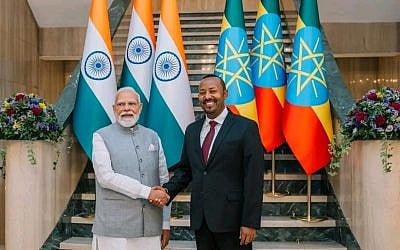
Quietly and gradually, a new strategic corridor is taking shape across Asia and the Middle East, with India at its eastern end and Israel at its western edge. The corridor has recently gained formal political expression following diplomatic moves between Israel and Somaliland, on the western flank of the Horn of Africa, as well as a visit by India’s prime minister to Ethiopia several weeks ago.
Last Friday, a mutual recognition agreement was signed between Israel and Somaliland, endorsed by Israeli Prime Minister Benjamin Netanyahu and Foreign Minister Gideon Sa’ar.
The implications of this move, which have so far received limited media attention, provide for the first time an official political framework for an emerging strategic axis linking India, the Gulf states, the Horn of Africa, and the Mediterranean.
The emerging corridor — increasingly referred to by analysts as the IAEC (India–Africa–Europe Corridor) — is also described in its more specific configuration as the ISEE route (India–Somaliland–Ethiopia–Europe), reflecting the central role of Somaliland and Ethiopia in bypassing traditional chokepoints.
The emerging India–UAE-Somaliland–Ethiopia corridor could, in the future, serve as a route bypassing Yemen and as an alternative bridge to Europe — via Sudan and the port of Benghazi in Libya, or alternatively through the port of Alexandria in Egypt. The feasibility of these routes will depend on political and governance arrangements in a region that has undergone particularly frequent and profound changes in recent years.
The new maritime–land bridge could draw on the infrastructure of the historic British trade route from Cairo to Khartoum and onward to Cape Town. Parts of this route were paved even before the Second World War, while other segments were upgraded by African states following independence.
The United Arab Emirates has been highly active in consolidating the new corridor. It has supported rebel forces in Yemen, which have recently taken control of parts of the country’s southern territory and pose a challenge to the Houthis in northern Yemen. At the same time, the UAE is a partner in the management of the Port of Berbera in Somaliland, operates a regular maritime line between the UAE and Somaliland, and manages a section of the port leased to Ethiopia, providing the landlocked country with maritime access after it was cut off from such access following its conflict with Eritrea.
The UAE also supports Sudanese rebel forces and is active in the development of ports in Syria. It is therefore not surprising that both the UAE and Syria did not sign the condemnation of Israel following its recognition of Somaliland — a statement endorsed by 21 countries in Africa and the Middle East.
Syria’s independent stance is particularly notable given that Turkey and Iran are the central actors involved in an opposing axis that supports existing regimes in the region — an axis inclined toward Chinese trade routes and one that complicates the activities of the United States and India.
The UAE and Saudi Arabia differ in their regional tactics. While Saudi Arabia favors the stability of existing regimes in accordance with UN resolutions and does not encourage extensive rebel activity, it has recently carried out airstrikes against rebel strongholds in Yemen backed by the UAE.
Following Israel’s public diplomatic move in Somaliland, and with Taiwan having been active in the territory for years, additional countries are expected to move toward recognition of the region’s distinctive democratic polity — foremost among them India, Ethiopia, and the United Arab Emirates.
The British newspaper The Guardian recently noted that while it may be understandable for UK Foreign Office officials to hesitate before recognizing Somaliland in the absence of regional precedents, Britain should be prepared to be second in line. This, the paper argued, reflects the substantial contribution of soldiers from British Somaliland during the Second World War, the long-standing role of Somaliland’s seafarers since the mid-19th century, and the contribution of the Somaliland diaspora in Britain today.
Italy, which maintains close ties with Israel, has also renewed its engagement in the Horn of Africa, strengthened relations with Ethiopia and India, and could serve as a mediating actor between Somalia and Somaliland, as well as between rival factions in Libya. The prospect of a land bridge to Europe via the port of Benghazi, and the renewed connection between Benghazi and Italy, evokes a sense of nostalgia in Italy. During the colonial period, the port served as a significant military and economic anchor, particularly during the Second World War and until the end of Italian rule in North Africa.
Concerned about the flow of migrants from Libya, Italy could promote a commercial bridge from Benghazi to Europe — contributing to economic welfare in the conflict-ridden country while helping to reduce migration pressures.
Related Topics
Related Posts