
A Golden Leash
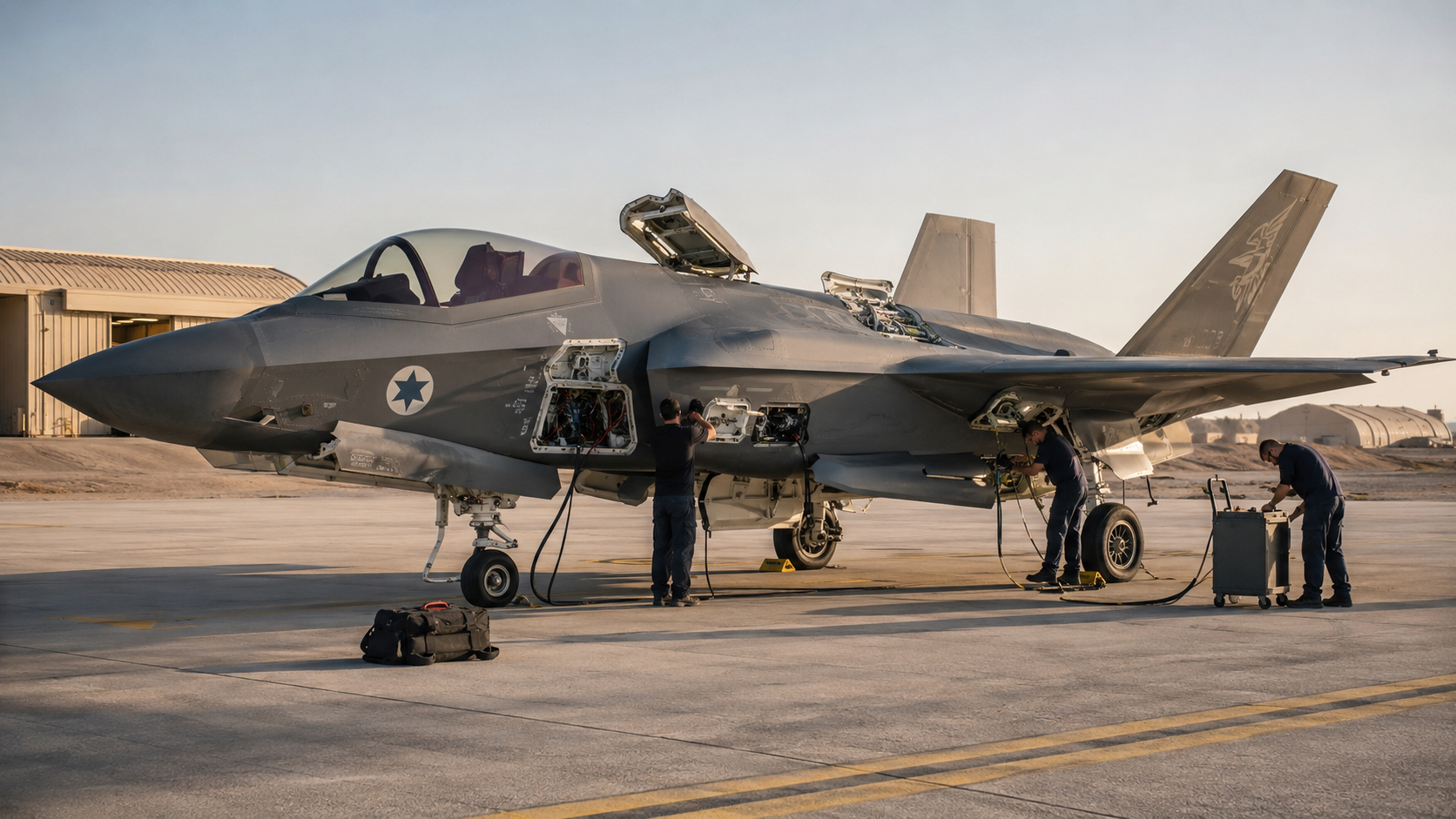
Israel can live without American aid. But it must prepare to live without American resupply.
After I published “Keep Your $3.8 Billion and Choke on It,” a friend asked an irritatingly good question:
Could Israel actually be all right without the United States?
My first impulse was: Of course.
My second was to look into it more carefully.
The answer is that American aid has become a golden leash. It is valuable, and Israel would pay a serious price if it disappeared suddenly. But its value gives Washington leverage, while the dependencies built around it leave Israel strategically constrained.
Israel can afford to give up American financial aid. It cannot presently lose the entire American military relationship without accepting a serious reduction in its security. That dependence is a strategic liability and, speaking as an Israeli citizen, I think we should address it.
The money is replaceable
The United States currently provides Israel with $3.3 billion annually in Foreign Military Financing, plus $500 million for missile-defense programs.
Against Israel’s wartime-elevated defense spending, the combined $3.8 billion amounts to roughly 8 to 10%. In many prewar years, however, American assistance represented closer to 15 to 20% of Israel’s defense budget.
The denominator is important. The recent expansion of Israeli military spending makes the American contribution look smaller than it did under more normal conditions.
Still, Israel can afford to replace it. The annual package is equivalent to approximately 0.6% of Israeli GDP. Doing without it would require some combination of higher taxes, additional borrowing, spending cuts and a permanently larger domestic defense budget.
None would be painless. None would be remotely existential.
If Washington stopped giving Israel money but continued selling it weapons at market prices, Israel would remain militarily powerful. Ending the subsidy might eventually leave Israel stronger.
Americans could no longer claim that every Israeli bomb, missile or military operation was conducted on their dime. Washington would lose some ability to treat assistance as a claim on Israeli decision-making. Israel would assume unambiguous responsibility for its own policies, including both their achievements and their failures.
Ending the subsidy would also alter Israel’s procurement incentives. Most American military financing must be spent on American products. The arrangement therefore supports American defense manufacturers while encouraging Israel to organize important parts of its military around American supply chains.
The idea of ending the subsidy is no longer hypothetical.
Prime Minister Benjamin Netanyahu has publicly said that he wants to taper American financial assistance to zero over the next decade. He has endorsed a congressional proposal to replace direct aid with Israeli-funded purchases of American weapons, describing the desired transition as one from “aid recipient to partner.”
That is the correct direction.
The supply chain is the real problem
But ending the financial allowance is only the first and easiest part of the problem. Israel’s deeper vulnerability is not the annual check.
It is the supply chain.
According to the Stockholm International Peace Research Institute, the United States supplied 66% of Israel’s imports of major arms during 2020–2024. That does not mean that 66% of Israel’s military is American. Israel produces many of its own missiles, drones, armored vehicles, electronic systems and air defenses.
But the American share is concentrated in areas of enormous importance.
Israel’s manned combat-aircraft fleet consists overwhelmingly of American F-35s, F-15s and F-16s. Israel modifies and maintains these aircraft to an extraordinary degree, but it does not independently manufacture every engine component, avionics module, replacement part or weapon they require.
An American embargo would not ground the Israeli Air Force the next morning. Israel has existing stocks, extensive maintenance capacity and a genius for improvisation. Over time, however, aircraft would be cannibalized to keep other aircraft flying. Readiness would decline. Scarce munitions would be reserved for the highest-priority missions.
Missile defense presents a similar problem. Iron Dome, David’s Sling and Arrow are Israeli achievements, but their development or production also involves American funding, technology and industrial participation. American satellites, radar, Aegis ships and THAAD systems add defensive depth against Iran.
Israel could replace more of that capacity than its detractors imagine. It could not replace all of it quickly.
The scale of the broader supply problem became visible during the war that began on October 7, 2023. Israel’s Defense Ministry now reports that more than 130,000 tons of munitions and military equipment have arrived on 1,150 cargo aircraft and 166 ships since the beginning of the war.
Not all of that material was American, and not all of it was aid. That distinction is essential. But the sheer volume demonstrates how heavily a prolonged war can draw upon overseas production and transportation.
Lessons of 1967 and 1973
History provides both reassurance and warning.
Israel did not win the Six-Day War because the United States fought it or replenished it. France remained Israel’s principal aircraft supplier, and Israel’s victory arose primarily from Israeli intelligence, mobilization, training, doctrine and execution.
The lesson of 1973 is more complicated. Israel stopped the Syrian advance and began reversing the war before the American airlift reached full force. Israeli soldiers, commanders and institutions produced the battlefield recovery. But Operation Nickel Grass subsequently delivered enormous quantities of equipment and munitions, helping Israel replace devastating losses and sustain its counteroffensive while the Soviet Union resupplied Egypt and Syria.
The United States did not produce Israeli military competence. It substantially increased Israeli endurance.
That remains the essential distinction today.
The appropriate response is not an abrupt rupture with Washington. Sovereignty does not require self-amputation, and no modern military manufactures every component it uses. The objective should not be autarky.
It should be eliminating any foreign government’s ability to create a military crisis in Israel by closing a single valve.
Preparing for independence
Israel therefore needs a strategic-independence program that goes beyond ending financial aid.
First, the post-2028 arrangement should replace grants with trade. Israel can continue purchasing American equipment, but increasingly with Israeli money. Joint research and development can continue as genuine co-investment rather than being folded rhetorically into an aid package.
Second, the government should conduct a systematic review of every critical capability for which Israel depends on a single foreign supplier. That review should include aircraft components, engines, guidance systems, interceptor parts, precision munitions, energetic materials and the raw materials required to manufacture them.
The operational details would necessarily remain classified. The governing principle should be public: no indispensable Israeli capability should depend indefinitely on the goodwill of one foreign government.
Third, Israel should establish minimum strategic reserves based on the demands of a prolonged multi-front war without emergency American replenishment. The assumption that an airlift will eventually arrive is not a defense policy. It is a wager.
Fourth, Israel should accelerate domestic production of bombs, missiles, interceptors, drones, replacement parts and raw materials. Israel’s defense industry is already moving in this direction. Netanyahu has announced a large multiyear investment intended to expand domestic arms production and reduce reliance on foreign suppliers.
The changing character of warfare may make some of this easier. Cheap drones, increasingly autonomous systems, additive manufacturing and rapidly produced replacement components can reduce dependence on a few expensive foreign platforms. Israel is well placed to exploit that shift. But inexpensive systems do not eliminate the need for combat aircraft, heavy munitions, missile interceptors or secure supplies of engines, explosives and electronics. They change the mixture. They do not abolish the supply problem.
That project should be judged not merely by how much money is announced, but by whether it actually eliminates specific supply-chain vulnerabilities.
Not everything must be manufactured in Israel. Some systems can be produced under license. Others can be purchased from multiple suppliers. The objective is resilience, not purity.
Fifth, Israel must begin addressing its overwhelming dependence on American combat aircraft. There is no quick solution. A serious plan might combine larger spare-parts reserves, licensed domestic component production, selective purchases from additional countries, greater reliance on advanced unmanned systems and, over the longer term, an Israeli or jointly developed combat platform.
Replacing the American aircraft ecosystem could take decades. That is an argument for beginning, not for accepting permanent dependence.
Sixth, joint missile-defense projects should become explicitly reciprocal ventures. Israel should pay its full agreed share and negotiate intellectual-property, production and supply arrangements that permit continued operation if political relations deteriorate.
Finally, the IDF should plan and exercise for a scenario in which Israel receives intelligence and diplomatic sympathy from abroad but no emergency weapons deliveries. If the resulting war plans are unacceptable, the gaps they reveal should determine procurement and production priorities.
None of this requires hostility toward the United States.
America can remain Israel’s closest ally, intelligence partner and preferred weapons supplier. But friendship is healthier when neither party can credibly describe the other as a dependent.
Independence may not mean restraint
There is also a paradox that critics of Israel should consider. A less dependent Israel might be more difficult to restrain. A country uncertain of replenishment has stronger incentives to strike first, destroy launchers at their source and conclude wars decisively.
Those who imagine that withdrawing American support would necessarily produce a more compliant Israel may discover that dependence was one of the forces producing caution.
My previous essay argued that $3.8 billion does not make Israel an American military project. I continue to believe that.
But a subsidy can be financially manageable while helping create strategically important dependencies. Denying those dependencies would be as foolish as exaggerating them.
Netanyahu is right to propose phasing out the financial allowance. The harder question is whether Israel will also undertake the costly and technically difficult work required to reduce its dependence on American resupply.
I am proposing a direction, not pretending to possess a complete military blueprint. I would especially like to hear from Israelis and others with experience in defense, aviation, logistics, economics or missile defense.
Which dependencies would be hardest to replace? What would a responsible timetable look like? How much should Israel be willing to pay for greater strategic independence? Where would domestic production make sense, and where would diversified foreign purchasing be more practical?
As I wrote in my previous post, the United States should keep its money. In the long run, the leverage that comes with the aid costs Israel too much. We can remain friends, buy American weapons and share intelligence when doing so serves the long-term strategic interests of both countries.
What Israel should not do is confuse a subsidy with security or dependence with friendship.
The leash may be golden. It is still a leash.