
President of Shahvand Think Tank
A Right-Wing Divide on Iran and Israel
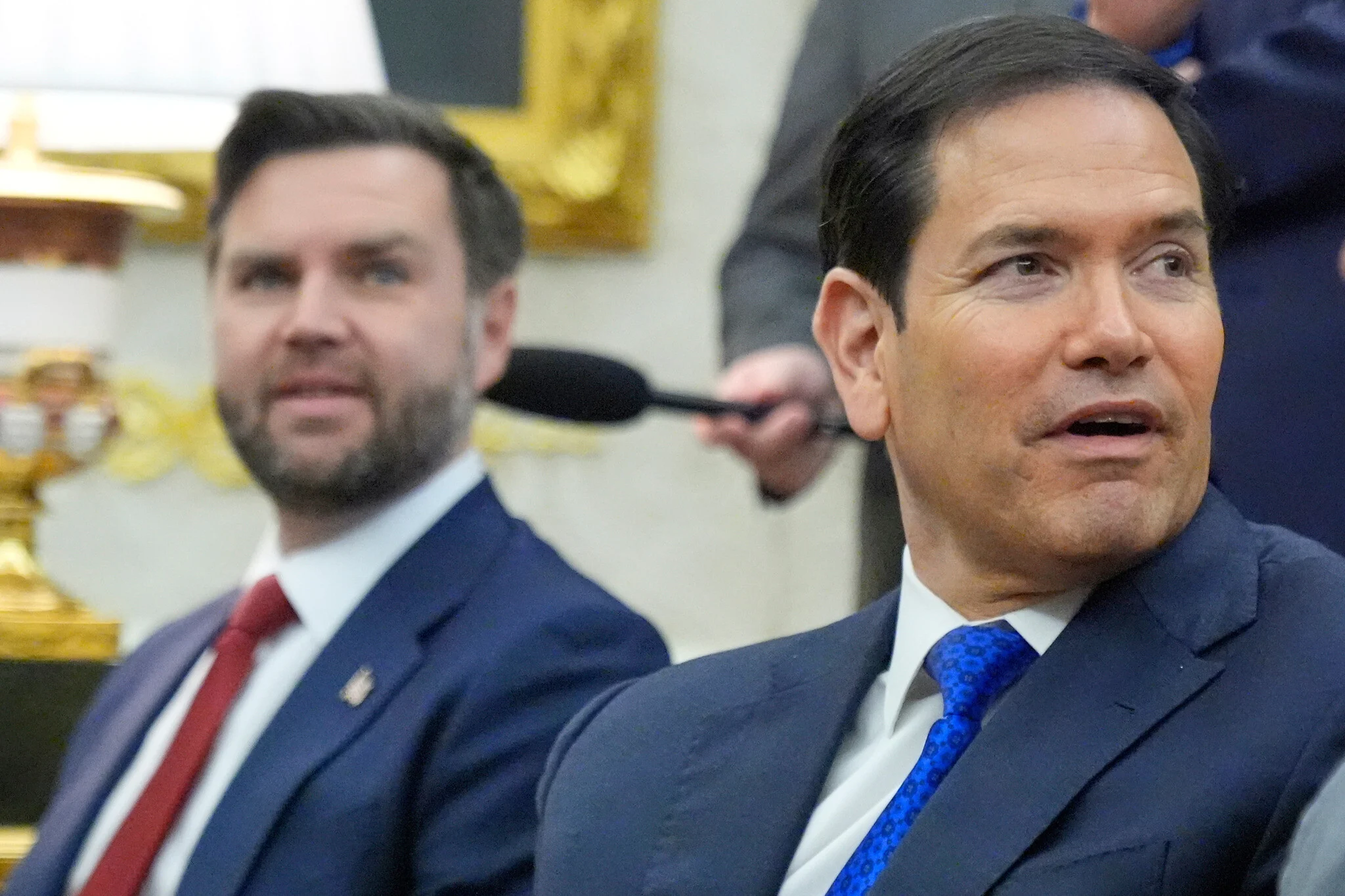
US Vice President JD Vance, left, and Secretary of State Marco Rubio attend a meeting in the Oval Office at the White House, March 3, 2026, in Washington. (AP Photo/Mark Schiefelbein, file)
The populist and the hawk split the New Right architecture over the deployment of American power against Iran and the radical left.
A growing divide within the contemporary American right is reshaping the contours of US foreign policy, particularly on Iran and Israel. This divide is not merely tactical but reflects competing strategic visions: a populistnationalist current skeptical of global entanglements and a more traditional hawkish internationalism committed to sustaining American primacy.
Recent public remarks by Vice President JD Vance illustrate the emergence of the former tendency. In a wide ranging interview on the Joe Rogan Experience, Vance articulated a critique of longstanding Republican foreign policy orthodoxies. He framed US engagement in the Middle East primarily through the lens of domestic economic stability, emphasizing the need to prevent energy shocks and avoid protracted military commitments. In this formulation, the strategic priority is not ideological transformation abroad but the insulation of the American working class from global volatility.
Notably, Vance also alleged that elements within the Israeli political and institutional landscape have sought to influence US policy in ways that could undermine diplomatic efforts with Iran. While such claims remain unverified and should be treated cautiously, their political significance lies in signaling a departure from unconditional alignment with Israeli policy preferences. Rather than endorsing a traditional alliance first framework, Vance’s rhetoric suggests an emerging willingness to subordinate longstanding partnerships to a narrower conception of national interest.
In contrast, Secretary of State Marco Rubio represents a more familiar paradigm of Republican foreign policy. His approach, visible in his remarks at a State Department Ministerial on Political Terrorism, emphasizes deterrence, alliance cohesion, and the proactive use of American power to counter adversarial states. On Iran, this translates into support for sustained pressure—economic, diplomatic and potentially military—aimed at constraining Tehran’s regional influence and strategic capabilities. For Rubio, the Iranian question is not reducible to energy markets or domestic economic concerns but is embedded in a broader effort to maintain international order.
The divergence between these positions reflects a deeper structural tension rather than a fully consolidated “New Right” doctrine. What is often described as a unified ideological shift is, in practice, a coalition still in formation, containing unresolved disagreements over the role of the United States in the world. The contrast between restraint and primacy, economic nationalism and security internationalism, remains unsettled.
Importantly, the Vance interview is best understood as a window into evolving political rhetoric rather than a statement of operational policy. Long form media appearances provide space for speculative or provocative claims that do not necessarily align with institutional realities or intelligence assessments. As such, while the interview is analytically valuable for tracing ideological shifts, it should not be read as evidence of concrete diplomatic initiatives or confirmed geopolitical dynamics.
The future trajectory of US policy toward Iran—and the broader Middle East—will depend on how this internal contest is resolved. Whether the United States moves toward a more restrained, domestically focused posture or reaffirms its traditional role as a global enforcer remains an open question. What is clear, however, is that the debate itself is reshaping the intellectual architecture of the American right.
Related Topics
Related Posts