
This Way Up: Spiritual Means to Psychological Ends
A Sweet (and Sour) New Year: Where Jewish and Chinese Wisdom Meet
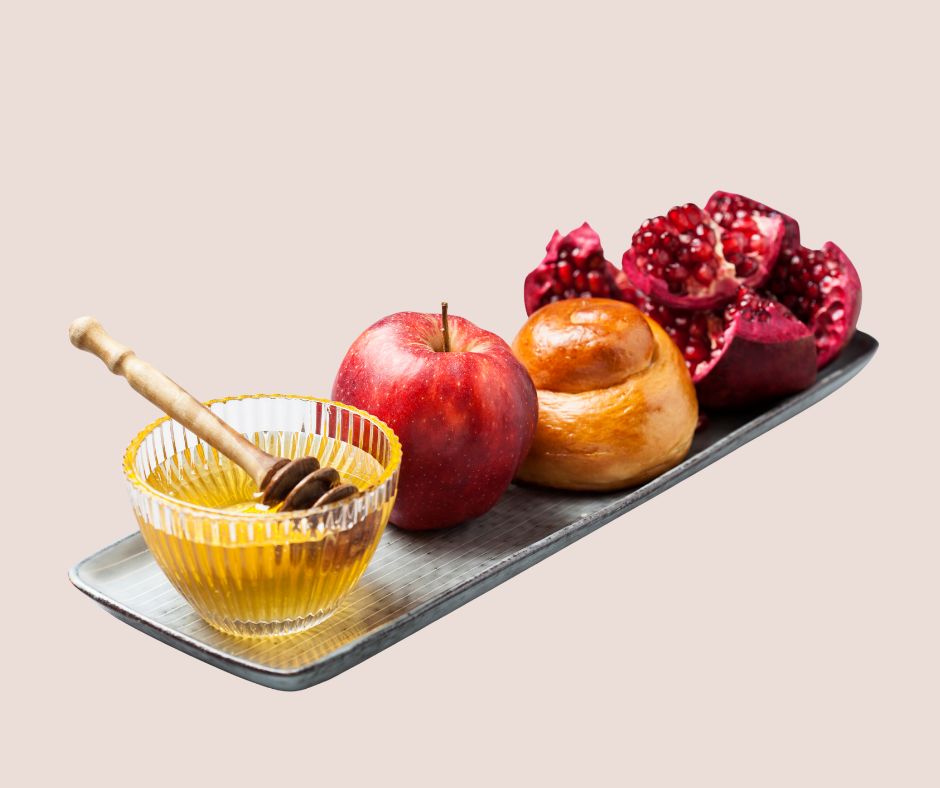
Image courtesy of Canva.com
At Rosh Hashanah tables around the world, Jews will perform a familiar ritual. We will dip an apple into honey and ask G-d to grant us a good and sweet year.
The meaning seems obvious. The apple is sweet. The honey is sweeter. Together, they express our hope for a year filled with happiness, health, and blessing.
But perhaps the ritual contains a more complicated message.
In a 2021 Rosh Hashanah sermon, Rabbi Elliot Cosgrove of Park Avenue Synagogue noted that the apples available in earlier times were not necessarily the sweet domesticated varieties we enjoy today. Some were decidedly sour. He therefore raised an intriguing possibility: perhaps, in the custom’s early development, the honey was intended to counteract the sharp taste of the apple.
Rabbi Cosgrove presented this as an interpretation, not a proven historical explanation. Yet the image is compelling. Perhaps the ritual was never meant to offer sweetness alone. Perhaps it brings sour and sweet to the table together.
That possibility changes the meaning of the moment.
We are not pretending that the coming year will contain nothing difficult. We are not asking G-d to remove every disappointment, loss, limitation, or unwelcome surprise. Instead, we take what is sour, dip it into sweetness, and consume them together.
Jewish tradition repeatedly returns to this idea.
Why do we wish one another a shanah tovah u’metukah, a good and sweet year? If a year is good, why must we add that it should also be sweet?
Chabad cites Rabbi Levi Yitzchak Schneerson, who explains that “good” can refer to divine kindness, while “sweet” suggests something more: the transformation and sweetening of severity. We ask not only that the year be good in some ultimate sense known to G-d. We ask that we be able to experience and recognize its goodness.
Honey itself carries this message. A bee has a sting, yet it produces something sweet. According to a teaching recorded in the 14th century, this expresses our hope that divine judgment will ultimately yield a sweet result.
The sting and the honey come from the same creature.
This paradox appears in Judaism’s central declaration of faith, the Shema: Hashem Elokeinu, Hashem Echad. Jewish mystical tradition associates the four-letter Divine name, represented here as Hashem, with mercy, while the name Elokim is associated with judgment, limitation, and the natural order.
Yet the Shema does not present us with two opposing powers, one loving and one severe. It declares that G-d is One. What we experience as mercy and what we experience as judgment may be different expressions of a reality whose unity we cannot always perceive.
Jewish spiritual maturity therefore requires the capacity to hold paradox. We stand between despair and denial, severity and kindness, fear and hope. We try not to be carried away by either extreme. We walk humbly, knowing that we do not yet see the whole.
Our Chinese friends may help us understand this lesson more deeply.
Chinese thought does not divide every experience into the two polarities in order to eliminate one of them. Yin and yang exist in relationship. Each helps define and regulate the other. Harmony does not require sameness. It arises when different forces find their proper place within a larger whole.
The same principle appears in traditional Chinese understandings of food and flavor. Sweet and sour are two of the five recognized tastes, along with bitter, pungent, and salty. Each has its own function. Wellness does not come from consuming only the most pleasant taste. It depends upon proportion, relationship, and balance.
Chinese cuisine makes the philosophy tangible. Sweet and sour are not always served in separate dishes, with one chosen and the other rejected. They meet in the same bite. The sour sharpens the sweet. The sweet softens the sour. Together, they create a taste that neither could produce alone.
Perhaps this is also what we enact when we dip an apple into honey.
This is not a celebration of suffering. Judaism does not ask us to call pain pleasant or injustice acceptable. Instead, sweetening severity means refusing to believe that difficulty must have the final word. It means searching for the response that can transform what has happened without denying its sting.
What sour experience from the past year might yet produce something sweet? What disappointment has taught us something necessary? What hardship has revealed a strength, a relationship, or a source of faith that we did not know was there?
These questions belong to individuals but also to communities.
Jewish and Chinese civilizations have both endured displacement, exclusion, discrimination, and profound historical upheaval. Both have survived by preserving ancient traditions while adapting to new surroundings. Both honor learning, family, memory, and responsibility to generations yet to come.
Neither community is unfamiliar with the sourness of history. Yet both have repeatedly transformed adversity into contribution. They have preserved what was precious, rebuilt what was damaged, and created sweetness for their children.
At a time of growing polarization, Jews and Chinese should not merely admire one another from a distance. We should bring our accumulated wisdom to the same table. Our commonalities offer the foundation for a deliberate alliance built through education, cultural exchange, civic cooperation, and friendship.
May the coming year be good. May we experience its goodness as sweetness. And may it be the year in which the Jewish and Chinese communities begin building a stronger bridge, one capable of carrying us together through whatever the future may hold.
Related Topics