Abraham was a warrior. So are the Neutras
This past Shabbat, we read the beginning of the story of Abraham, which is also the beginning of the story of the Jewish people. We often think of Abraham as a patriarch. As the father not only of Judaism, but of monotheism itself–the forefather of Christianity and Islam, as well.
Or, we think of Abraham as a philosopher. The first person to come to the rational conclusion that there can only be one God. In fact, Maimonides frames Abraham not only as the first Jew but as the first philosopher.
But there is a different aspect of Abraham’s character which is often overlooked. Not Abraham the patriarch, nor Abraham the philosopher, but rather Abraham the general. The warrior.
In Parshat Lech Lecha, we read a story about Abraham’s nephew, Lot. Though Lot was technically Abraham’s nephew, his father Haran—Abraham’s brother—had died when Lot was young, and Abraham had become a father figure to the boy.
Lot is kidnapped and taken hostage by a coalition of four kings. When Abraham receives word that his nephew has been taken hostage, he doesn’t convene a council. He doesn’t dispatch diplomats. He assembles an army of 318 men and pursues the four kings all the way to Syria, north of Damascus. He divides his forces strategically, launches a nighttime assault, and successfully rescues not only his nephew, but all of the hostages who had been taken captive.
One of the first stories in the history of the Jewish people is a story about a war that was waged for the sake of redeeming hostages. That’s how the Jewish story began, 4,000 years ago. Four millennia later, we are still waging that same war. Ein Hadash Tachat HaShemesh. There truly is nothing new under the sun.
One of the first things that the first Jewish person in the Torah does is redeem captives. Pidyon Shvuyim, the redemption of captives, is a fundamental Jewish obligation that goes all the way back to the very beginning of the Jewish story. As our tradition teaches, there is no mitzvah, no commandment, greater than the obligation of Pidyon Shvuyim, the redemption of captives.
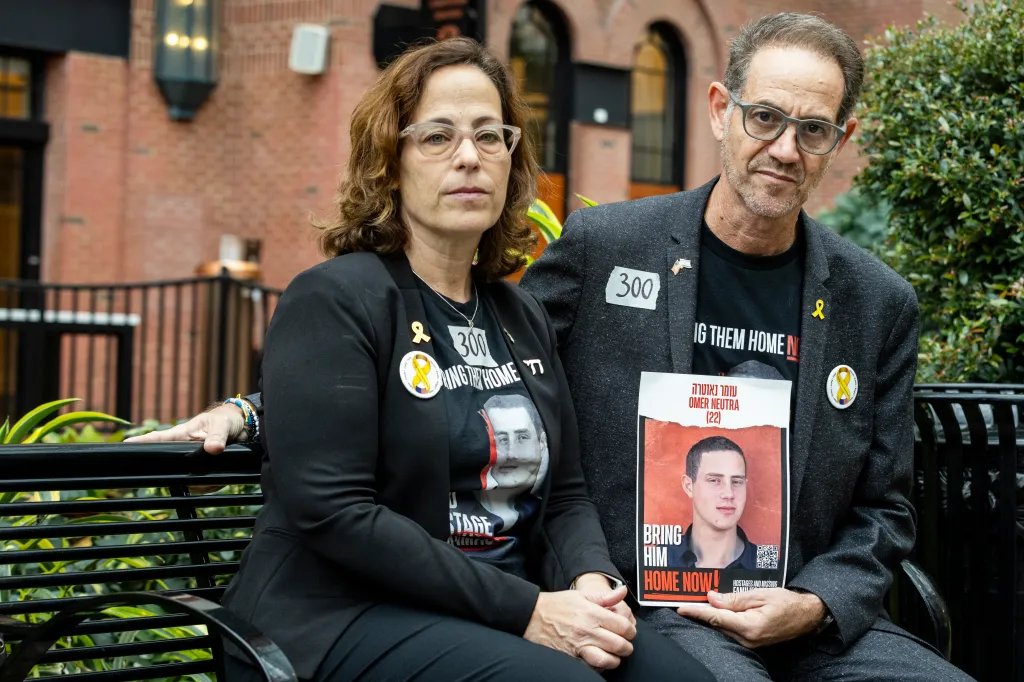
This past Shabbat at my synagogue in New Jersey, I spoke about Captain Omer Neutra. Omer was a tank platoon commander serving in the Gaza Envelope. On the morning of October 7th, his tank was attacked by Hamas terrorists with explosive devices. All four soldiers in Omer’s tank were abducted and taken to Gaza. In December of 2024, his parents, Orna and Ronen, received the most devastating possible news from the IDF; their intelligence indicated that Omer had been killed on October 7th and Hamas had taken his body to Gaza. As of this past Saturday, his body was still there.
On Shabbat, I gave a sermon decrying the fact that Omer was not yet home. I am thrilled to be able to say that yesterday, he finally came home.
Abraham was a warrior who would stop at nothing to bring his kidnapped nephew–who was really like a son– home. And so too were Orna and Ronen Neutra.
Over the past two years, Orna and Ronen have spent every waking minute trying to bring Omer home. Since October 7th, the Neutras have been to Washington at least 40 times, including multiple meetings with both President Biden and President Trump. They have been back and forth to Israel countless times, rallying at hostage square, meeting with Knesset members, working as hard as they possibly can to bring Omer home.
I am elated that they finally have the ability to properly bury their son, and have some sense of closure after two unbearable years.
Ein Hadash Tachat HaShemesh. There is nothing new under the sun. 4,000 years ago, Abraham fought a war to redeem captives. We are still fighting that same war today. But the story of Abraham and Lot teaches us something else: Abraham didn’t rescue only his nephew and declare victory. He brought back all of the hostages. Our war cannot be over until every last hostage—living or dead—finally comes home.
Baruch Atah Adonai, Eloheinu Melech ha’olam, matir asurim.
Blessed are You, Lord our God, Ruler of the Universe, redeemer of captives.